
Minister Nusron Discusses Chain of Knowledge and Leadership Ethics at UI Tarawih Lecture
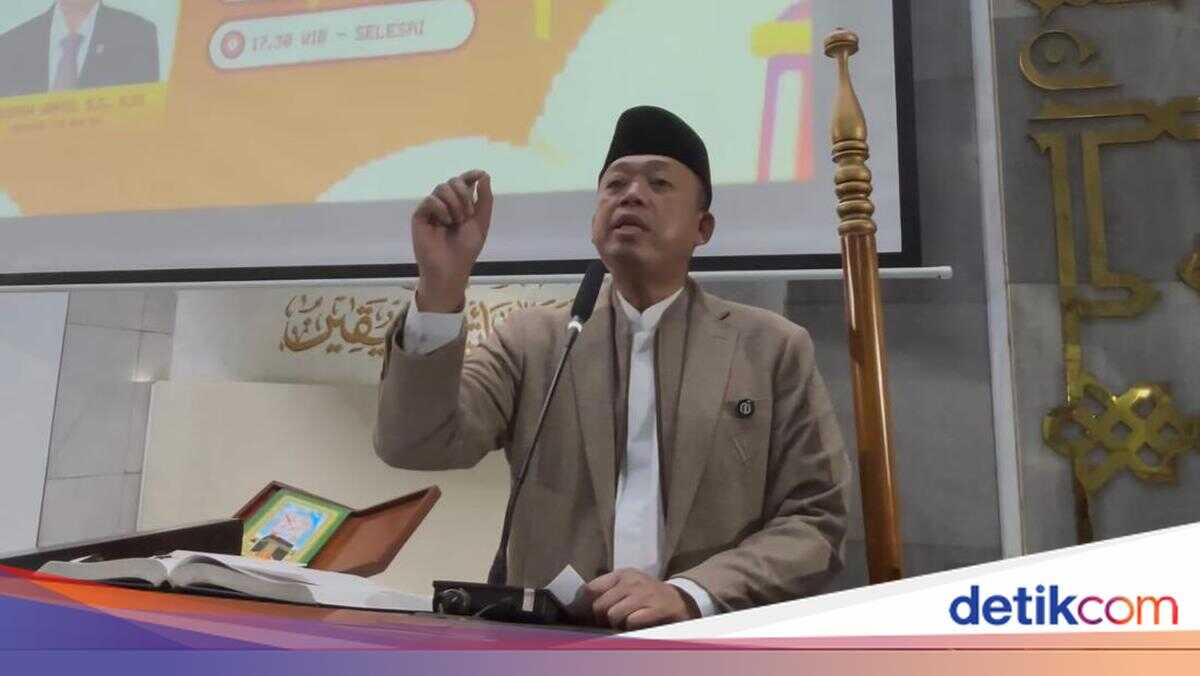
Agrarian and Spatial Planning Minister/Head of the National Land Agency (ATR/BPN) Nusron Wahid has emphasised the importance of scholarly chains of knowledge (sanad) and leadership ethics as the foundation for making public policy decisions. He argued that, just as knowledge requires clear references, policy must also stand upon accountable data, regulation, and legal frameworks.
Nusron made the remarks during a Tarawih lecture at the Ukhuwah Islamiyah Mosque at the University of Indonesia (UI) in Depok on Monday evening (23 February). In his address, the UI alumnus explained that the Islamic scholarly tradition places the sanad — the chain of knowledge transmission — as the foundation for legitimising truth.
“Knowledge must have its sanad, because without it we will go astray. Imam Muslim stated in his work, Sahih Muslim, that the sanad is part of religious teaching. Without it, people tend to speak recklessly, saying whatever they please,” he explained in a written statement on Tuesday (24 February 2026).
Nusron then drew a parallel with governance. He argued that if the sanad serves as the guardian of scholarly authority, then in government that role is fulfilled by data, regulation, and normative foundations. Without tested foundations, public decisions risk becoming personal perceptions cloaked in official authority.
He also cautioned that leadership is not merely a technical matter but also a moral one. According to him, human beings have tendencies to believe they are always right, to be manipulative, self-serving, or to oppress the weak. If left unchecked, the resulting policies may drift far from justice.
Nusron then quoted a prayer of the Prophet regarding leadership as a reminder for holders of public trust: “O Allah, whoever becomes a leader and makes life difficult for others, then make his life difficult, O Allah. Conversely, whoever leads and eases the affairs of his people, then ease his life.”
In the context of his duties at the Ministry of ATR/BPN, Nusron referred to Surah Al-Hasyr verse 7 — “…so that wealth does not merely circulate among the rich among you” — as a guiding principle.
According to him, under the leadership of President Prabowo Subianto, land and spatial planning policies are being formulated with the spirit of strengthening resource distribution to be fairer and not concentrated among a select few.
“Policies such as the restructuring and regulation of leasehold rights (HGU), land redistribution, and spatial planning are directed at reducing structural economic inequality and broadening social benefits for the public,” affirmed Nusron, who also serves as Chairman of the Indonesian Ulema Council’s (MUI) Disaster Management Division.
He also referenced a principle from classical scholars that the survival of a state is determined by its justice, not by its symbols or formal identity.
“Therefore, the essence of leadership is ensuring that justice is truly present in public policy,” Nusron concluded.
At the close of the lecture, Nusron urged students to understand leadership as a long-term moral responsibility. He argued that the younger generation must combine professional competence with ethical integrity, so that public policy is not only technocratically effective but also socially just.