
Minister Bahlil: Indonesia Ranks Second in Global Energy Resilience
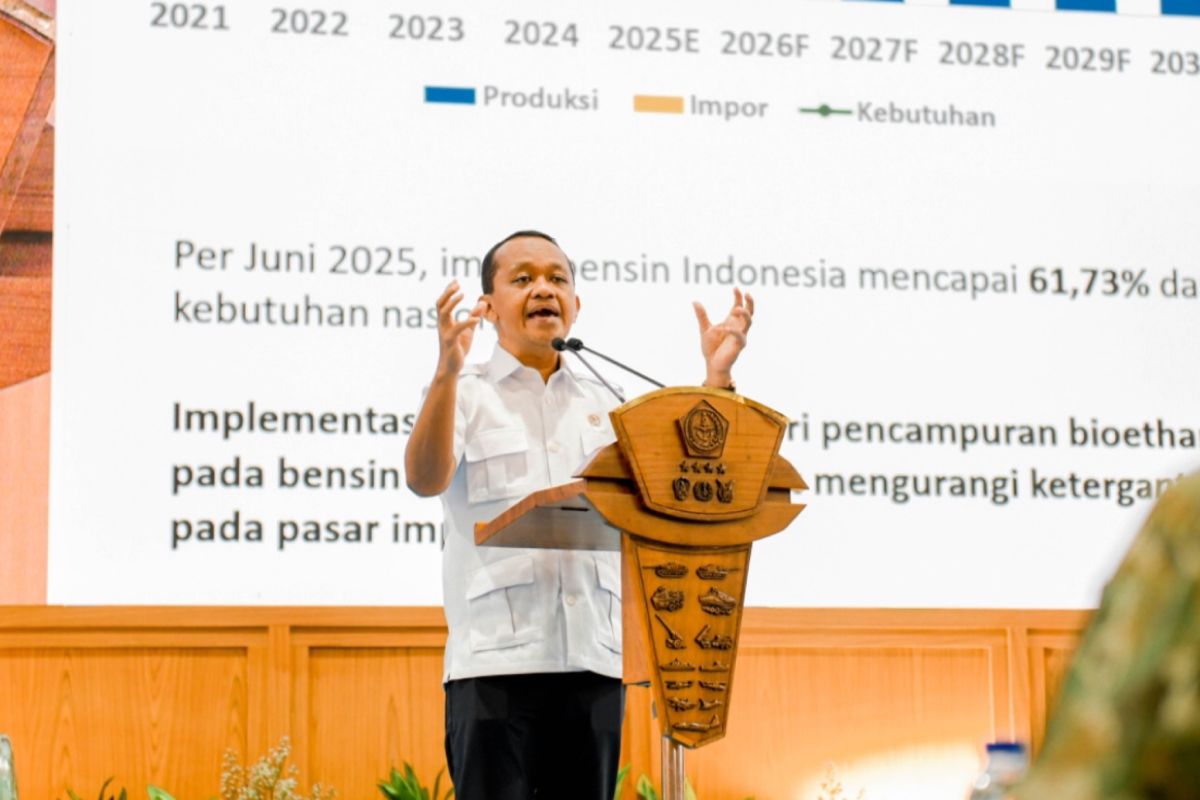
Indonesia is assessed by JP Morgan as the second-best country in the world for energy resilience.
Jakarta (ANTARA) - Energy and Mineral Resources Minister Bahlil Lahadalia stated that Indonesia is viewed by other nations as a country with strong energy resilience.
During the 2026 TNI Unit Command Briefing in Bogor, West Java, on Wednesday (29/4), Bahlil noted that the energy sector plays a crucial role in supporting economic stability and national defence. Other countries assess Indonesia as having the world’s second-best energy resilience, even as global geopolitical dynamics affect energy supplies in various parts of the world, including domestically.
“In such conditions, we must be grateful under the leadership of President Prabowo Subianto, who is a TNI alumnus, that Indonesia is rated by JP Morgan as the second-best country in the world for energy resilience,” Bahlil said in a statement in Jakarta on Thursday.
This achievement is based on the Eye on the Market report issued by JP Morgan Asset Management. The report analyses 52 of the largest energy-consuming countries, representing around 82 per cent of global energy consumption.
Indonesia ranks second, behind South Africa, but one position ahead of China in third place.
Indonesia is considered resilient to the current energy crisis due to its substantial domestic production of oil and natural gas (migas).
Resilience against the crisis is also supported by Indonesia’s coal production and reserves, which can still meet domestic needs. Additionally, the vast potential for new and renewable energy across Indonesia supports the country’s energy independence.
Furthermore, Bahlil stated that in the migas subsector, energy resilience is bolstered by Indonesia’s oil lifting achievement in 2025, which met the state budget target of 605,000 barrels per day (bpd).
This year, the target has been increased to 610,000 bpd. To boost lifting production, the government is promoting optimisation through advanced technology, reactivation of idle wells, and exploration of migas potential in eastern Indonesia.
The latest findings from the Geliga-1 well exploration in the Ganal Block, off the coast of East Kalimantan, have revealed gas resource potential of around 5 trillion cubic feet (Tcf) and 300 million barrels of condensate. This discovery is in the Ganal Working Area (WK) operated by ENI and Sinopec.
“For a year and a half, we conducted exploration and found gas again in East Kalimantan, called Geliga. That’s 5 TCF, 5 trillion cubic metres. With 300 million condensate, equivalent to 375 million barrels of oil. This will be produced in 2028-2029,” he explained.
Not only migas lifting, the government is also continuously working to reduce fuel oil (BBM) imports through the development of 50 per cent biodiesel (B50), targeted for national implementation on 1 July 2026. This will have a significant impact on reducing national BBM imports.
“Our needs for diesel BBM in 2026 will be around 40 million kilolitres. From these 40 million kilolitres, with B40 and B50, alhamdulillah, starting in 2026, we will no longer import diesel for the first time since the republic was founded. From diesel, we will no longer import,” Bahlil explained.
Efforts to reduce imports are also being made for LPG, by seeking various substitutes, including Dimethyl Ether (DME) and Compressed Natural Gas (CNG), which are currently under government review.
CNG itself is already widely used by various industries, such as hospitality, restaurants, and several Natural Gas Fuel Filling Stations (SPBG), with raw materials sourced domestically.