
Mining Revenue-Sharing Reform Plan Similar to Oil and Gas Still Underway!
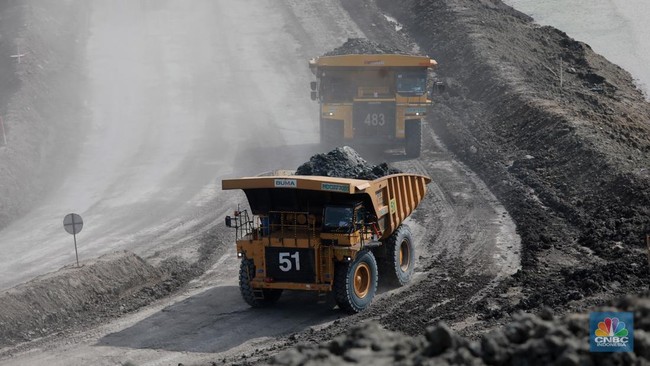
The Ministry of Energy and Mineral Resources (ESDM) is still refining the proposal to change the revenue-sharing scheme in the mineral and coal mining (minerba) sector, similar to the scheme used in the upstream oil and gas (migas) sector.
Director General of Mineral and Coal (Dirjen Minerba) at the Ministry of ESDM, Tri Winarno, confirmed that the government is conducting a study on the proposal to implement a gross split system or cost recovery in the mining sector. As of now, the preparation of the relevant regulations is still ongoing internally within the government.
“It is still in process, still in process,” he said when met at the BUMN Financial and Development Supervisory Agency office in Jakarta on Tuesday (12/5/2026).
Although the oil and gas scheme plan has begun to emerge in public discourse, the government has not provided a definite timeline for when the regulation will be officially enacted. Tri emphasised that every new policy requires a comprehensive evaluation process before it is signed off by the authorities.
“Well, it’s still in process,” said Tri when asked about the target date for the official launch of the new regulation.
Energy and Mineral Resources Minister Bahlil Lahadalia previously stated that the study on the mining revenue-sharing scheme stems from the mandate of Article 33 of the 1945 Constitution, which affirms that natural resources are controlled by the state and used to the greatest extent for the prosperity of the people.
“Article 33 of the 1945 Constitution states that all wealth contained within the Indonesian earth, both on land and sea, and all other outer space, is controlled by the state and used to the greatest extent for the prosperity of the people. That means these are state assets,” said Bahlil.
He then emphasised that mining companies are essentially granted permission only to manage these resources. Therefore, the government is now seeking the best formulation to ensure that the distribution of benefits between the state and business actors remains balanced.
“Business actors are only given permission to manage it. As for what the scheme will be like, the government will certainly look at what is win-win. What is the win-win? Good for the state, good for the private sector. And that hasn’t been finalised in my exercise yet,” he said.
Business Response
In response to the proposal, Chairman of the Indonesian Mining & Energy Forum (IMEF), Singgih Widagdo, assessed that the minerba sector has very different characteristics from the oil and gas industry, so the implementation of a similar scheme needs to be studied carefully.
“I don’t know the details of the policy yet. But clearly, the minerba mining industry is different from oil. In the past, there was even revenue sharing in the form of royalties in-kind, but through Presidential Decree 76/1996, it was changed to cash,” said Singgih to CNBC Indonesia, quoted on Friday (8/5/2026).
According to him, the fundamental difference is evident in the permitting system in the minerba sector, which is far more diverse than in oil and gas. He explained that mining business permits range from small levels like IPR to IUPK.
“If it’s equated with oil, especially with cost recovery, how to supervise with 946 permit holders, and this is just for coal, not yet minerals,” he said.
In addition, he also highlighted the diverse characteristics of minerba commodities. For coal, for example, there are various qualities with different market patterns. Meanwhile, minerals have hundreds of types with different processing patterns, especially since the government no longer permits the export of raw materials.
“I see the government’s aim more as increasing state revenue, amid the current financial situation. But in the current global economic situation, it shouldn’t be rushed,” said Singgih.
He then reminded that Indonesia is not actually the owner of the world’s largest minerba resources, so regulatory certainty is an important factor for new investors. According to him, business actors will still compare Indonesia’s investment attractiveness with other countries.
“We are not the owner of the world’s largest resources for minerba either, so for this kind of certainty, new investors need to compare with other countries. It could become a boomerang if we don’t look at the details of the policy draft first,” said Singgih.