
Mineral Sector to Be Required to Export Via Special State-Owned Enterprises
Jakarta, CNBC Indonesia – The Ministry of Energy and Mineral Resources (ESDM) has revealed that nickel commodities are not yet included in the list of mining commodities required to export through a Special State-Owned Enterprise (BUMN) or PT Danantara Sumber Daya Indonesia.
In the initial phase, the one-door export policy will be applied to three strategic commodities with the largest export value: crude palm oil (CPO), coal, and ferroalloys.
However, Minister of ESDM Bahlil Lahadalia emphasised that all mineral commodities will eventually be directed to export through the company designated by the Badan Pengelola Investasi (BPI) Danantara.
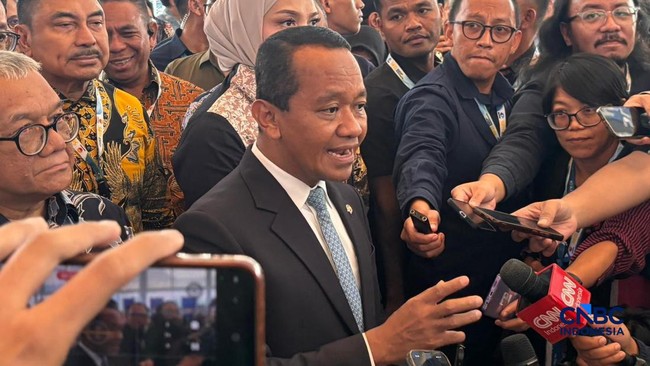
‘All minerals will go through Danantara. But the initial phase is coal. Coal and some iron, yes, iron ore, and there is some processing involved. Those two will be the transitional ones, while we adjust to other minerals,’ said Bahlil after attending the IPA Convex 2026 event, quoted Thursday (21 May 2026).
According to him, the policy’s implementation will commence this year through a transitional period with the government-designated state-owned enterprises.
‘The policy will start this year, this year. So it will transition with the state-owned enterprises that will be appointed,’ he said.
Separately, Tri Winarno, the Director-General of Minerals and Coal (Dirjen Minerba) at the Ministry of ESDM, said the government is still finalising the implementation scheme, including determining which mineral commodities will be consolidated in their sale.
As far as his observations go, there is no mandate requiring nickel commodities to be managed by the special body yet. ‘Not yet, not yet. For now, it’s only these three,’ he said.
The goods currently included in the scope of the one-door export regulation plan cover the energy and plantation sectors. The three commodities referred to are coal, alloyed metal products or ferroalloys, and crude palm oil (CPO).
‘The commodities are mainly coal, ferroalloy, and CPO,’ he explained.
The government includes ferroalloys in the list because of its contribution to the national export value. This product is a high-value-added mineral processing product, including ferronickel, which has long been a cornerstone of the country’s foreign exchange earnings from the mining sector.
‘The value of our exports for that is the highest,’ he added.
Although the one-door export scheme has been touted, officials say they do not yet know in depth the technical mechanism or on-the-ground operational flow. The ESDM Ministry is awaiting further coordination from the regulation drafters regarding certainty of policy implementation for business actors.
‘The flow and the clear picture of it I do not yet know,’ Tri closed.
Earlier, President Prabowo Subianto revealed that sales of all Indonesia’s natural resources—from palm oil, coal, and ferro alloy iron—must be conducted through a Special Export State-Owned Enterprise.
‘Sales must be conducted through a state-owned enterprise appointed by the Government of the Republic of Indonesia as the sole exporter. In other words, every export output will be channelled to the government-appointed BUMN for those activities,’ Prabowo explained.
He stated that the aim of forming this Special Export BUMN can be seen as a marketing facility, thereby strengthening supervision and monitoring to combat under-invoicing, transfer pricing, and even leakage of export proceeds.
‘This policy will optimise tax receipts and state revenue from the management of our natural resources; with this policy we hope that our revenue can reach levels similar to Mexico, the Philippines and our neighbouring countries,’
‘We do not want our revenue to be the lowest because we are not willing to manage our own assets, assets of our nation,’ Prabowo declared.