
Millennial Farmers in Blora Regency Successfully Produce Organic Rice
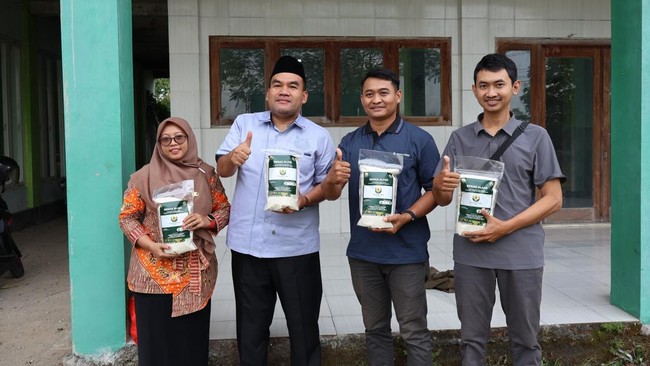
Blora Regent Arief Rohman continues to encourage the development of organic farming in his region as part of efforts to strengthen food security whilst improving farmer prosperity. This is evident through the success of millennial farmers in Sumber village, Kradenan district, Blora Regency, who have begun producing organic rice.
Regent Arief Rohman received a shipment of organic Mentik Susu rice variety from millennial farmers part of the Selaras Alam Sejahtera Organic Farmers Association in Sumber village on Saturday, 7 March 2026. The rice is the product of organic farming practices developed sustainably by local young farmers.
“Alhamdulillah, I received a special shipment of organic Mentik Susu variety rice from millennial farmers in Sumber village. Thank you and the highest appreciation for their spirit and dedication in developing organic farming in the village,” Arief stated.
According to Arief, organically produced food products have several advantages, including longer shelf life compared to conventionally produced crops. Additionally, organic farming practices are considered capable of maintaining soil health and fertility. He added that soil health and fertility are two primary factors driving many farmers to transition to organic farming systems and sustainable agricultural practices.
“Organic farming is also able to reduce production costs, thereby providing greater profit for farmers in the long term,” he explained.
Arief also mentioned that he tried the rice after it was cooked into rice. “After cooking, the rice tastes fluffy and delicious. I always support organic rice programmes like this. The millennial farmers of Sumber village are really impressive,” he said.
He hopes that increasingly more young people will become interested in pursuing agriculture, particularly organic farming. “My hope is that in the future, more young people will have awareness, willingness, and pride to directly engage in organic farming. Never be ashamed to go down to the rice fields, because farming is cool,” he stressed.
Arief called on the community to continue supporting local agricultural products as part of efforts to strengthen regional food self-sufficiency. With community support, it is hoped that organic rice products from local Blora farmers can continue to develop and achieve increasingly higher economic value.
One of the organic farmers from Sumber village, Rakam, said he is increasingly enthusiastic about developing organic rice cultivation. According to him, support from the local government serves as great motivation for farmers, particularly the younger generation.
“We feel more motivated to grow organic rice, especially as the Regent is strongly supportive of this programme and ready to help if there are difficulties during planting or harvest season,” Rakam said.
He explained that initially, the cost of conventional farming did appear cheaper compared to organic farming. This is because organic farming practices require more labour.
“In fact, conventional farming costs do appear cheaper compared to organic farming at present. In organic farming, costs often feel higher because more labour is needed,” he explained.
However, when looking at raw materials, according to Rakam, organic farming is actually more economical because it utilises natural materials available in the surrounding environment.
“Regarding raw materials, organic farming is actually cheaper compared to conventional farming. In the future, the cost of organic farming will also become cheaper, because organic material in the soil or rice field has already accumulated,” he added.
He explained that in the long term, farmers will no longer need much additional organic material from outside the land. Farmers simply need to utilise harvest residue straw that is returned to the rice field as a source of natural organic material.
“That way, harvest straw can be returned to the land so the soil becomes more fertile and the need for external fertiliser decreases,” Rakam said.
For fertilisation, Rakam continued, farmers apply processed compost during land preparation. With the help of tractors, the compost can be mixed and distributed evenly throughout the rice field. Additional fertilisation is also carried out during osrok activities, when farmers conduct weeding or removal of weeds for the second time.
“We conduct at least four osrok sessions, cleaning weeds four times during the cultivation period,” he explained.
Furthermore, Rakam along with the Selaras Alam Sejahtera organic farmer group in Sumber village hopes that in the future they can have their own post-harvest facilities, such as drying equipment and rice mills. Such facilities are important for maintaining the quality of organic rice.
“Our hope is that after harvest we can have our own dryer and rice mill. So far we have been using shared community mills that are also used for conventional rice, so sometimes organic rice can become mixed with regular rice,” Rakam said.
The Mentik Susu organic rice produced by millennial farmers in Sumber village is sold at a price of Rp20,000 per kilogramme and marketed in 2-kilogramme packages. The product is also marketed online through social media to reach a wider consumer base.