
Military Position Abolished During Gus Dur Era Re-emerges in Indonesian Armed Forces
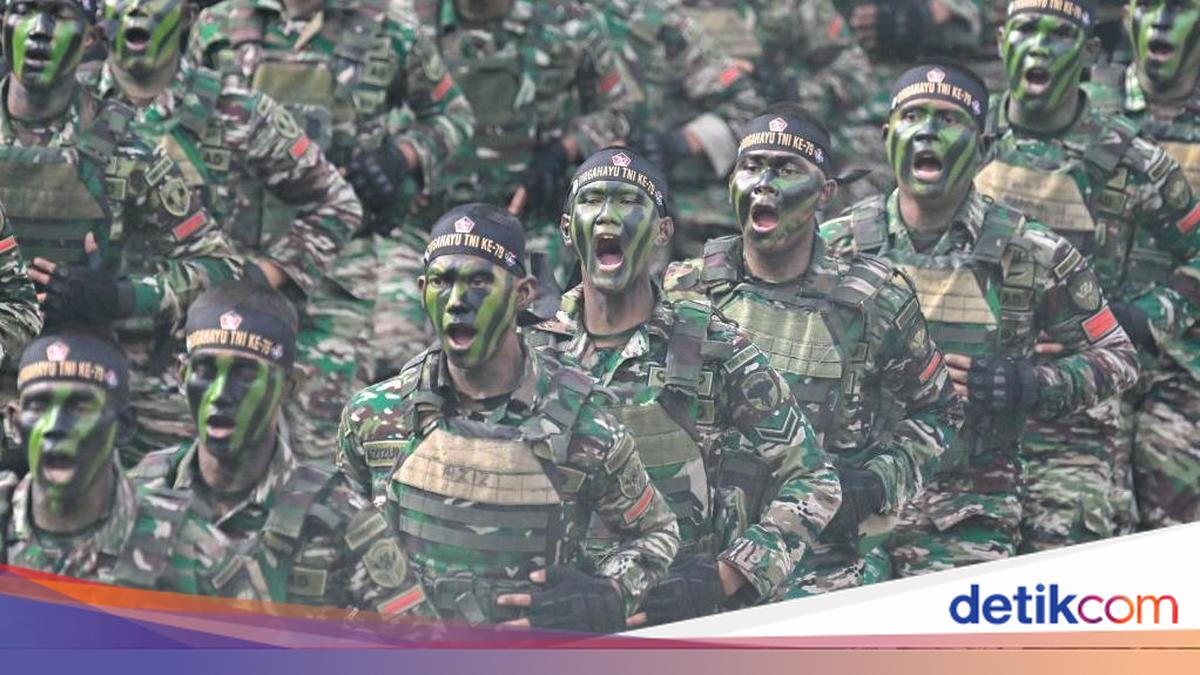
Indonesian Armed Forces Commander General Agus Subiyanto has revived a position that previously existed during the New Order era. This position was subsequently abolished during the tenure of Indonesia’s fourth president, Abdurrahman Wahid (Gus Dur).
The position in question is Chief of Territorial Staff (Kaster TNI). Recently, the Commander appointed Lieutenant General Bambang Trisnohadi as Kaster TNI.
According to a mutation letter seen on Wednesday (11 March), Lieutenant General Bambang Trisnohadi was appointed to the position of Kaster TNI. Lieutenant General Bambang previously served as Commander of Kogabwilhan III (Regional Command).
Meanwhile, the position of Kogabwilhan III Commander is now held by Major General Lucky Avianto, who previously served as Commander of Kodam XXIV/Mandala Trikora.
Regarding the positional transfer, TNI Information Centre Chief Brigadier General Aulia Dwi Nasrullah has provided confirmation. Aulia stated that mutations within the TNI are commonplace.
“I should convey that positional mutations within the TNI constitute routine practice, in the context of career development of military personnel and organisational requirements,” Aulia told journalists on Wednesday (11 March 2026).
Aulia stated that the mutation was conducted to ensure the TNI remains adaptable to organisational challenges. He emphasised that the decision supports the execution of the TNI’s core responsibilities.
“This measure is also taken to ensure the TNI organisation remains adaptable to dynamic task challenges. Every decision is made based on considerations to support the execution of the TNI’s core duties,” he said.
Regarding the Kaster TNI Position
The Kaster TNI position was previously abolished during the Gus Dur era. As cited from the 2003 Human Rights Report published by the Institute for Policy Research and Advocacy (Elsam), this position originally bore the name Chief of Sociopolitical Affairs (Kasospol) TNI.
However, in its evolution, the position changed its designation to Chief of Territorial Staff (Kaster TNI). The position carried out the TNI’s duties in the sociopolitical field.
This position was previously held by Agus Widjojo through to Susilo Bambang Yudhoyono (SBY). During the reform era, Gus Dur undertook a reform process of the TNI institution.
A number of changes were implemented within the TNI by Gus Dur. One of these involved abolishing the Kaster TNI position in 2001.
Commission I DPR Confident Against Dual Function
Deputy Chair of Commission I of the People’s Consultative Assembly Dave Laksono has responded to the Commander’s action. He expressed confidence that the restoration of the Kaster position would not lead to the reactivation of ABRI’s former dual function.
“The decision of the TNI Commander to revive the Chief of Territorial Staff (Kaster) position should be understood as part of an organisational development process that adapts to contemporary dynamics. The TNI is an institution required to remain continuously prepared to face new challenges, so structural reorganisation sometimes becomes a necessity. Nevertheless, this measure should not be interpreted as a return to ABRI dual function practices,” Dave told journalists on Friday (13 March).
This Golkar politician believes the Kaster TNI position holds urgency for the present time. According to him, the position plays an important role in strengthening territorial coordination to address increasingly complex security challenges.
“The presence of this position is expected to enhance readiness, strengthen territorial development, and ensure more structured support for the TNI’s core responsibilities. With the Kaster in place, communication channels and synergy between territorial commands and the centre can operate more effectively, making the TNI organisation increasingly adaptable and responsive to national dynamics,” he said.
Dave stated that the position serves as an instrument to ensure more solid governance. “The authority possessed remains within the scope of core duties, so the focus is strengthening internal coordination and enhancing organisational work effectiveness. With clear limitations, this position actually becomes an instrument for ensuring more orderly and solid governance,” he said.
Commission I DPR RI, which partners with the TNI, Dave continued, views the strengthening of this structure as a positive step in modernising the TNI organisation. He expressed optimism that the restructuring will strengthen readiness and maintain public confidence in the defence institution.
“Oversight (by the DPR) continues to be exercised to ensure every policy runs transparently and accountably, so the TNI becomes increasingly robust as the frontline guard that is professional and trusted by the people,” he said.