
Military Involvement in Counter-Terrorism Feared to be Counterproductive
JAKARTA — Wahyudi Djafar, Director of Rakhsa Institute, has stated that the use of military force in counter-terrorism operations has frequently proven counterproductive, as evidenced by cases in Burkina Faso, Nigeria, Kenya, and Mali.
“Military involvement has the potential to create prolonged conflict, increase risks of civilian casualties, result in lack of accountability, and constitute human rights violations,” Wahyudi said in a press statement.
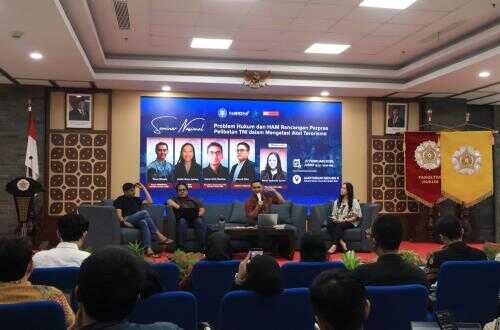
These concerns were raised during a national seminar titled “Legal and Human Rights Issues in the Draft Presidential Regulation on TNI Involvement in Combating Terrorism Acts” held at the Auditorium of Building B, Faculty of Law, Universitas Gadjah Mada, on Friday, 27 February 2026.
According to Wahyudi, the primary problem with the draft regulation is the lack of clarity in defining several key terms. Notably, “terrorism acts” are not distinctly separated from “terrorism,” whilst the phrase “other operations” lacks clear boundaries. This ambiguity risks elastic interpretation and creates potential for misuse of authority.
He further noted that military involvement in counter-terrorism can legitimise terrorist organisations whilst simultaneously diminishing the legitimacy of democratic governance when the military assumes security responsibilities that should be handled by law enforcement.
Azifah Retno Astrina, lecturer at the Department of Politics and Government, Universitas Gadjah Mada, explained that within the Indonesian context, Military Operations Other Than War (OMSP) fall within an auxiliary assistance framework. However, she criticised the regulation’s provisions on prevention and recovery, arguing they are impractical because the TNI is not trained to perform these functions. She noted that these concepts are primarily found in the context of United States military operations abroad.
In a domestic context, Astrina argued, military involvement in these two areas represents not merely securitisation but militarisation, which poses a danger to democratic continuity. Whilst the military possesses counter-terrorism capabilities, she maintained that the police force is better equipped for such operations.
The draft regulation is viewed as displaying symptoms of military role expansion beyond TNI institutions. The concept of terrorism prevention is feared to become a legitimising umbrella for TNI involvement in various matters outside its assigned duties and functions, reminiscent of practices during Indonesia’s New Order period. Critics contend the regulation is dangerous for democracy and rule of law enforcement.