
Military Court System Should Remain Separate from Ordinary Courts, TNI Argues at Constitutional Court Hearing
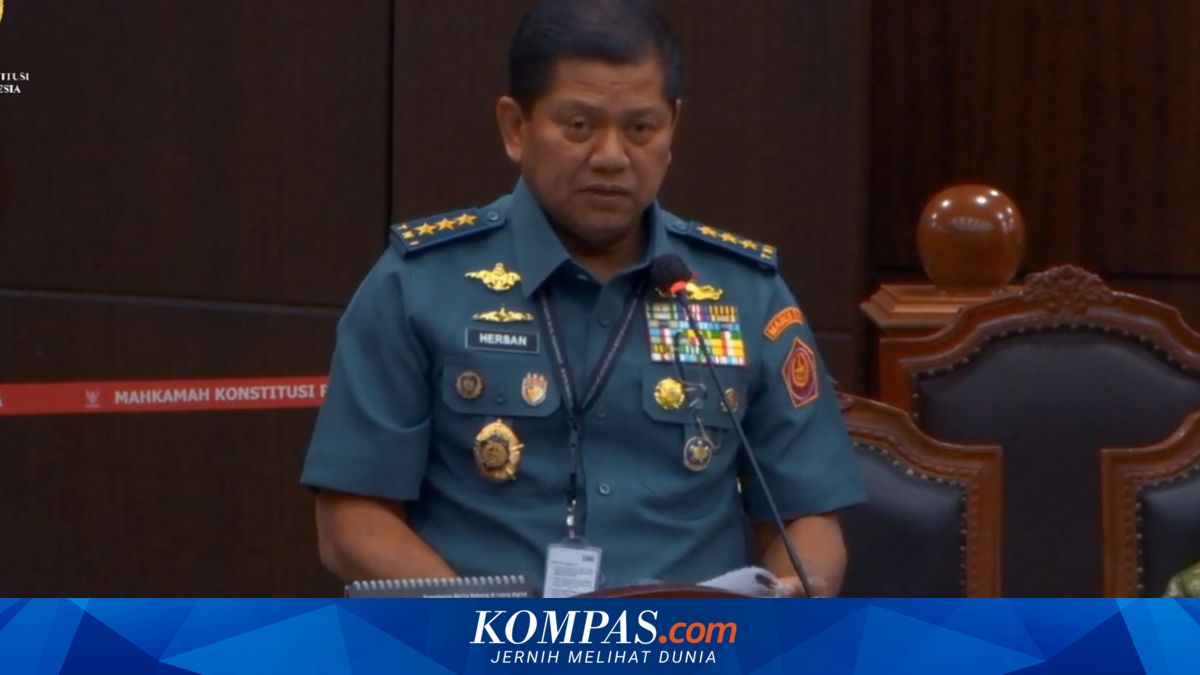
Jakarta — At a Constitutional Court hearing, TNI Inspector General Laksdya Hersan outlined the rationale for maintaining a separate military court system distinct from ordinary courts.
Hersan presented this argument whilst reading the Commander’s response to a judicial review petition concerning Law No. 31 of 1997 on Military Courts, which was being heard at the Constitutional Court (MK).
“Military personnel of the TNI come from selected Indonesian citizens who meet the required criteria and undergo specialised formation training as troops prepared to serve as a primary component of the national defence system,” said Hersan during the session broadcast live on the Constitutional Court’s YouTube channel on Thursday, 12 March 2026.
Hersan explained that military personnel undergo training using distinctive methods designed to develop professionals capable of fulfilling their role as guardians of national defence. A commanding officer also bears responsibility for resolving legal matters involving their subordinates.
Hersan argued that this hierarchical structure necessitates a distinct military court system separate from ordinary courts. “Consequently, military personnel of the TNI require a specialised judicial system, different from that applicable to other Indonesian citizens in the civilian sphere,” he stated.
The status of military personnel is regarded as lex specialis — a special legal category that allows for exemptions from general criminal law principles, provided that law enforcement observes the requirements of due process. “Military courts possess a distinctive rational foundation, reflecting that military personnel are part of the national defence organisation with a command structure, discipline, and high vigilance,” Hersan said.
Hersan stressed that a separate military judiciary does not automatically grant impunity to TNI members. “Military courts are constitutionally a sub-judicial body of the Supreme Court, there is no impunity for TNI personnel, and this arrangement does not contradict Article 1(3) of the 1945 Constitution,” said Hersan.
He concluded by reading the requested relief: “We reject the petitioners’ application for judicial review in its entirety, or at a minimum declare the petitioners’ application for judicial review inadmissible.”