
"Middle power" strengthens, FPCI urges Indonesia to formulate new diplomatic strategy
Indonesia also needs to determine which middle power countries should be approached more closely, as well as building relationships based on coalition formation.
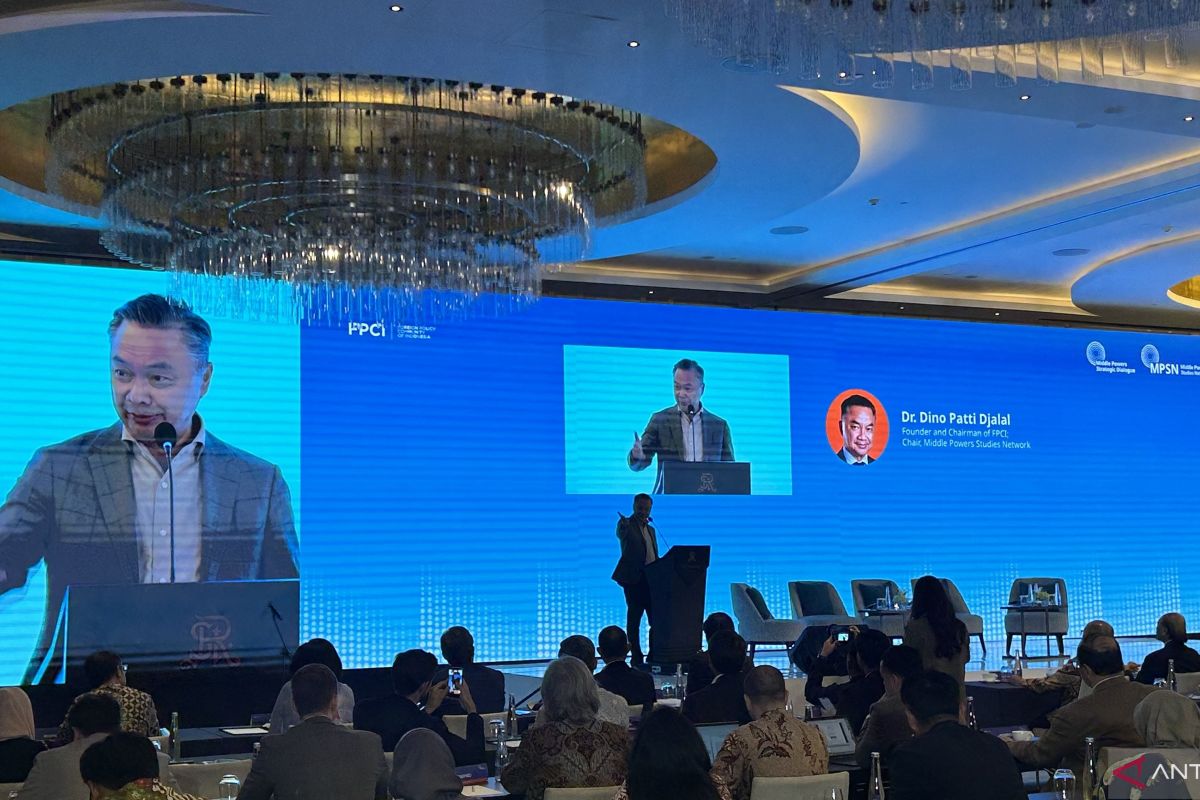
Jakarta (ANTARA) - Founder of the Foreign Policy Community of Indonesia (FPCI), Dino Patti Djalal, has urged the Indonesian government to formulate a new diplomatic strategy in line with the strengthening role of middle power countries.
The statement was delivered by Dino while speaking at the Middle Power Conference in Jakarta on Tuesday, which highlighted changes in the global geopolitical landscape, particularly the strengthening of cooperation between countries in the Global North and South regions.
“What we have observed at FPCI is that middle power countries from the North and South regions are now beginning to build increasingly close relationships. We see this trend clearly, where various bilateral relations are being further strengthened,” said Dino.
The former Indonesian deputy foreign minister stated that middle power countries from the Global North and South, numbering around 20 nations, are now playing an increasingly important role in shaping the future of the next world order.
Furthermore, he assessed that the strengthening of these relations is reflected in the continuously increasing intensity of cooperation among middle power countries, both in the Global North and South.
Indonesia, said Dino, is one of the countries actively expanding its diplomatic networks. Over the past 15 months to two years, Indonesia has been recorded as increasing cooperation with several strategic partners.
Some of the relationships highlighted by Dino include Indonesia’s cooperation with Australia, France, India, South Korea, and Turkey. The strengthening of these relations is seen as reflecting Indonesia’s efforts to expand its diplomatic networks amid changes in the global order.
“We are actively engaging with the government to encourage them to have this middle power strategy, which we believe is a very appropriate strategy for Indonesia’s free and active foreign policy,” he said.
Not only Indonesia, he continued, but a similar trend is also occurring widely among other middle power countries, both in the Global South and Global North regions.
Therefore, FPCI calls on the Indonesian government that, as a middle power country, it is important for Indonesia to develop a specific strategy that can maximise Indonesia’s potential in the global chessboard.
“We need to understand what our ambitions are, what assets we have, and how our position is in the continuously evolving world order. In addition, Indonesia also needs to determine which middle power countries should be approached more closely, as well as building relationships based on coalition formation,” said Dino.