
Middle East Conflict Widens as Pro-Iran Militias Move Against U.S. and Israel
The escalation of the conflict in the Middle East has entered a new, increasingly menacing phase as Iranian-backed militias have begun intensifying attacks against Israel, the United States (US) and their allies in retaliation for the joint US-Israel strikes on Tehran. The involvement of these armed actors threatens to unleash wider chaos and violence in the region. At present, the militias’ attacks are focused mainly on Iraq, which has emerged as the front line in this new, often covert confrontation.
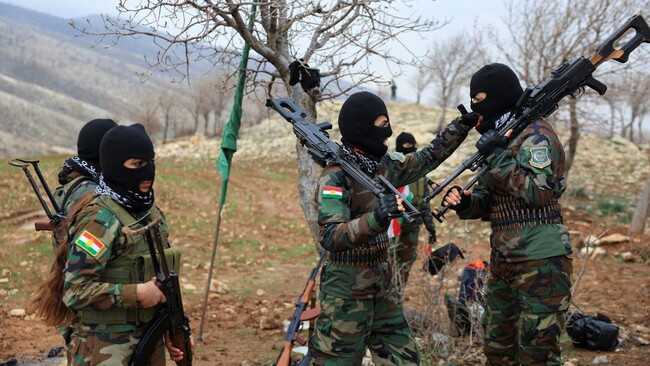
In Iraq, the militias have launched dozens of attacks since last Saturday, targeting Israeli territory as well as US military bases in Jordan and Iraq. In addition, in recent days they have targeted infrastructure belonging to the Iran-Kurdistan opposition group in northern Iraq, an autonomous region.
The militias have even issued explicit warnings to Western countries not to intervene in the confrontation. In a joint statement on Thursday, the allied armed factions issued a very serious threat: ‘We warn European countries not to join this war and we threaten their troops and bases in Iraq and the surrounding areas,’ the statement quoted by The Guardian on Thursday 6 March 2026.
On the ground, the militias’ movements appear to show broader coordination. Iraq’s state news agency reported attempts to launch missiles from Basra aimed at a neighbouring country, though the attempt was thwarted by security forces. Meanwhile, the Israeli military has begun to feel the direct impact of these attacks: ‘Drones have been launched at Israel from Iraq, though their number is not significant,’ a spokesperson for the Israeli military said on Wednesday night.
Michael Knights, an Iraqi affairs expert from Horizon Engage, said the aggressive moves are an attempt by the militias to show their existence after the death of their supreme leader. ‘Iran-backed groups in Iraq are trying to find ways to stay relevant and to respond to the death of Ayatollah Ali Khamenei,’ Knights said.
However, the militias’ audacity has to be paid for. Secret counterattacks believed to be carried out by Israeli or US special forces have begun striking their bases. The militias’ bases in southern Baghdad, Nasariya, and Basra have been attacked by ‘suicide drones’, reportedly killing 15 fighters, most from the Kataib Hezbollah faction.
Knights suspects a covert ground operation is underway to hunt these militias in their own territory. ‘There is a short-range drone system used in Iraq that cannot be flown far from Israel. We are seeing the same pattern as in last year’s conflict, which indicates covert actions on the ground. There are many proxy wars taking place,’ Knight added.
The militias’ strength appears to be eroding. Kataib Hezbollah has confirmed the loss of one of its commanders in an attack in southern Iraq, where a vehicle near their main base was blown apart. Their Jurf al-Nasr base has also been repeatedly pounded since the weekend.
A senior researcher at Chatham House, Renad Mansour, argues that these militia groups are currently in a survival phase amid the massive counter‑offensive. ‘This is very much about survival. And survival for them is based on calculations that are not always about Iran’s survival,’ Mansour said.