
Middle East Conflict Could Threaten National Budget, Prabowo Hopes Worst-Case Scenario Does Not Materialise
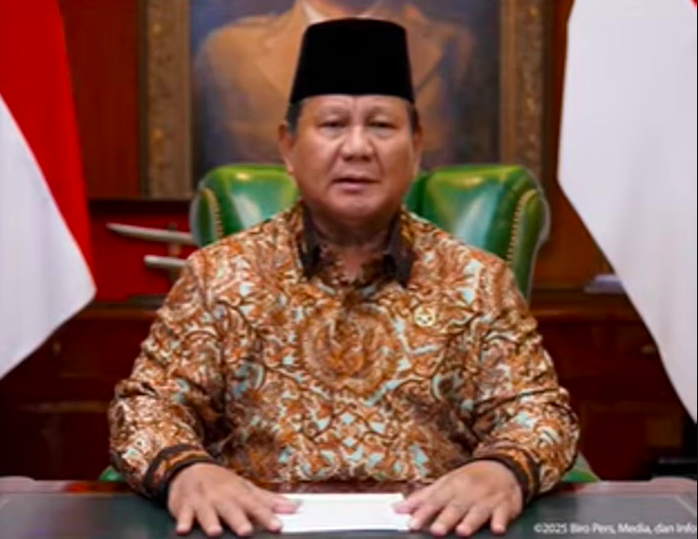
President Prabowo Subianto has expressed his hope that the worst-case scenario imagined by various parties regarding the Middle East does not materialise, particularly following the war between Iran, the United States and Zionist Israel, which has now lasted approximately two weeks.
Speaking before ministers and state officials at a Full Cabinet Meeting at the State Palace in Jakarta on Friday 13 March, the President emphasised that the government has taken several steps to anticipate the impact of war in the West Asian region, whilst examining several cost-saving options.
“We hope the worst-case scenario does not occur in the Middle East, but many predictions also suggest this could be a very long war, a very long war,” said Prabowo.
Nevertheless, the President stated that Indonesia is currently in a relatively safe condition. However, the President cautioned his officials to remain vigilant and not become complacent. “Although we feel safe, we must not panic, we must prepare ourselves for the worst possible scenario,” said the President.
During today’s Full Cabinet Meeting, the impact of the war between Iran versus Zionist Israel and the United States also came under scrutiny. Coordinating Minister for Economic Affairs Airlangga Hartarto and Chairman of the National Economic Council (DEN) Luhut Binsar Pandjaitan directly reported their respective notes regarding the issue and its impact on Indonesia.
When presenting his report to the President, Airlangga raised the possibility that the state budget deficit could exceed 3% should the war scenario extend for five months, six months and ten months.
In scenarios developed by the government, the price of crude oil is predicted to reach $90 per barrel if the war lasts five months, then $97 per barrel if the war extends to six months, and $115 per barrel if the war lasts ten months.
“If we factor this into our current state budget, in this first scenario, the ICP is at $86 per barrel, the exchange rate at Rp17,000. Our state budget exchange rate is Rp16,500, and with growth we maintain. So this is what we maintain at 5.3% growth. State securities yield at 6.8%, then the deficit is 3.18%,” said Airlangga.
Airlangga then continued with the moderate scenario, meaning crude oil price of $97 per barrel, the rupiah exchange rate against the dollar at Rp17,300, economic growth assumption of 5.2%, and state securities yield of 7.2%, the state budget deficit is predicted to reach 3.53%.
“Then, if we take the worst-case scenario, the pessimistic one, with crude oil price at $115 per barrel, our rupiah exchange rate at Rp17,500, growth at 5.2%, state securities at 7.2%, the deficit would be 4.06%,” said Airlangga.
“So, what this means with these various scenarios is that the 3% deficit will be difficult for us to maintain, unless we want to cut spending and reduce growth, Mr President,” added Airlangga when presenting his report to President Prabowo.
The Middle East conflict is also threatening the Formula 1 agenda and the Bahrain Grand Prix and Saudi Arabian Grand Prix, which were previously scheduled to be announced this weekend.
Prabowo also emphasised that the government possesses various data and intelligence reports regarding various parties attempting to influence public opinion.