
Microsoft Begins Distributing AI Copilot Cowork, Capable of Performing Tasks Without Instruction
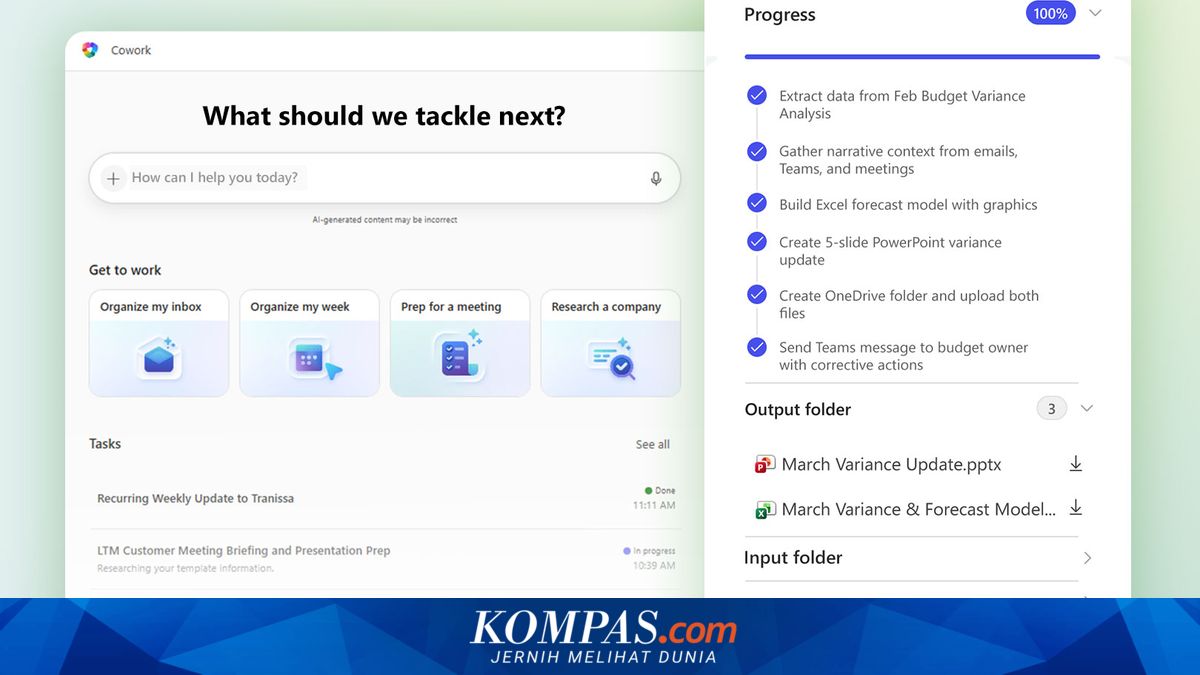
Microsoft has begun distributing its latest feature, an artificial intelligence (AI)-based work “assistant” named Copilot Cowork, to early access users. This feature is available through the Frontier programme, an early access scheme for Microsoft 365 Copilot customers to try out the latest AI innovations before a broad release. Copilot Cowork was previously tested in a “Research Preview” phase since early March with a limited number of customers. Now, Microsoft is expanding access via the Frontier programme. In simple terms, Copilot Cowork is an AI feature that is “agentic,” meaning users can assign tasks to the AI to complete independently in the background. With Copilot Cowork, users simply need to explain the end goal of the work. After that, the AI will: [Note: Original text appears incomplete here, but implies autonomous task execution.] Moreover, Copilot Cowork can be used for various needs, such as: [Note: Original text incomplete, but suggests diverse applications.] Copilot Cowork also allows users to run multiple tasks simultaneously (multi-tasking) and monitor them all in a single view. Microsoft states that the technology is supported by AI concepts from Anthropic, particularly the “Claude Cowork” system, as well as capabilities from OpenAI’s AI models. This multi-model AI approach is then integrated into Microsoft’s Copilot ecosystem, resulting in Copilot Cowork. Users interested in trying Copilot Cowork can join the Frontier programme by accessing the following link. [Note: Link not provided in original text.] There is no information yet on when this agentic AI feature will be available to the general public. In addition to Copilot Cowork, Microsoft has updated the Researcher feature in Copilot, which can now: [Note: Original text incomplete, but implies improved research capabilities.] They have also introduced two new features in Researcher: Critique and Model Council. The Critique feature separates the creation and evaluation processes. One AI model generates an initial draft, while another acts as a reviewer to refine the results. Meanwhile, Model Council allows users to compare responses from multiple AI models side by side, complete with summaries of differences and similarities.