
Meteorite Impact 6.3 Million Years Ago Creates Vast Expanse of Natural Glass in Brazil
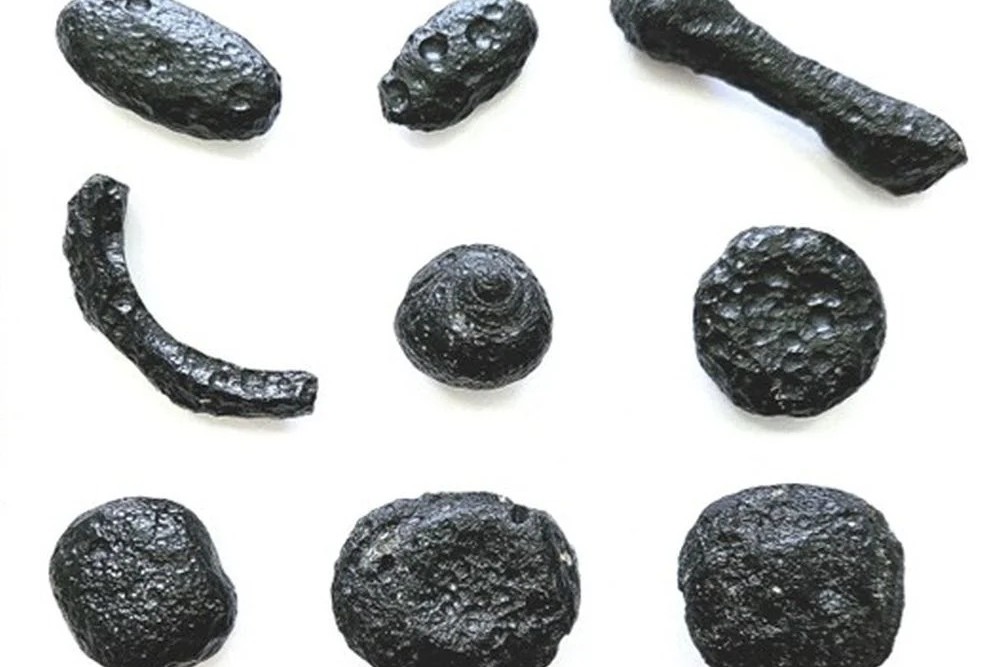
Scientists have identified the first tektite field ever found in Brazil. The specimen has been named geraisites, after the Brazilian state of Minas Gerais where the material was first found. Previously, the world knew of five major tektite fields located in Australasia, Central Europe, Ivory Coast, North America, and Belize.
Tektites are natural glass formed when an asteroid or other extraterrestrial body impacts the Earth with extreme energy. Physically, tektites display aerodynamic shapes formed as molten material cools in the atmosphere, producing spheres, ellipsoids, teardrops, and twisted dumbbell shapes.
Although they appear jet black and opaque, tektites reveal a greenish-grey transparent hue when held to bright light. Their surfaces are pockmarked with small holes or cavitations, trace marks of gas bubbles released during rapid cooling, a feature that distinguishes tektites from other terrestrial glass.
The discovery of this tektite field spans across northern Minas Gerais into northeastern Brazil, including Taiobeiras, Curral de Dentro, São João do Paraiso, Bahia, and Piauí, extending over more than 900 kilometres.
To date, researchers have collected more than 600 tektite fragments, ranging from less than 1 gram to 85.4 grams, with the longest dimension up to 5 cm.
The authenticity of geraisites as an impact-derived material was reinforced by in-depth geochemical analyses. Researchers found inclusions of lechatelierite, a high-temperature silica glass that can form only under extreme heat not found in internal Earth geological processes.
Additionally, the very low water content—only about 71 to 107 parts per million—serves as incontrovertible evidence. By comparison, volcanic glass such as obsidian can contain up to 2% water, much wetter than tektites, which are known to be extremely dry. Isotope data also indicate the material originated from the ancient crust Craton São Francisco, dating back more than 3 billion years.
Using argon dating methods, the research team concluded that the impact occurred at least 6.3 million years ago, near the end of the Miocene epoch. Three dating results clustered consistently, supporting the conclusion that all material originated from a single, massive event.
So far, the crater associated with geraisites has not been found. This aligns with global geological records where of six tektite fields, only three have confirmed craters. While the precise location remains a mystery, the volume of melted rock and the wide distribution of fragments suggest the impacting body was of considerable size.
The find is published in the journal Geology by a research team led by Álvaro Penteado Crósta, a geologist and senior professor at the Institute of Geosciences, Universidade Estadual de Campinas (IG-UNICAMP). Crósta collaborated with researchers from Brazil, Europe, the Middle East, and Australia.