
Merah Putih Pam Cooperative Sends 10.5 Tonnes of Copra to Surabaya
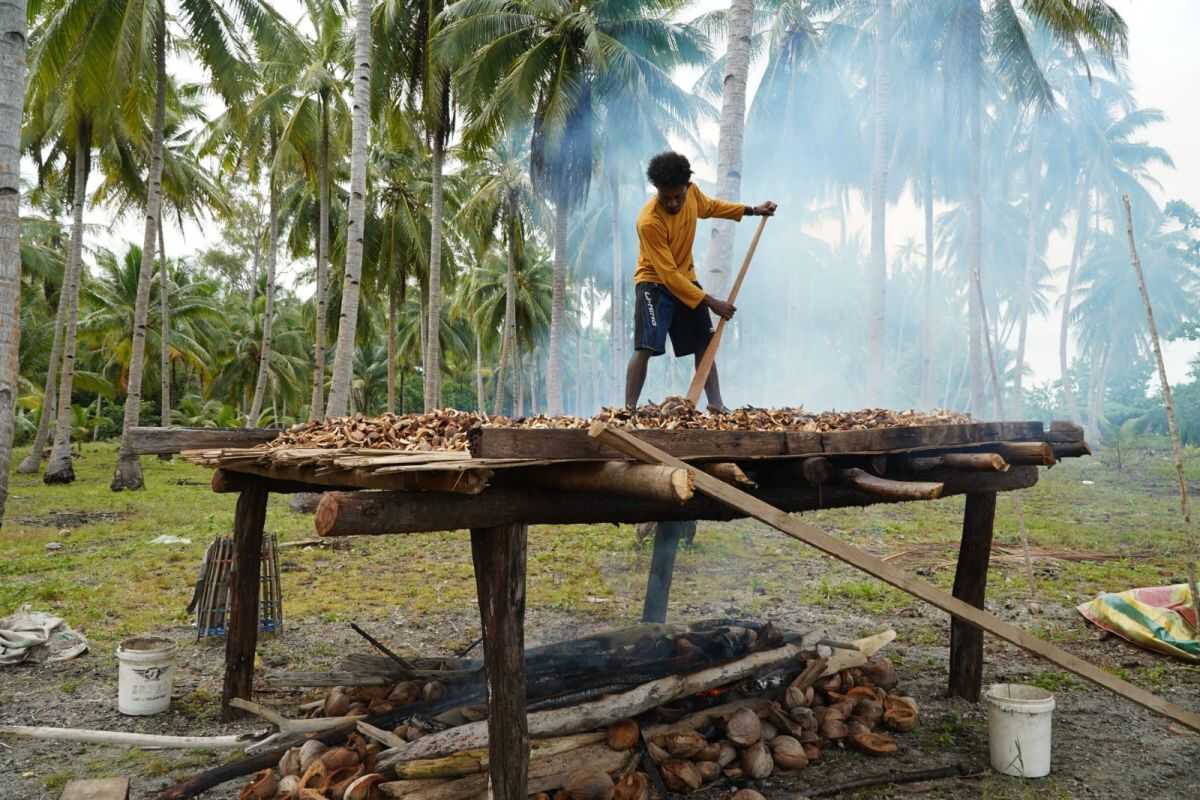
Jakarta — Merah Putih Pam Cooperative, located in Pam Village, Raja Ampat Regency, West Papua Province, has shipped 10.5 tonnes of copra to Surabaya, East Java, in January 2026 as part of its expansion into the national market.
“Merah Putih Pam Cooperative supports 13 farmers who are also owners of coconut plantations,” said Yopi Mambrasar, Chairman of Merah Putih Pam Cooperative, during the Cooperative Partners Meeting: Enhancing Local Community Resilience through Sustainable Economic Development, organised by the EcoNusa Foundation in Sorong from 23–25 February 2026.
According to Yopi, approximately 95 per cent of Pam Village residents work as copra farmers. Under favourable weather conditions, production can reach 30 to 50 tonnes per month, with coconut plantations spread across small islands in the Pam Islands region.
He acknowledged that public understanding of the cooperative system still needs strengthening to encourage more farmers to channel their harvests through the cooperative.
“Therefore, we need more public education on the cooperative process and system so that 2026 can be better,” he said.
Institutional strengthening efforts began in 2024 through the establishment of an independent copra management cooperative to strengthen farmers’ bargaining position. When the Merah Putih Cooperative Programme was launched in July 2025, its management was entrusted to Yopi, and the independent cooperative subsequently became one of the operational units of Merah Putih Pam Cooperative.
“Previously, because we were not organised, it was difficult to access government assistance. Yet assistance is usually based on mutual cooperation,” he said.
The cooperative also implements a savings scheme of three per cent from members’ sales profits to support education costs and emergency needs.
Since August 2025, the EcoNusa Foundation has provided capital support with a profit-sharing arrangement of 70 per cent for the cooperative and 30 per cent for EcoNusa. Yopi views this scheme as more favourable to farmers compared to typical capital-sharing arrangements.
In 2026, the cooperative is targeting warehouse construction and increased production capacity to promote economic stability for the community.
“This is expected to lead to improved community economics and more stable economic circulation. It can also become an independent village through the use of village potential,” Yopi stated in an official statement on Friday.