
Menko AHY: Three Million House Programme a Solution to Housing Backlog and Economic Growth
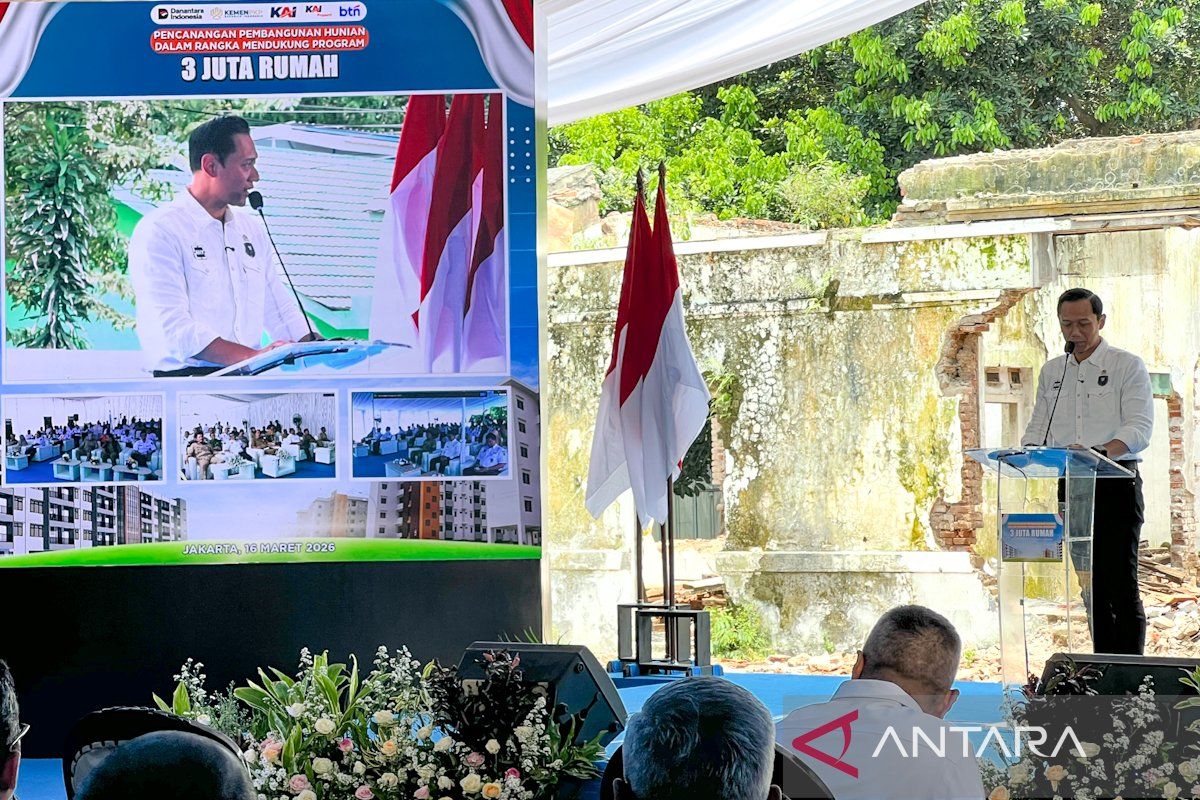
Jakarta — Coordinating Minister for Infrastructure and Regional Development Agus Harimurti Yudhoyono (AHY) has stated that the three million house programme addresses housing backlog whilst driving economic growth through the provision of adequate housing for low-income communities.
Housing backlog refers to the gap between the number of homes needed by communities and the number of homes available.
During the launch of the Housing Development Initiative Supporting the Three Million House Programme on PT Kereta Api Indonesia land in the Manggarai Station area of Jakarta on Monday, AHY noted that the programme launch forms part of President Prabowo Subianto’s broader vision.
“The President is steadfast in his commitment and has believed from the outset that a healthy family begins with a good home, and an empowered society begins with a prosperous home,” AHY stated.
The government has launched the three million house programme as part of its national development vision to provide adequate housing for the Indonesian people.
According to AHY, the three million house programme aims to address the persistent housing backlog and improve housing quality for communities living in substandard dwellings.
The government targets the programme to expand access for disadvantaged and low-income communities to adequate and affordable housing across various regions of Indonesia.
AHY explained that housing sector development extends beyond housing provision, delivering a multiplier effect on national economic growth through construction activities.
He noted that the housing sector has the potential to mobilise at least 180 types of industries related to construction, building materials, and other supporting sectors across various regions.
As the sector develops, popular housing development is considered capable of creating substantial employment opportunities whilst boosting community economic activity.
Additionally, AHY emphasised that the success of the national housing programme depends heavily on the availability of developable land with clear legal status and free from disputes.
The government is coordinating relevant ministries to build an integrated housing ecosystem, including ministries handling land matters, public works, transportation, and residential areas.
In the context of urban development, AHY considered vertical housing development a solution to land limitations in increasingly densely populated major cities.
He explained that the vertical housing concept based on Transit Oriented Development (TOD) enables communities to live closer to public transport access and economic activity centres.
“Especially as 70 per cent of the world’s population, including Indonesians, are predicted to live, work and conduct activities in cities. Therefore, once again, the main challenge is that land area is extremely limited and contested for many purposes. Consequently, the approach focuses on housing or vertical housing,” he explained.
According to AHY, this concept has been widely implemented in modern cities worldwide and represents an important approach to developing more integrated urban areas.
“And thanks to PT KAI, which remarkably possesses assets throughout Indonesia in prime locations,” AHY said.