
Memories Flowing from the Wok: Preserving Dodol and Nurturing Jakarta
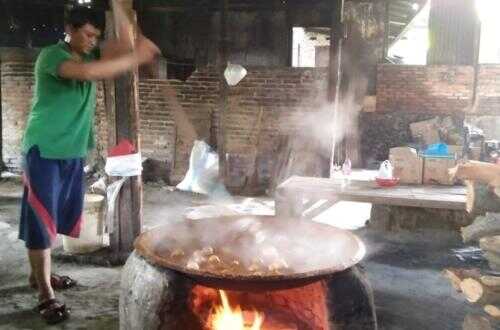
There was a distinct aroma in the Setu Babakan area on Friday afternoon. Not just the usual scent of cooking, but a sweet, lingering fragrance that drifted from residents’ houses, mingled with wisps of wood-smoke wafting from traditional kitchens.
In a house on Jalan Moch Kahfi II, Srengseng Sawah, Jagakarsa, South Jakarta, the smoke rose thicker. There, Dodol Nyak Mai, one of Betawi culinary heritages that survives in the face of changing times, was carrying out its annual ritual: making dodol to greet Ramadhan and Idulfitri.
Juani (65) stood before a large wok, watching workers busy stirring the thick brown batter. “I’m the successor to my mother; I’m already the second generation,” she said. Her eyes squint, half-smiling as she recalls her mother, Nyak Mai, who started the business in the early 1990s. Actually, the roots go deeper: since around the 1950s, when her mother was young and her dodol began to be known by neighbours.
Now Juani, along with other second-generation artisans, Mpok Djuanih and Bang Udin, keep the flame of the tradition burning. Ten workers take turns stirring the batter in large pans heated with wood. The ingredients are simple: palm sugar, granulated sugar, coconut milk, and glutinous rice flour. No preservatives, no chemicals. Only patience and strong muscles, because the dough must be stirred continuously for eight to ten hours.
“Apparently not easy,” a voice was heard from the doorway. The Governor of DKI Jakarta, Pramono Anung Wibowo, had just arrived and was immediately impressed by the stirring process, workers sweating. He tried stirring the dodol himself at the wok. After a few minutes his arm felt tired. He chuckled, imagining the workers taking turns for hours.
“Therefore, three to four people are needed to swap the stirring,” said Pramono, who then sat down to chat with Juani and the workers. “Behind the exhausting process, the Governor perceived a noble value: gotong royong.”This is its hallmark, its strength, its advantage — the gotong royong we refer to,” he said.
Pramono has a plan. He wants this Betawi dodol to feature at every event at the Balai Kota. Not just a snack, but a symbol that Jakarta still cares about its cultural heritage. “I ask for events at the Balai Kota to be catered here,” he said firmly.
He even admitted he often takes Nyak Mai’s dodol to his family. The flavour is distinctive, irreplaceable. And he wants more people to taste it. Therefore, Pramono urged that dodol producers receive support from the DKI Provincial Government, including modernisation of equipment, without erasing the traditional values that define its character. “The hope is to modernise, but not to let the traditional aspects disappear. Quite the opposite — that is where its distinctiveness and strength lie,” he urged.
Ramadhan blessings in Bekasi’s kitchens
The same aroma, but in a different place, was also detectable in Kampung Ceger, Desa Sukajaya, Cibitung District, Bekasi Regency. Here, Wulan (39) was scrambling to meet a flood of orders. Her production kitchen has hardly been quiet since the start of Ramadhan.
“Orders for Betawi dodol for Ramadhan jumped up to tenfold compared with ordinary days. Production rose by 100 percent,” she said amid the bustle.
Five large woks lined up in her kitchen. Each holds 90 kilograms of batter. Every day, during Ramadhan, she produces 450 kilograms of dodol. If accumulated up to the days leading to Idulfitri, it could reach 12 tonnes. “Sales peak usually occurs in the last ten days before Lebaran,” she added.
Wulan does not just produce original dodol. She also makes chocolate and black glutinous rice variants. Prices range from Rp40,000 to Rp70,000 per kilogram. Revenue? Wulan smiled. “It naturally follows. The higher the production, the more money comes in.”