
Megawati Condemns Killing of Ayatollah Khamenei by Israel and the United States
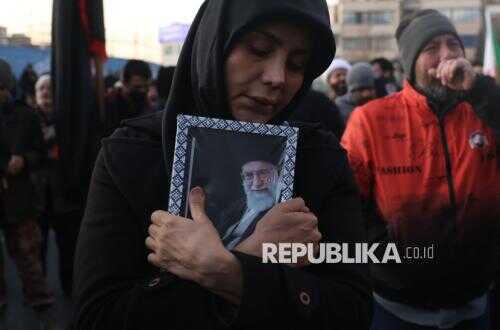
Former President of Indonesia Megawati Soekarnoputri has sent a condolence letter to the Government of the Islamic Republic of Iran expressing profound sympathy over the death of Ayatollah Ali Khamenei. The Supreme Leader of Iran died in an attack launched by Israel and the United States against the country.
Megawati’s condolence letter was delivered directly by the Secretary General of the Indonesian Democratic Party of Struggle (PDIP), Hasto Kristiyanto, together with the Head of the PDIP Central Board’s Foreign Affairs Division, Ahmad Basarah, to the Ambassador of the Islamic Republic of Iran to Indonesia, Mohammad Boroujerdi, at the Iranian Embassy in Jakarta on Tuesday, 3 March 2026.
After dialogue and the delivery of Megawati’s condolence letter to the Iranian Government, Hasto shared the contents of the letter. In the letter, Megawati, as Indonesia’s fifth president, a representative of the Sukarno family, and chairwoman of the PDIP, expressed: “My condolences on the death of His Excellency Ayatollah Ali Khamenei, Supreme Leader of the Islamic Republic of Iran, who fell in the sudden military attack launched by Israel and the United States against Iranian territory on 28 February 2026.”
“On behalf of myself and the extended Sukarno family, and representing the Indonesian nation and people who cherish peace, justice, and the sovereignty of independent nations, I extend our sincere sympathy and solidarity to the family, government, and all people of Iran,” Megawati continued.
Megawati acknowledged that for over three decades Ayatollah Ali Khamenei led his nation in an extremely difficult situation, amid geopolitical pressures, economic sanctions, and military threats, whilst consistently maintaining the nation’s sovereignty and the dignity of Islam.
“In him we saw a cleric and statesman who sought to combine religious faith, social justice, and an anti-imperialist stance within a consistent line of struggle.”
According to Megawati, for Indonesia, Ayatollah Ali Khamenei held a spiritual and intellectual closeness to Sukarno’s struggle.
“Various testimonies show how since his youth he admired Sukarno, read his ideas, and made Indonesian experience, especially Pancasila and the spirit of the Bandung Principles, one of the references in formulating a synthesis between religion, nationalism, and social justice in Iran. In his leadership we perceived echoes of the anti-colonial spirit, Third World solidarity, and the determination to reject all forms of global domination and injustice.”
“As the eldest daughter of Sukarno, an initiator of the Asia-Africa Conference and one of the architects of the Non-Aligned Movement, I feel deeply the historical and ideological bonds between the Indonesian and Iranian peoples. This brotherhood is forged not only through formal diplomacy, but also through shared fate as nations opposing various forms of colonialism, struggling for independence, and desiring a more just and dignified world order.”
Megawati also recalled her official visit to Tehran in 2004, in her capacity as President of the Republic of Indonesia. The visit was to attend the D-8 Conference whilst strengthening bonds of friendship and cooperation between the two countries.
“At that time I had the opportunity to meet Ayatollah Ali Khamenei. I felt the warmth of his friendly reception and the charisma of his leadership that emanated from him.”
After praising Khamenei, Megawati did not fail to condemn the attack on Iran launched by the United States and Israel since last Saturday. “On this occasion, I must reaffirm that the Indonesian nation stands with the Iranian people in rejecting and strongly condemning all forms of unilateral military aggression that violate state sovereignty and endanger regional and global peace.”
“We hold fast to the principle that we have maintained since the era of Sukarno until today, namely that the resolution of conflicts must be pursued through dialogue, fair negotiation, and respect for international law, not through violence and the use of armed force.”