
Megathrust Rupture: These Indonesian Regions Face Severe Tsunami and Earthquake Risk
Indonesia lies in one of the world’s most seismically active regions. Geographically, Indonesia is situated on the Pacific Ring of Fire, a zone where three major tectonic plates converge: the Indo-Australian Plate, the Eurasian Plate, and the Pacific Plate. This geological setting makes earthquakes, including megathrust earthquakes, a genuine risk that Indonesia must contend with.
According to National Geographic, the Ring of Fire is a series of volcanoes and seismically active locations around the edges of the Pacific Ocean. This region contains approximately 75% of the world’s active volcanoes and is the location of 90% of measured earthquakes globally.
Despite its name, the Ring of Fire is not truly ring-shaped but rather resembles a horseshoe, stretching approximately 25,000 miles or 40,000 kilometres. The volcanic chain extends from southern Chile, along the western coast of the Americas, through islands off Alaska, and continues to Japan and the Philippines.
The Ring of Fire was formed by the movement of tectonic plates—large sections of the Earth’s crust that fit together like puzzle pieces. These plates move over a layer of solid and liquid rock called the mantle, sometimes colliding, moving apart, or shifting relative to one another. Most of the tectonic activity in the Ring of Fire occurs in geologically highly active zones.
The movement of tectonic plates can trigger earthquakes. When one plate is forced beneath another, pressure and friction develop between the plates. This friction between plates is what causes earthquakes.
Tectonic plate activity in the Ring of Fire region has frequently produced major earthquakes recorded in history, including megathrust earthquakes.
A megathrust earthquake is a large-scale earthquake that occurs due to plate movement in subduction zones. Typically, these earthquakes happen when a denser oceanic plate slides beneath a lighter continental plate. With its tremendous force, a megathrust earthquake can pose a significant risk of generating large tsunamis.
According to Indonesia’s 2017 Source and Seismic Hazard Map, Indonesia has 13 main megathrust segments (updated to 14) with the potential to cause significant seismic events. Each megathrust segment has different magnitudes that trigger varying earthquake activity.
The 13 megathrust segments in Indonesia:
Aceh-Andaman Megathrust with earthquake potential of M9.2
Located in the Aceh and Andaman region, this segment has potential earthquake magnitude up to 9.2. Historical data shows that large earthquakes rarely occur in this area. However, this does not mean the risk has disappeared, as ongoing tectonic processes create potential for significant seismic activity.
Nias-Simeulue Megathrust with earthquake potential of M8.7
The Nias-Simeulue segment, located off the western coast of Sumatra, has significant potential for producing megathrust earthquakes. This segment is known for its history of devastating seismic events, including major earthquakes in 2005 and 2006.
Batu Megathrust with earthquake potential of M7.8
The Batu segment also has considerable potential for generating megathrust earthquakes. Data from the Meteorology, Climatology and Geophysics Agency (BMKG) shows that this segment has the possibility of releasing tremendous seismic energy capable of triggering large tsunamis. Additionally, the Batu megathrust segment has not experienced a major energy release for a long time, raising concerns about the potential for megathrust earthquakes in the future.
Mentawai-Siberut Megathrust with earthquake potential of M8.9
The Mentawai-Siberut megathrust segment spans approximately 200 km in length and 200 km in width. With a slip rate of up to 4 cm per year, this segment shows accumulation of seismic energy with the potential to produce large earthquakes. Historical records show that megathrust earthquakes have occurred in this region in 1797 with magnitude 8.7 and in 1833 with magnitude 8.9.
Mentawai-Pagai Megathrust with earthquake potential of M8.9
The Mentawai-Pagai megathrust segment, located off the western coast of Sumatra, has the potential to generate large earthquakes with maximum magnitude up to 8.9. With this level of force, earthquakes in this area could even trigger large tsunamis.
Enggano Megathrust with earthquake potential of M8.4
The Enggano megathrust segment has the potential to cause earthquakes with maximum magnitude up to 8.4. The BMKG identifies Enggano as part of a seismic gap, meaning this segment has not experienced a major seismic energy release for a considerable time, thus increasing the risk of megathrust earthquakes in the future.
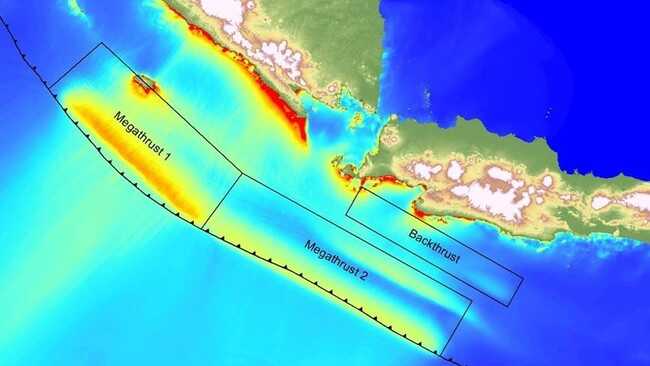
Sunda Strait-Banten Megathrust with earthquake potential of M8.7
The Sunda Strait megathrust segment is located between the islands of Sumatra and Java. This segment is considered a seismic gap zone with potential to generate large earthquakes. Historical records show that this region has not experienced a major earthquake for a long time, with the last recorded event in 1757.
West Java-Central Java Megathrust with earthquake potential of M8.7
The West Java-Central Java megathrust segment is situated along the southern coast of Java. Research indicates that this segment has the potential to generate large earthquakes with maximum magnitude reaching 8.7, capable of triggering tsunamis. According to the BMKG, this region is classified as a seismic gap zone that has not experienced major seismic energy release for hundreds of years, thus raising the risk of megathrust earthquakes in the future.
East Java Megathrust with earthquake potential of M8.7
The East Java megathrust segment is located along the southern coast of East Java. This segment spans approximately 440 km in length and 200 km in width, with a slip rate of up to 4 cm per year, indicating significant accumulation of seismic energy.