
Meet the "Old Man" Adang Fault Making Kalimantan Unsafe from Earthquakes
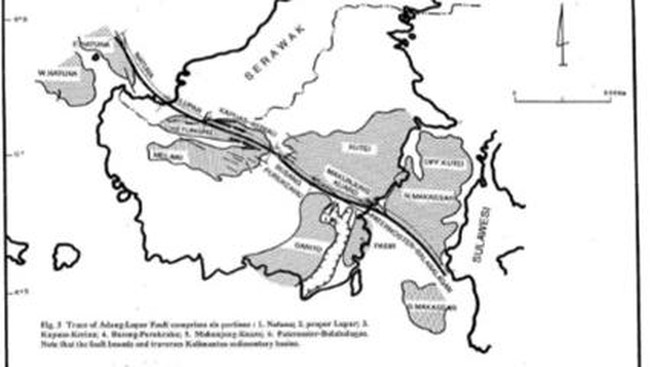
Jakarta, CNBC Indonesia - Member of the National Earthquake Study Centre (PUSGEN) Daryono has revealed that the tectonic earthquake with a magnitude of M 5.0 which struck the Kayan Hilir area in Sintang, West Kalimantan, at 03:04 WIB on 13 March 2026, is a sign that an old fault in Central Kalimantan is active. That old fault is the Adang Fault.
“One of the local earthquake sources in Kalimantan that needs to be monitored is the Adang Fault, which is strongly suspected as the trigger of the earthquake,” said Daryono, quoted from a written statement on the Instagram account @daryono_bicara_gempa, Sunday (22/3/2026).
Daryono explained that the Adang Fault is a regional fault structure that stretches across Borneo island from the eastern coast to the northwestern part of the island. The Adang Fault extends through the Lupar area, which is the border between West Kalimantan and Sarawak near the city of Kuching.
He stated that the age of the Adang Fault is generally interpreted as an old fault that has developed since the Tertiary period, not a Quaternary fault that is very active like many faults in Java or Sumatra.
“Several local earthquakes recorded in West Kalimantan, particularly around Sintang and Sekadau, are often associated with the activity of this fault,” said Daryono.
According to Daryono, earthquakes triggered by the Adang Fault usually have small to moderate magnitudes. However, because they originate from shallow sources in the Earth’s crust, they trigger shallow crustal earthquakes whose vibrations can feel quite strong in areas around the epicentre.
“The magnitude tends to be smaller, but the depth is shallow, so the potential for local shaking can be relatively significant,” said Daryono.
Daryono said that the effect of the shallow depth of this earthquake triggered shaking in the Kayan Hilir area, causing residents to wake up and rush out of their homes. Even the earthquake’s effects were felt in Sintang, Sanggau, Katingan, Melawi, and several other areas in West Kalimantan and Central Kalimantan.
“In this context, the earthquake threat in Kalimantan is more local and sporadic, not large earthquakes that often occur like in western Indonesia,” he explained.
Kalimantan’s low seismic activity is not unrelated to the island’s position in the interior of the Sunda Shelf, far from active plate boundaries.
Unlike Sumatra and Java, which are directly influenced by the interaction between the collision of the Indo-Australian Plate and the Eurasian Plate, Kalimantan is in a relatively stable crustal area.
As a result, the tectonic deformation that occurs is weaker and rarely triggers major earthquakes. Nevertheless, old fault structures like the Adang Fault can still experience reactivation due to regional stresses acting on the Earth’s crust.
Daryono mentioned that the Adang Fault structure starts from the Adang Bay area around Paser Regency in East Kalimantan. From there, its path is estimated to continue into the island’s interior towards the Sintang, Sekadau, and Sanggau areas.
This fault is then estimated to continue towards the border area around Entikong and connect with the geological structure system in the Kuching area, Sarawak.