
Meat Traders Protest Government Unfairness Over Price Regulation
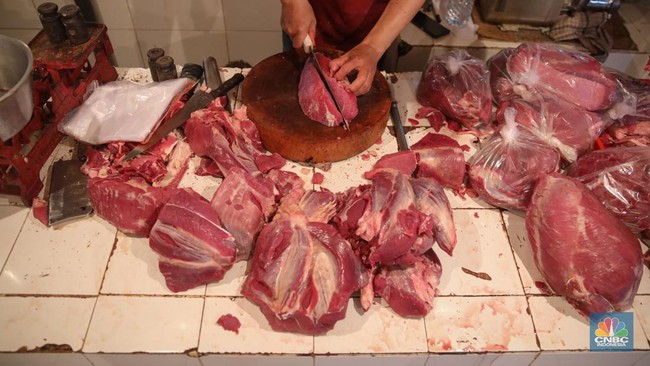
Jakarta — Beef prices continue to rise steadily. Meat traders believe the government’s food price oversight has been inconsistent, arguing that authorities focus primarily on beef traders in traditional markets whilst businesses trading in imported buffalo meat escape similar scrutiny or oversight.
“The government is treating price regulation unfairly, particularly concerning beef. Imported buffalo meat, whose prices have already soared and violate regulations set by the National Food Agency, is simply left alone,” stated Asnawi, General Chairman of the Indonesian Network of Meat Slaughterers and Traders (JAPPDI), during a statement in Jakarta on Monday, 9 March 2026.
According to him, current imported buffalo meat prices have clearly exceeded the limits outlined in National Food Agency Regulation Number 12 of 2024 regarding reference purchase prices at producer level and reference sale prices at consumer level for several strategic food commodities, including beef and buffalo meat.
National Food Agency data shows the average price of imported buffalo meat on 9 March 2026 reached Rp107,667 per kilogramme. However, the regulation sets the reference sale price for imported buffalo meat at Rp80,000 per kilogramme, meaning market prices are already nearly 35 per cent higher than the established limit.
The price surge has been even steeper in certain regions, particularly on Java Island. Imported buffalo meat prices have reportedly reached around Rp120,000 per kilogramme in some areas, approximately 50 per cent above the reference sale price.
Asnawi believes that prices exceeding the reference limits should prompt the government to take firm action against businesses selling above established prices. He even referenced the role of the Central Task Force for Clean Sweep Operations on Price, Food Safety and Quality Violations (Satgas Saber).
“Those distributors are not accused of being criminals like beef sellers often are when selling above the reference price. This is extremely unfair,” he stressed.
He also highlighted the structure of meat imports, which he views as increasingly concentrated among state-owned enterprises. Based on 2026 Commodity Balance Sheet data, total meat import quota reaches 297,000 tonnes. Of this, 100,000 tonnes consist of imported buffalo meat from India, 75,000 tonnes of beef from Brazil, and 75,000 tonnes of meat from other countries. All quotas are allocated to state-owned enterprises.
Meanwhile, private companies only receive meat import quotas of approximately 30,000 tonnes, with a further 17,000 tonnes allocated for industrial use.
This quota structure means the supply of imported buffalo meat in the market is practically controlled by state-owned enterprises. He views this policy as further restricting space for private sector operators in the meat trading sector.
Asnawi revealed that his association previously attempted to obtain imported buffalo meat supplies directly from PT Berdikari. However, the request was not fulfilled because the company stated stocks were depleted. He noted that according to the company’s explanation, imported buffalo meat distribution had been allocated to 12 private distribution companies.
“On behalf of our Association, we previously requested to become a distributor with PT Berdikari, but our request was not fulfilled with the reason that supplies were exhausted. We were instead suggested to purchase from distributors,” he explained.
Eventually, JAPPDI managed to obtain imported buffalo meat from PT Berdikari in limited quantities, approximately 8 tonnes. However, the purchase price obtained turned out to exceed the reference price. His association had to pay Rp90,000 per kilogramme for the Indian meat.
“That purchase price is clearly above the reference price at consumer level,” he stated.
Regarding government claims that beef prices approaching Eid Al-Fitr remain stable and within reference price ranges, Asnawi believes such conditions likely only apply to areas outside the Greater Jakarta region.
Under National Food Agency Regulation Number 12 of 2024, reference sale prices for beef are set in the range of Rp130,000 per kilogramme for front leg cuts to Rp140,000 per kilogramme for hind leg cuts. However, meat traders in the Greater Jakarta region face greater pressure to comply with these reference prices.
“But for the Greater Jakarta region, it is actually difficult for traders to sell at the reference price. However, meat traders fear the Task Force, fear being accused and arrested as criminals. That is why they sell beef by reducing quality to comply with the reference price,” he concluded.