
Meat and Rice Prices Rise, Statistics Agency Warns of Two Commodities
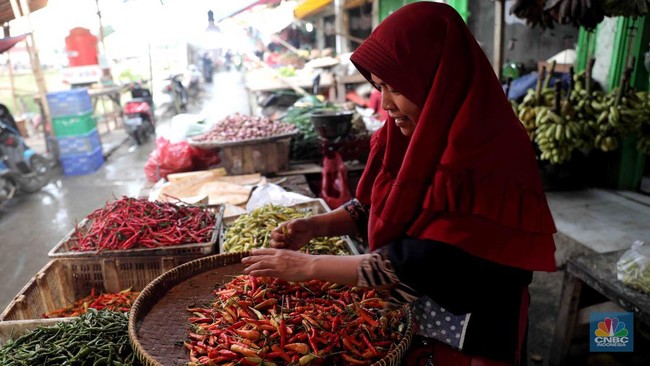
Jakarta — Indonesia’s Central Statistics Agency (BPS) has recorded a number of key food commodities experiencing price increases across various regions in the lead-up to Eid al-Fitr 1447 Hijra. The increases are predominantly affecting chilli peppers, beef, and layer chicken eggs.
Ateng Hartono, Deputy for Distribution and Services Statistics at BPS, noted that these findings were based on monitoring of the Price Development Index (IPH) during the second week of March 2026.
“The commodities contributing to the increase in the Price Development Index (IPH) in the second week of March 2026 are mainly chilli peppers, beef, and layer chicken eggs,” said Ateng during a Regional Inflation Control Coordination Meeting on Monday (16 March 2026).
BPS recorded that the number of districts experiencing IPH increases had grown compared to the previous week. In the second week of March, price increases occurred in 222 districts/cities, up from 204 districts/cities in the first week of the same month.
Beyond the three main commodities, several other food items also contributed to price increases, including layer chicken, rice, and cooking oil.
“This mainly occurred with commodities having quite significant contributions, namely beef, layer chicken, and also rice,” he said.
According to BPS mapping, notable price increases were felt in several areas of Sumatra and Java. On the island of Sumatra, the highest IPH increase was recorded in Bener Meriah District, Aceh, with an IPH change of 3.17 per cent. The price increase in that area was driven by rising prices for beef, layer chicken, and rice.
Next, Bintan District, Riau Islands, experienced an IPH increase of 3.04 per cent, also influenced by rising beef and layer chicken prices.
Similar increases also occurred in West Tulang Bawang District, Lampung, driven by rising beef and layer chicken prices.
Meanwhile, on the island of Java, the highest IPH surge was recorded in Brebes District, Central Java, with an increase reaching 3.07 per cent. Price pressure in that region was mainly from chilli peppers, layer chicken, and beef.
Another region experiencing quite high increases was the Thousand Islands, Jakarta, with an IPH change of 2.85 per cent.
“Layer chicken, chilli peppers, and also a slight increase in shallots,” explained Ateng.
In East Java, several areas such as Ponorogo, Pasuruan, and Malang also recorded price increases driven by chilli peppers and layer chicken.
Meanwhile, Pekalongan City, Central Java, recorded an IPH increase of 2.31 per cent due to rising chilli pepper and layer chicken prices.
“In Banten, here in Tangerang District, in West Java here in Cirebon District, the increases are mainly influenced by chilli peppers,” he said.
Nationally, BPS also recorded price increases for several commodities across many regions.
Layer chicken egg prices rose in 230 districts/cities, up from 210 areas in the first week of March. The highest price recorded reached Rp100,000 per kilogramme in Intan Jaya District.
For chilli peppers, price increases occurred in 199 districts/cities, up from 177 areas the previous week. The highest price recorded reached Rp200,000 per kilogramme in Nduga District.
Meanwhile, layer chicken experienced price increases in 192 districts/cities, with the highest price also reaching Rp100,000 per kilogramme in Intan Jaya.
On another front, cooking oil of various qualities was monitored to have risen in 112 districts/cities, with the highest price around Rp60,000 per litre.
“Specifically for cooking oil and chilli peppers, we ask for collective attention,” said Ateng.
Additionally, IPH increases were also recorded for beef in 109 districts/cities and rice in 107 districts/cities.
These findings demonstrate that food price pressure is beginning to broaden ahead of Eid, particularly for animal protein commodities and food items widely used by the public in observing major national religious holidays such as Eid al-Fitr.