
MBG Has Absorbed Rp 1.21 Trillion in Financing from Financial Institutions
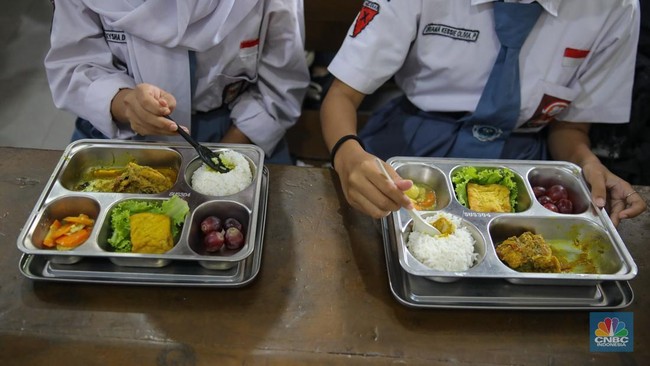
Jakarta, CNBC Indonesia — The Financial Services Authority (OJK) has revealed that financial services institutions have reported an increase in financing for several priority sectors. Among them, the realisation of financing related to the Free Nutritious Meals (MBG) has reached Rp 1.21 trillion as of January 2026.
The amount of financing was received by 1,373 units of Nutrition Service Fulfilment Units (SPPG). This was stated by OJK Commissioner Chair Friderica Widyasari Dewi during a working meeting at the House of Representatives Commission XI.
“On the financing side of the financial services sector, we have encouraged various strategic programmes such as free nutritious meals with a financing realisation of Rp 1.21 trillion,” said the woman familiarly known as Kiki at the DPR RI Building, Wednesday (1/4/2026).
In addition, the financial services sector also supports MBG through security cross funding by 3 issuers and 266 investors. OJK also provides special incentives for financial services institutions supporting the Asta Cita programme in the form of adjusted assets up to 0%.
Kiki continued that strengthening the village economy is also carried out through financing for Red-White Village Cooperatives, which has reached Rp 174.73 trillion as of January 2026. In her presentation material, the provision of financing facilities can be excluded from the maximum credit granting limit (BMPK).
Then, support for the 3 million houses programme with a realisation of Rp 1.44 trillion for 11,468 units or equivalent to 3.28% of the national target. Kiki said this is to expand housing financing access for low-income communities (MBR).
On the MSME side, Kiki stated that OJK is strengthening infrastructure through financing via the development of credit scoring and national credit registry, integration of SLIK data, and other support systems as well as policies to accelerate financing through MSME credit distribution obligations, low risk weight adjustments, and strengthening the role of the capital market. In addition, this includes forming a special department in banking supervision for MSME sector development.
“These efforts are also complemented by financial literacy programmes, business matching, and policies to accelerate MSME recovery. Including financing restructuring and relaxation of provisions for business actors in disaster-affected areas, so overall it is expected to strengthen financial inclusion and drive more equitable and sustainable economic growth,” explained Kiki.