
Materialism and Sacred Space
Materialism and Sacred Space
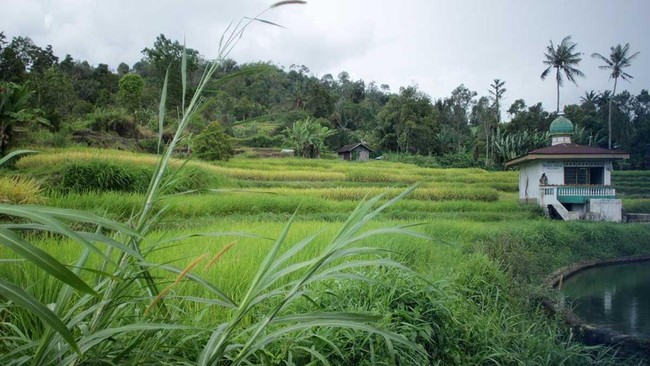
In a valley in West Sumatra, amidst rice fields that mirror the sky and coconut trees standing like guardians of time, stands a surau (traditional Islamic learning space). Its walls are old wood beginning to blacken with age, its floor cold from dawn dew, and its roof creaks softly each time a mountain breeze passes silently.
There is no signboard, no schedule, and no written curriculum. After the dawn call to prayer, before the sun fully decides to rise, the surau comes alive. Not through sound, but through silence full of meaning.
An elderly man sits cross-legged in a corner of the room, his eyes closed, his breathing calm, as if he is not entirely present in the same world as the rice fields and mountains surrounding him. This is Inyiak Mursyid.
There are no academic titles before his name, no certificates on the surau’s walls, yet people come from far away to sit with him. Not to learn something new, but to remember something they had long forgotten.
In that surau, time does not move like it does in the city. It is not divided into working hours and rest hours. It flows like river water that never asks where it must go. The students sit cross-legged. They do not take notes, they do not ask questions. They simply listen.
Sometimes Inyiak speaks, sometimes he remains silent. And it is precisely in that silence that the deepest lessons often occur. The surau is not merely a building; it is a sacred space separated from the outside world, not by walls, but by intention.
Outside, rice fields require farmers, markets require traders. The world continues to move with all its affairs. Yet inside the surau, for a few hours each day, people are permitted to be nothing. Not workers, not fathers, not children, not part of the economic machine that keeps turning. They are merely servants.
Inyiak Mursyid does not simply transmit knowledge. He maintains the spiritual atmosphere of the space. The way he sits, the way he is silent, the way he looks, even the way he breathes—all become part of the teaching.
In the spiritual tradition, what is transmitted is not merely knowledge, but inner state. Inyiak Mursyid does not give his students a curriculum like modern education. He gives stories of journeys and experiences. From these stories, students find courage to begin their own paths.
The nature surrounding the surau seems to understand this rhythm. The morning mist never arrives in haste. The wind does not force leaves to move faster than they should. Even the birds seem to know that there is a space that should not be disturbed by noise.
Simplicity is not an aesthetic choice in that place. It is the natural condition of life untouched by the obsession to become more. Yet like everything living in the world, the surau was also bound by time.
One day, without announcement and without great ceremony, Inyiak Mursyid passed away. Nothing collapsed physically. The surau’s walls remained standing, its floor remained cold, the rice fields continued to mirror the sky as usual.
But something invisible had departed. For some time, the students still came. They sat in the same place, trying to remember the voice that once filled the room. Yet the silence that was once full of meaning now felt different. It was no longer living silence. It had become empty silence.
Gradually, one by one they stopped coming. Not because they no longer believed, but because they no longer knew how to remain in a space that had lost its centre of gravity.
Several years later, a signboard was hung at its entrance. Schedules began to be written, children arrived with books, the sound of lessons replaced the silence. The surau had now become an MDA (Madrasah Diniyah Awaliyah, an Islamic elementary school). An institution that is tidy, structured, and fully suited to the needs of the times.
There is nothing wrong with that. Children learn to read the Qur’an, they learn hadith, prayers, Islamic history, memorisation of the Qur’an, Islamic creed, Islamic ethics and all religious teachings systematically. The surau now produces something recognisable to the modern world: output.
Yet in that transformation, something else gradually disappeared. Not the building. Not its function either. What disappeared was the sacred space itself.
This change did not occur in a vacuum. It proceeded alongside a transformation in the way people understand the world. Modernity introduced a way of thinking increasingly materialistic in viewing the world, especially as a series of functions, results, and utilities.
In such a view, something is valued by what can be produced from it. Education produces graduates, work produces income, and institutions produce output that can be measured through materialism.
In a world arranged by such logic, a space that produces nothing often appears inefficient. The old surau, with its long silence and unhurried time, gradually became foreign to a world increasingly accustomed to measuring everything.
This is where Émile Durkheim’s argument becomes relevant. In The Elementary Forms of Religious Life (1912), Durkheim explains that the essence of religion is not merely belief in God, but the creation of a shared sacred space where the community can experience a collective consciousness that transcends individual material interests.