
Massive Hunt for Plecostomus Fish in Jakarta
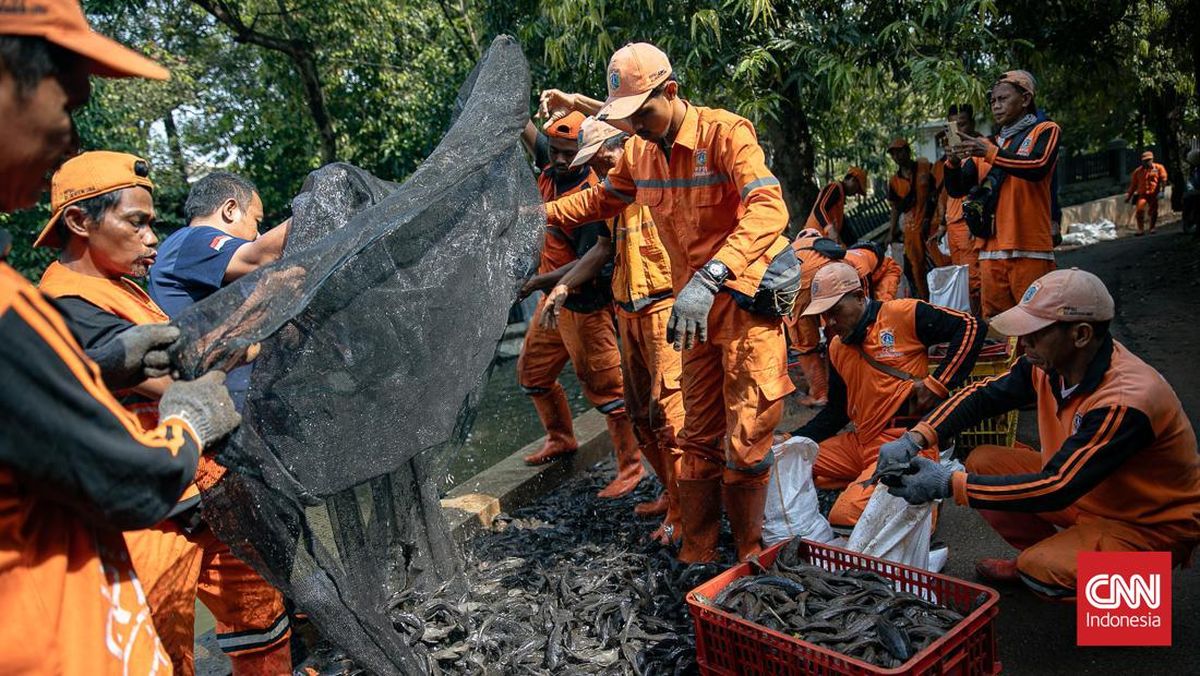
Dozens of PPSU officers and Water Resources Agency (SDA) personnel crowded the elite residential area on Jalan Janur Elok VI Blok QD9, Kelapa Gading, North Jakarta, on Friday morning (17/4). They descended en masse into the river in the area to hunt for plecostomus fish. Meanwhile, local residents gathered to watch the major operation to hunt plecostomus fish. The officers cast nets into the river with its pitch-black water. After a few minutes, they lifted them, and hundreds of plecostomus fish were caught in the nets. Jakarta Governor Pramono Anung stated that his side was carrying out this mass capture because the population of the invasive fish originating from South America had reached a worrying point and threatened the existence of local biota in Jakarta. “From the KKP’s analysis, it is estimated that more than 60 percent of plecostomus fish now dominate the waters in Jakarta, and this is very invasive, then it also makes other fish in the area, especially the endemic local ones, almost all of which cannot survive because they eat the eggs,” said Pramono at the Kelapa Gading housing complex, North Jakarta, on Friday (17/4). Pramono explained that this mass capture movement was being carried out simultaneously in five administrative areas of Jakarta to suppress the increasingly uncontrollable population growth. “This fish averages over 0.3 residues. And that is very dangerous. If consumed, it will be dangerous, and if left alone, it will cause damage because in making its house, it always gnaws at walls and so on,” he said. Pramono assured that his side would not stop at ceremonial actions in eradicating plecostomus fish, but would continue with more structured long-term policies. “Specifically, we will assign PPLH which is tasked for that. PPLH specifically to reduce the dominance of plecostomus fish. There will be a special assignment for PJLP handling plecostomus fish,” he said. Director General of Aquaculture of the Ministry of Marine Affairs and Fisheries RI, Haeru Rahayu, who accompanied him, said that manual or conventional capture is currently the most effective method. The use of chemicals or natural predators is feared to create new environmental problems. “KKP is currently preparing the software in the form of Minister of Marine Affairs and Fisheries Regulation number 19 of 2020, and it is currently being revised to be more applicable in controlling the plecostomus fish population,” said Haeru. Interestingly, the action in the elite Kelapa Gading housing complex received unique support from local residents. RW 06 Chairman, Ihsan, took the initiative to provide cash incentives for anyone who successfully catches plecostomus fish in his area. “As a reward or incentive to motivate in this area, we value it at Rp5,000 per kilo, and the money from the plecostomus is specifically for RW 06 area,” said Ihsan. After the nets were lifted, more than 200 kilograms of plecostomus fish were collected from the river flow. Hundreds of kilograms of fish originating from South America ended up in the grave. North Jakarta Mayor Hendra Hidayat has prepared a special location in the yard around the RW Post to bury the fish carcasses to avoid further environmental pollution. “Specifically in RW 06, we have prepared a location, there is an RW post, then there is also a yard, we will bury it there, plant it there. For other places, adjust accordingly,” said Hendra. The option to bury the fish was chosen as the safest so that the dangerous residues from the fish’s body do not contaminate the wider environment or are misused as food by irresponsible parties.