
Mars Flyby: NASA's Psyche Spacecraft Successfully Executes Gravity Assist Toward the Golden Asteroid
The NASA Psyche spacecraft is currently on its way to its primary target, the asteroid 16 Psyche, which lies in the main belt between Mars and Jupiter and is believed to be rich in valuable metals whose value would exceed Earth’s entire economy. The certainty about its composition will be revealed when Psyche reaches it in the summer of 2029.
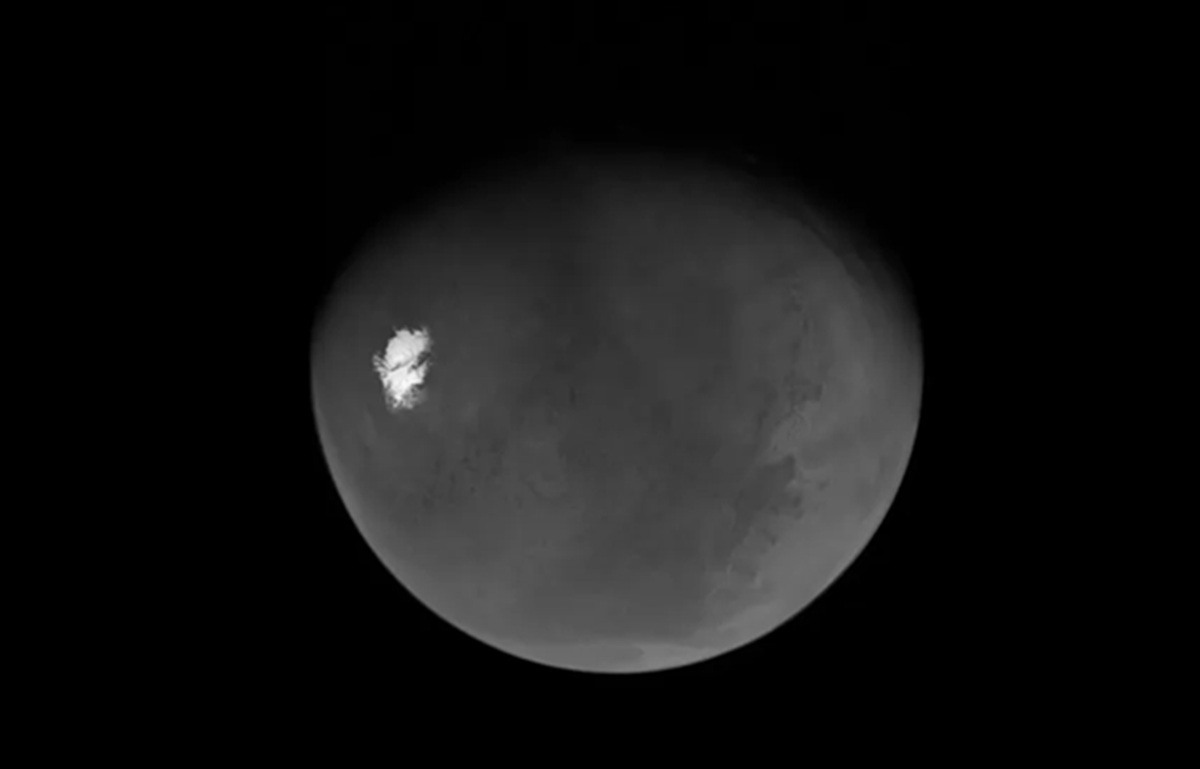
During its journey, the spacecraft has made an impressive stop by flying by Mars at a distance of 4,609 kilometres from the planet’s surface. The moment was used to test its camera instruments and to capture a series of striking images of the Red Planet on 15 May.
Psyche’s multispectral imaging camera captured Mars in a crescent shape. This shape arises due to the high phase angle between the Sun, Mars and the spacecraft. Mars’ dusty atmosphere scatters light, making the crescent appear brighter and more expansive than initially expected. The camera is capable of taking images in visible light and near-infrared.
“We have captured thousands of images as we approached Mars and of the planet’s surface and atmosphere at closest approach. This data set provides a unique and important opportunity for calibrating and characterising the camera’s performance, as well as testing the initial version of our image-processing tool that we’ve developed for use at the Psyche asteroid,” said Jim Bell, head of the Psyche imaging instrument at Arizona State University, in a formal statement.
Calibration imaging will continue for the rest of the month as the spacecraft moves away. “As the spacecraft continues on its journey after the flyby, we will continue Mars calibration imaging for the rest of this month as the planet recedes,” Bell added.
In addition to the crescent, the Psyche instrument captured near-full Mars views, including a south polar ice cap more than 700 kilometres wide. Other images show 50-kilometre wind streaks across a crater, and a refined colour rendering of Huygens Crater, which is about 470 kilometres in diameter.
The trajectory was deliberate to perform a gravity assist, using Mars’ gravity to fling the spacecraft onto the targeted trajectory without expending a lot of fuel.
“We have confirmed that Mars provides about 1,000 miles per hour of boost to the spacecraft and shifts its orbital plane by roughly 1 degree relative to the Sun. We are now on the right track to reach the asteroid Psyche in the summer of 2029,” said Don Han, head of Psyche navigation at Jet Propulsion Laboratory NASA. The navigation team confirmed this position using the Doppler shift via the Deep Space Network.
During the flyby, NASA also activated a magnetometer to detect solar wind dynamics near Mars. The mission also tests the space-based optical communications system (DSOC) using laser transmissions.
“We have anticipated this Mars flyby for years, and now it is completed. We thank the Red Planet for providing the gravity assist that will propel our spacecraft further into the solar system,” said Lindy Elkins-Tanton, principal investigator for the Psyche mission at the University of California, Berkeley. “Onward to the asteroid Psyche!”
NASA will also launch LOXSAT in July 2026 to test cryogenic fuel charging in orbit to support Moon and Mars missions.