
Marking International Women's Day, Citi Indonesia Discusses Women's Leadership
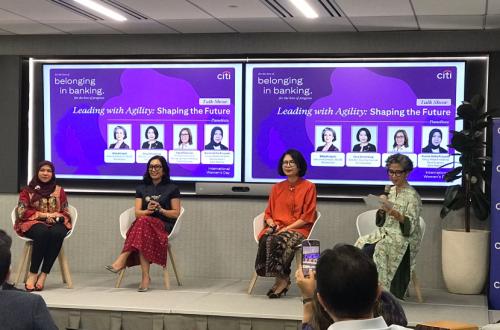
Citibank, N.A., Indonesia (Citi Indonesia) through its employee affinity group Citi Indonesia Women Network (IWN) organised a talk show entitled “Leading with Agility: Shaping the Future” to mark International Women’s Day (IWD).
The event, which resulted from collaboration with Indonesia Business Coalition for Women Empowerment (IBCWE), Synergy in Women’s Network (SIWN) at Shell Indonesia, and Bank Mandiri Srikandi, featured various perspectives from women leaders across different industrial sectors in an interactive discussion format.
Executive Director of IBCWE Wita Krisanti, acting as moderator, stated that marking International Women’s Day should not merely be a ceremony, but also a reminder that Indonesian women, particularly at the level of business leadership, still face many challenges.
“A survey we conducted with IDX in 2022 showed there are only eight female CEOs among 200 listed companies with the largest capitalisation on the Indonesia Stock Exchange. Furthermore, only approximately 15 per cent of companies have female representation at executive level,” Wita said when opening the event in Jakarta on Thursday, 12 March 2026.
Wita added that the Diversity Matters Even More report released by McKinsey in 2023 showed companies with high gender diversity on their boards of directors have a 28 per cent greater opportunity to record superior financial performance.
According to her, gender diversity also helps companies retain top talent, expand market reach, and build a good reputation, both among consumers and investors.
“We know the current workplace is very dynamic and full of uncertainty. Currently, there are even four generations working together in one organisation, ranging from baby boomers, Generation X, millennials, to Generation Z. Not to mention rapid technological development. Our way of working must change so that these four generations can work together effectively,” she said.
In line with Wita, Citi Indonesia Country Council Director Vera Sihombing believes that female leaders today need to build synergy, change mindsets, and foster trust within teams.
“Leadership signature for me is presence as a leader. Although not always physically present, teams can still feel our presence and support,” said Vera, who has had a career of more than 30 years at Citi Indonesia.
Besides Vera, President Director and Managing Director of Mobility at Shell Indonesia Ingrid Siburian also shared her experience as a female leader in the energy sector. With more than 17 years of experience at Shell, Ingrid has led various regional operations in Indonesia, Singapore, and Hong Kong, and has international experience at Shell’s Global Network Centre of Excellence in London.
Ingrid said it is important for someone to dare to voice their wishes in career development. “At Shell we have two major businesses, namely lubricants and mobility. I stated that I wanted to lead the mobility business. Whenever we discuss individual development plans, that has always been my top priority,” she said.
That opportunity finally came when the Russia-Ukraine conflict was taking place and she was entrusted to lead the mobility team. According to Ingrid, that challenge became a test of leadership to keep motivating the team and adjusting business strategy.
Meanwhile, a different experience was shared by Kurnia Sofia Rosada, Group Head of Enterprise Data Analytics at Bank Mandiri. Nia, as she is affectionately known, leads the management of corporate data and analytics to support business growth and increase productivity.
Under her leadership, the Group Enterprise Data Analytics won six international awards in 2025, including the ASEAN Tech Excellence Awards.
Nia admitted that initially she never imagined she would lead the data analytics field. Previously she had a career mainly in business, marketing, and the energy sector. “My understanding at that time was that data is the new oil. We have a lot of data that can be utilised and monetised to support business growth,” she said.
Despite facing various challenges, particularly in utilising data whilst following technological developments, Nia remains optimistic. “This is indeed a new domain and not easy, but as long as it is not nuclear engineering, we can still learn it,” she said.