
Makassar Mayor Conducts Market Inspections, Finds Chilli Prices Soaring Ahead of Idul Fitri
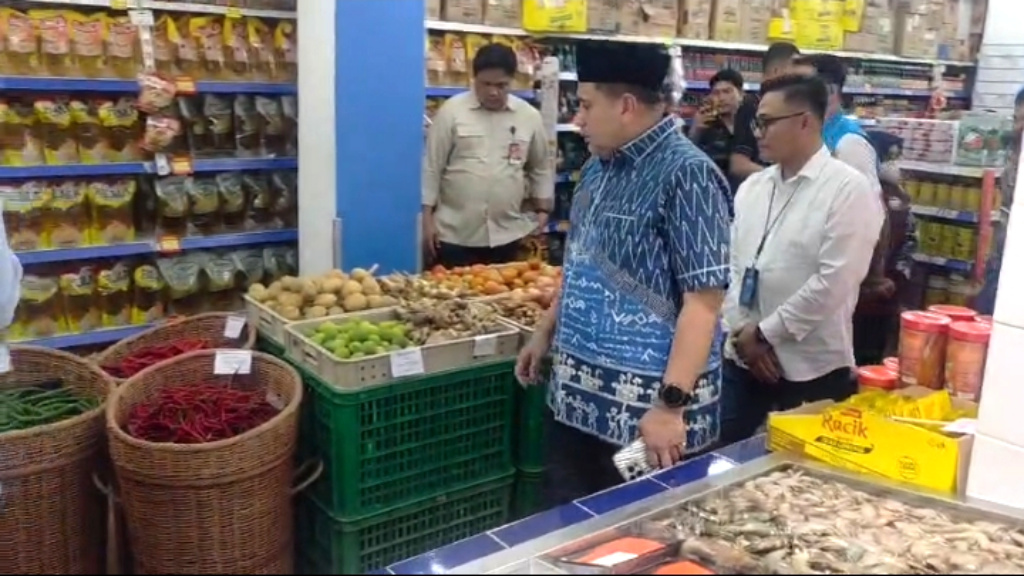
Seven days before Idul Fitri 1447 Hijriah, Makassar Mayor Munafri Arifuddin was not content to remain idle. Dressed in a white shirt and accompanied by his integrated task force, he walked through the lanes of Pabaeng-baeng Market, Tamalate District, on Thursday 12 March 2026, to ensure that basic commodity prices did not skyrocket and stocks remained secure until the Islamic holiday.
The mayor, commonly known as Appi, stopped at each stall. He engaged with vendors, enquiring about the prices of rice, cooking oil, chicken, eggs, and coconuts. The results showed that several commodities remained stable, whilst some had increased and others had decreased.
“Indeed, some prices have risen, but they remain at reasonable levels. The prices that have increased quite substantially are red chillies and large chillies,” Appi told the media after the inspection.
He explained that market activity at H-7 (seven days before the holiday) had not yet shown peak congestion. According to him, a surge in purchases was predicted to occur only in the coming days leading up to the festival.
Interestingly, amid concerns over price increases, there was good news regarding coconut prices. Appi revealed that coconut prices had actually declined. This phenomenon was triggered by an export ban policy that made domestic supplies abundant. “I asked why coconut prices had dropped, and it turned out to be because of an export ban policy. That’s good—supply is plentiful and prices follow suit,” he explained.
Meanwhile, commodities such as shallots and garlic recorded increases in the range of 5 to 10 per cent. However, Appi considered these increases to be within tolerable limits given the increased demand among the public heading towards the Islamic holiday.
Among the many commodities, the mayor’s special attention was directed towards eggs. Appi instructed his team to control the distribution flow of eggs to prevent shortages or unreasonable price spikes.
“Egg consumption will be very high during Idul Fitri. Stock must be carefully maintained, and we will oversee its distribution to keep prices stable,” he stressed.
Regarding the purchasing power of residents, Appi acknowledged that conditions varied. Based on information from traders, some complained of declining sales compared to the previous year, whilst others reported stable or even increasing sales.
“As I see it, overall sales are relatively slightly down. But this is still dynamic, depending on location and commodity type,” he said.
To ease the burden on residents whilst serving as a price control mechanism, Makassar City Government through its Food Security Office is intensifying its cheap market programme. The programme is held daily at nine different locations spread throughout the districts.
“We want to ensure the public has a price reference. With the existence of cheap markets, traditional market vendors have a comparison point, so they cannot arbitrarily raise prices that burden residents,” Appi explained.
He added that the cheap market programme also serves as a government intervention tool to keep market prices under control until the Islamic holiday arrives.
After monitoring the traditional market, Munafri and the integrated supervision team continued their inspection to Hypermart on Boulevard Street, Panakkukang District, and directly checked the implementation of the cheap market at the Panaikang Sub-district Office.
This step ensured that supervision touched not only traditional markets but also modern retail, so food price stability and availability were truly maintained across all channels ahead of Idul Fitri.
“With this synergy, we are optimistic that prices will remain controlled and Makassar residents can celebrate Idul Fitri with peace and happiness,” Appi concluded.
Raw chillies currently reached Rp100,000 per kilogram, up from the previous Rp60,000 per kilogram, or approximately a 25 per cent increase. Class I premium rice, which previously cost Rp14,400 per kilogram, increased to Rp15,200 per kilogram, whilst Class II premium rice rose from Rp14,000 per kilogram to Rp14,800 per kilogram. Beef was sold at Rp140,000 per kilogram, chicken meat at Rp39,000 per kilogram, and chicken eggs at Rp29,000 to Rp31,500 per kilogram. Packaged rice, previously sold at approximately Rp14,000 to Rp15,000 per kilogram, now reached Rp16,000 to Rp17,000 per kilogram. At Pasar Gedhe Klaten market, local medium IR-64 rice remained stable at Rp14,000 per kilogram, whilst Bulog SPHP rice stayed at Rp12,500 per kilogram. One of the most sought-after products was beef sold at Rp100,000 per kilogram, considerably cheaper than market prices. Bulog also ensured the supply of cooking oil remained available.