
Major Decision! Reasons Why Fuel Prices Don't Need to Rise Until Year-End
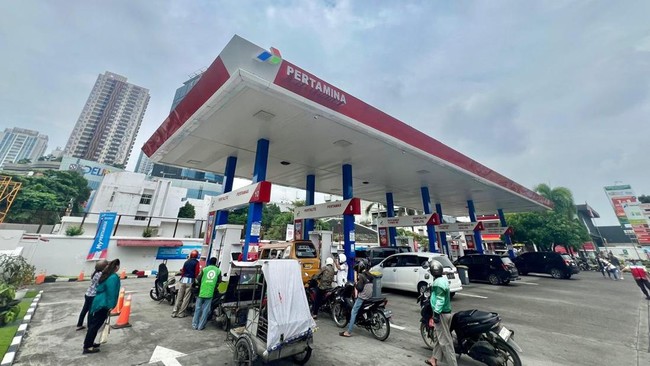
Jakarta, CNBC Indonesia - The Indonesian government announced last week that the prices of subsidised fuels such as Pertalite will not increase. This comes despite the high volatility in global crude oil prices due to the war between Iran and the United States and Israel in the Middle East.
This decision has received approval from the DPR following detailed calculations on state budget resilience by Commission XI and officials from the Ministry of Finance. The calculations respond to President Prabowo Subianto’s directive to his ministers not to raise subsidised fuel prices until the end of 2026.
“We have prepared all the exercises. We discussed with the Minister of Finance, the Director General of Budget, and the Secretary General of the Ministry of Finance to determine how strong we can sustain this subsidised fuel without any increases,” said Chairman of Commission XI Mukhamad Misbakhun on Squawk Box CNBC Indonesia, Tuesday (7/4/2026).
From various simulations calculating the effects of fuel price increases on the economy and the state budget, the government and DPR found that the risks to public purchasing power outweigh the pressures on the state budget. This is because the state budget has been designed to face pressures from rising global crude oil prices up to an average of US$100 per barrel, even though the 2026 macro assumptions only project US$70.
“Because this increase would have an inflationary impact on core inflation components and administered prices; when fuel prices rise, logistics will increase, transportation will increase. It will spread everywhere and this will affect purchasing power,” Misbakhun emphasised.
Therefore, rather than adjusting fuel prices, Misbakhun said the DPR supports the government in optimising the state budget deficit to absorb pressures from global crude oil prices that have exceeded the 2026 macro assumptions. However, he stressed that the deficit will not exceed the safe limit in the State Finance Law of 3% of GDP.
“Because there are many allocations in the state budget that we can modify, meaning we can make them more efficient, use other mechanisms, and then allocate the savings if a situation occurs in the calculation scenarios where the average exceeds US$100,” he stated.
He emphasised that the state budget deficit will not face severe pressure because the conflict also affects the rising prices of Indonesia’s key export commodities, such as coal, nickel, copper, aluminium, and gold. According to him, the rise in export commodity prices will also provide windfall profits for tax revenues.
“Out of 1.2 billion tonnes of global coal trade, 43% comes from Indonesia. If prices rise, how much revenue can Indonesian businesses receive? Of course, we can prepare the government for what? The windfall tax scheme to cover the rest,” said Misbakhun.
With these various schemes, he said the 2026 state budget deficit will indeed increase, but only by around 0.2 percentage points from 2.68% of gross domestic product (GDP) to 2.88% of GDP or approaching 2.9% of GDP. He stated that this deficit increase will raise the government’s debt reserves, which can serve as a buffer to support pressures on subsidised fuel prices due to rising oil prices.
“That means 2.88%, still within a very adequate and safe range to follow the existing law, namely 3%. The 0.2% is Rp200 trillion that we can increase our reserves with. What does that mean? Rp200 trillion will be very capable of supporting the dynamics of fluctuations from price increases,” he explained.
Previously, Finance Minister Purbaya Yudhi Sadewa also emphasised the government’s reasons for holding subsidised fuel prices amid high pressures from global crude oil prices.
He explained that the fuel subsidy policy has been carefully calculated considering various scenarios, including assumptions of global oil prices reaching US$100 per barrel until the end of the year. Based on these calculations, the state revenue and expenditure budget (APBN) deficit remains maintained at around 2.9%.
“Subsidies for fuel will continue until the end of the year and subsidised fuel prices will not rise. Our budget is sufficient,” the Finance Minister asserted.
In addition, the government also has a fiscal buffer in the form of a budget surplus (SAL) of Rp420 trillion that can be used if greater pressures occur, such as uncontrolled oil price surges. However, the government assesses that the likelihood of oil prices remaining high in the long term is relatively small.
The Finance Minister urged the public not to be influenced by speculation regarding the state of national finances. He affirmed that the government’s fiscal capacity is still adequate to support the various policies that have been set.
“The public doesn’t need to worry, our money is sufficient. Every policy given certainly has cost consequences and we have calculated it to be enough,” he asserted.
On the other hand, the Finance Minister explained that the deficit increase at the beginning of the year is a consequence of the government’s accelerated spending strategy. This step is taken to ensure more even economic growth throughout the year, not concentrated at the end as in previous patterns.
“I want to create government spending growth that is almost even throughout the year. So the large deficit is a logical consequence of our policy,” he said.