
Main Issues Behind Recurring Floods in Greater Jakarta
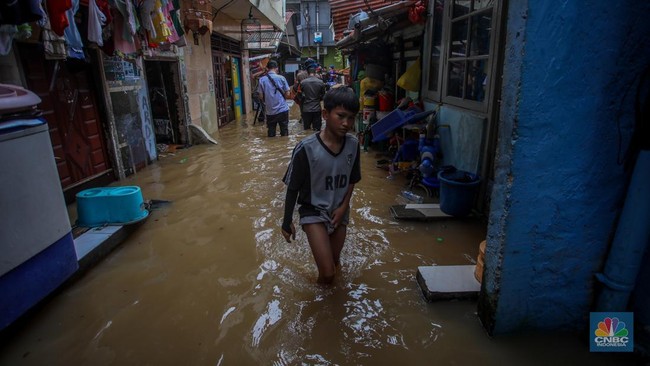
Jakarta – Flooding that frequently occurs during heavy rainfall in the Greater Jakarta region (Jabodetabek) is not solely attributable to high rainfall intensity. However, the government acknowledges that flooding in the Jabodetabek region is also triggered by river conditions experiencing narrowing due to sedimentation as well as rubbish accumulation.
David Partonggo Oloan Marpaung, Head of the Ciliwung Cisadane River Basin Authority, stated that the primary factor causing flooding is actually water discharge exceeding the river’s carrying capacity.
“The first cause of flooding is flood discharge exceeding the river’s carrying capacity,” David told CNBC Indonesia on Monday (9 March 2026).
However, these conditions are worsened by several additional factors hindering water flow.
“This is compounded by sedimentation that reduces the river’s capacity and also rubbish accumulation that obstructs flow,” he stated.
According to him, the combination of high rainfall, river narrowing, and rubbish blockages makes flooding increasingly difficult to control.
“When rainfall causes water discharge to exceed the river’s carrying capacity, and the river narrows due to sedimentation with rubbish obstruction, flooding becomes increasingly severe,” he explained.
To address these issues, his agency continues to strengthen cooperation with regional governments in maintaining river conditions. These efforts include regular river dredging and rubbish cleaning activities.
“We work together with regional governments in rubbish cleaning and also conduct regular river dredging,” David said.
Additionally, an early warning system is being continuously developed to provide faster information to the public. The system utilises rainfall sensors installed in upstream areas to predict water discharge flowing towards downstream regions.
“We install sensors upstream so we can determine how many hours later water will arrive downstream and what the discharge magnitude will be,” he stated.
With this information, the government can implement mitigation measures earlier whilst providing warnings to residents.
“We communicate this mitigation to the public so they can prepare when water discharge begins to increase,” David said.