
Mahfud MD Clarifies Statement on Former Religion Minister Yaqut's Hajj Quota Corruption Case
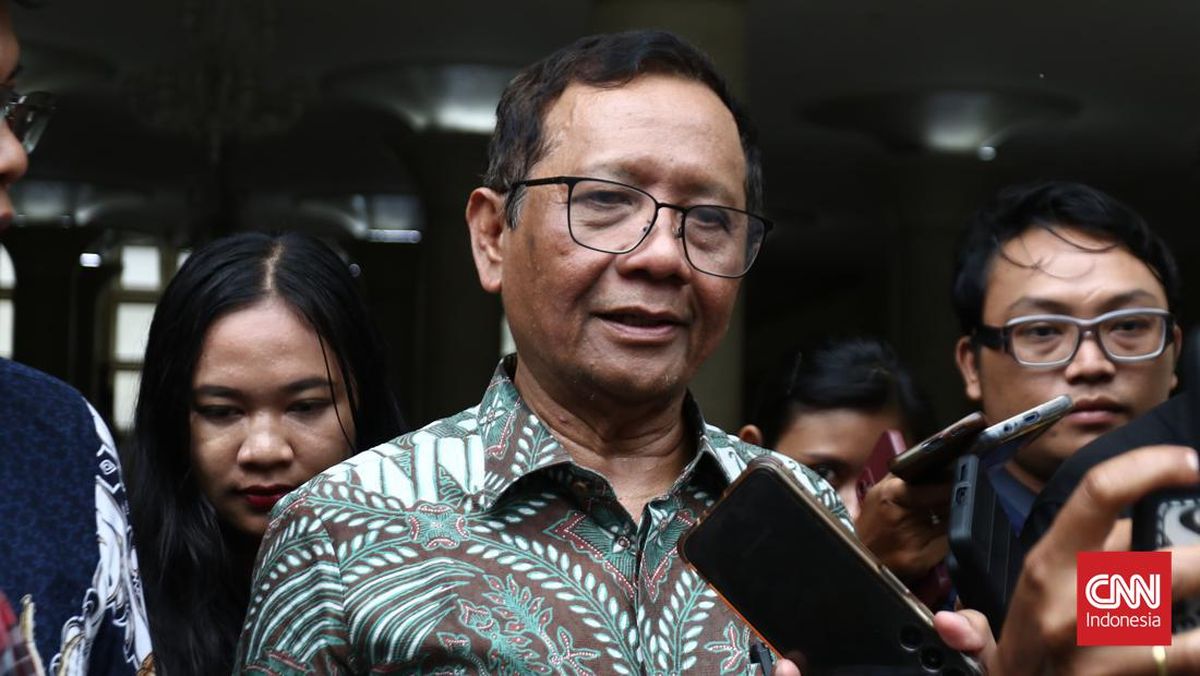
Constitutional law expert Mahfud MD has clarified his statement regarding the pre-trial process filed by former Religion Minister Yaqut Cholil Qoumas against the Corruption Eradication Commission (KPK).
In a press statement issued by Yaqut’s legal team, Mahfud stated that the head of the KPK does not have the authority to designate suspects. Mahfud explained the background of his comments when initially interviewed.
“Here is what happened: a friend called me saying Ansor wanted to pay me a courtesy visit. Since it was Ansor—and I was formally an advisor to Ansor—I said I did not need to discuss legal matters related to the former Ansor chairman, Pak Yaqut,” Mahfud said in a written statement on Tuesday (10 March).
This prompted him to accept the Ansor delegation’s visit. However, Mahfud claimed he was shocked to discover the visitors had brought cameras and wanted to interview him about Yaqut.
“I told them I did not want to discuss Gus Yaqut because my position was already clear. But if you want to have a discussion, let’s do it,” said Mahfud.
During the discussion, Mahfud felt the interviewers appeared biased in favour of Yaqut. He then offered to discuss other matters. Eventually, they were permitted to record only what seemed proportional, unlike the press statement that circulated.
For instance, regarding KPK leadership not having the right to determine suspect status.
“But it seems almost nothing from that interview was published. They took what I said before and cherry-picked parts that seemed to blame the KPK and so forth,” Mahfud said.
Regarding suspect designation, Mahfud explained that under the law, only investigators—not the KPK—have that right. However, the KPK may announce it, so there is no problem since the law specifies this.
“I was asked about this, and I said the KPK leader should not designate suspects; only investigators can do that based on law. Both the new Criminal Procedure Code and the KPK Law state this. If it’s just an announcement, that is fine, as has been done. So I believe it is merely a misperception, and that misperception was constructed,” Mahfud said.
Regarding the hajj quota case, he argued that if the hajj quota from Saudi Arabia’s King was lost or misused, it constitutes state finances. Mahfud emphasised that even if it is not part of the state budget or hajj savings fund, it is provided by the government to the government.
In the Law on State Finance, he reminded, state finance encompasses all rights and obligations that can be measured in money and are administered by the state. Therefore, the hajj quota administered by the state also constitutes state finance.
“Because if it were not the Religion Minister who was entrusted with managing it, it would not be state finance. Because he is the Religion Minister, then it falls under state finance. It does not enter the state budget or regular hajj savings administered separately, but under the law it is classified as state finance,” Mahfud said.
KPK responds
The KPK responded to Mahfud MD regarding the additional hajj quota case involving the Religion Minister under President Joko Widodo. KPK Spokesperson Budi Prasetyo said the hajj quota was provided from government to government.
“The hajj quota is provided from government to government, from nation to nation. So the hajj quota is not given to individuals or travel agencies. So the management rights belong to the state,” Budi told reporters at KPK headquarters on Tuesday (10 March).
Therefore, said Budi, the matter of the hajj quota falls within the scope of state finance.
“And under the Law on State Finance, this also falls within the scope of state finance,” Budi said.
Because of this, said Budi, the State Audit Board (BPK) as the state auditor has also agreed.
In addition to agreeing that the hajj quota is state property, they also agreed that unlawful actions by the parties involved that resulted in alleged state financial losses mean the BPK, as state auditor, would conduct calculations.
From the BPK’s calculation, said Budi, a state financial loss of Rp622 billion emerged.
“Therefore, from the calculation report of Rp622 billion, which we also presented in the pre-trial hearing, this confirms that it falls within the scope of state finance,” Budi said.
Previously, before making his clarification, Mahfud reminded that although corruption is a barbaric act that must be prosecuted firmly, law enforcement must not be arbitrary.
“Everything must be correct and in accordance with regulations,” Mahfud said in a written statement on Sunday (8 March).
Regarding the substance of the case, he also raised concerns about several matters. In his view, the provision of the hajj quota in this case should not be categorised as state financial loss.
“I have been puzzled about this from the beginning. The hajj quota is not state financial loss; it is not appropriate to categorise it as such. There is no state money involved, right?” he said.
Additionally, the policy adopted by Yaqut at the time also, in Mahfud’s view, constituted legitimate discretion based on situational considerations and authority inherent to his office.
Mahfud reminded that if discretion is criminalised, the consequences will be far-reaching: officials will fear making decisions and be reluctant to perform their duties.
“Discretion cannot be criminalised,” said the former Constitutional Court (MK) chairman.
In this case, Yaqut and his special staff member Ishfah Abidal Aziz, alias Gus Alex, have been designated by the KPK as suspects in the alleged additional hajj quota corruption case. However, neither has been detained.
Yaqut is currently undergoing a pre-trial hearing regarding his designation in this case. A single judge at the South Jakarta District Court (PN), Sulistyo Muhammad Dwi Putro, has scheduled the judgment reading for the pre-trial case.