
Machine Learning in Indonesian Banking: From Data Analysis to Future Business Strategies
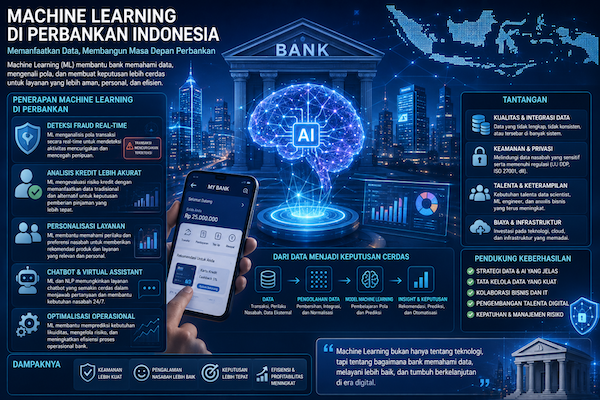
The banking industry is one of the sectors most rapidly propelled towards digital transformation. Changes in customer behaviour, the rise in digital transactions, and competition from fintech companies mean that banks can no longer rely solely on conventional business models.
Amid these changes, machine learning (ML) is beginning to play an increasingly important role.
If a few years ago this technology was largely viewed as an experiment or supplementary innovation, its position is now shifting to become part of the core business strategy in banking.
This is because, for an industry that processes millions of transactions and vast amounts of customer data daily, the ability to read patterns and make predictions is highly valuable.
Machine learning essentially enables systems to learn from data and automatically recognise certain patterns. In the banking context, this capability opens up significant opportunities to improve efficiency, strengthen security, and better understand customer behaviour.
One of the most evident uses of machine learning is in fraud detection systems or digital scams. As online transactions and mobile banking increase, cybercrime threats to the banking sector are also evolving rapidly.
Previously, detecting suspicious transactions relied heavily on static rules; now, machine learning allows systems to recognise unusual transaction patterns in real-time. The system can learn customer transaction behaviours and detect deviant activities, even before losses occur.
In practice, this capability is crucial because digital attack patterns are becoming increasingly complex and often difficult to identify manually.
In addition to security, machine learning is also being used in credit analysis processes. Banks are no longer relying solely on conventional approaches based on loan histories and formal documents. With machine learning, alternative data can be analysed to gain a deeper understanding of prospective customers’ risk profiles.
This approach opens opportunities for the unbanked and underbanked sectors, which previously struggled to access formal financial services.
On the other hand, the use of machine learning also helps banks understand customer behaviour in a more personalised way. Transaction data, service usage patterns, and digital preferences can be analysed to deliver more relevant products and services.
This is what makes current digital banking services feel increasingly personal. Product offerings, service recommendations, and marketing communications are beginning to be tailored to each user’s characteristics.
However, the development of machine learning in Indonesian banking is not just about technology. Far more important is the change in how the industry views data.
Previously, data was often positioned as operational archives; now, data is beginning to be seen as a strategic asset that can aid business decision-making.
This shift is driving banks to strengthen investments in data infrastructure, cloud computing, and digital talent development.
Nevertheless, implementing machine learning in the banking sector also faces significant challenges.
One of the main challenges is data quality and integration. Many financial institutions still have data scattered across various systems and not fully integrated. Yet machine learning heavily depends on the quality of the data used.
Additionally, data security and privacy issues are also critical. The banking industry handles highly sensitive data, so the use of AI and machine learning must go hand-in-hand with strengthened governance and regulatory compliance.
In the Indonesian context, the enactment of the Personal Data Protection Law (UU PDP) makes data management even more crucial.
Another issue is talent. Developing machine learning requires a combination of technological skills, analytics, and strong business understanding. Amid global competition for AI talent, the demand for human resources in the financial sector is growing much faster than the supply.
However, despite these various challenges, the direction of industry development appears clear. Machine learning is expected to become increasingly integrated with banking services in the future.
This technology is no longer just used for automation but also to support faster and more accurate decision-making.
In fact, in the coming years, the combination of machine learning, generative AI, and data analytics is expected to shape financial service models that are far more personal and predictive.
In the context of industry competition, the ability to leverage data will be the main differentiator between adaptable banks and those left behind.
Ultimately, the development of machine learning in the banking sector demonstrates one important thing: the future of the financial industry is no longer determined solely by the size of assets or the number of branches, but also by the ability to understand data and transform it into business value.
And in the digital era, that capability is increasingly determined by machine intelligence.