
Machine Learning in Data-Driven Industrial Transformation
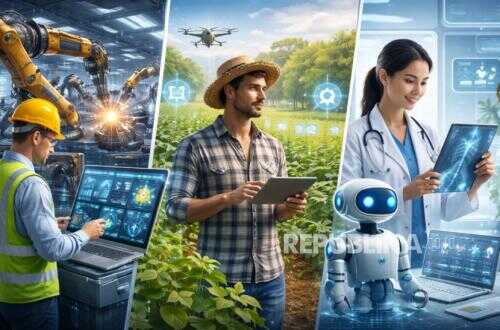
Technology-based data development has transformed how industries operate and make decisions. Machine Learning has become one of the key innovations in this process, capable of processing large volumes of data to generate patterns, predictions, and more accurate recommendations. Its presence is no longer viewed as a future technology, but rather as the foundation of digital transformation strategies across various sectors.
Industrial transformation demands both technological readiness and adaptive human resource competence. Consequently, the utilisation of Machine Learning has become a strategic step in enhancing efficiency, competitiveness, and service quality in an increasingly competitive digital era.
Implementation of Machine Learning across various industrial sectors
Machine Learning has become an important part of modern industrial operations. This technology helps companies increase efficiency, reduce risk, and produce more accurate decisions through structured data analysis. Its application has become evident across various strategic sectors.
In the manufacturing industry, Machine Learning is used for predictive maintenance and quality control based on computer vision. Meanwhile, in the agricultural sector, this technology supports precision agriculture through weather data and soil condition analysis. In healthcare, machine learning systems assist medical imaging analysis and patient data processing, making the diagnostic process faster and data-driven.
Although its application has become increasingly widespread and demonstrates significant impact, implementation does not always proceed without obstacles. Human resource readiness, data quality, and technology infrastructure are important factors that determine the success of industrial transformation.
Why does Machine Learning implementation still face challenges?
Although its potential is significant, Machine Learning implementation does not always run smoothly. One of the main challenges is the quality and availability of data that remains non-standardised. Without clean and structured data, systems cannot produce optimal analysis. This often becomes an initial barrier in the digital transformation process.
Additionally, human resource readiness is also a crucial factor. Not all organisations possess experts capable of managing and developing artificial intelligence-based systems sustainably. On the other hand, the need for adequate technology infrastructure requires considerable investment, so adoption is still being conducted in stages.
Therefore, an integrated strategy is required that strengthens competence, ensures technology readiness, and manages data so that transformation can run effectively and sustainably.