
M4CR Programme Strengthens Mangrove Rehabilitation in Kalimantan
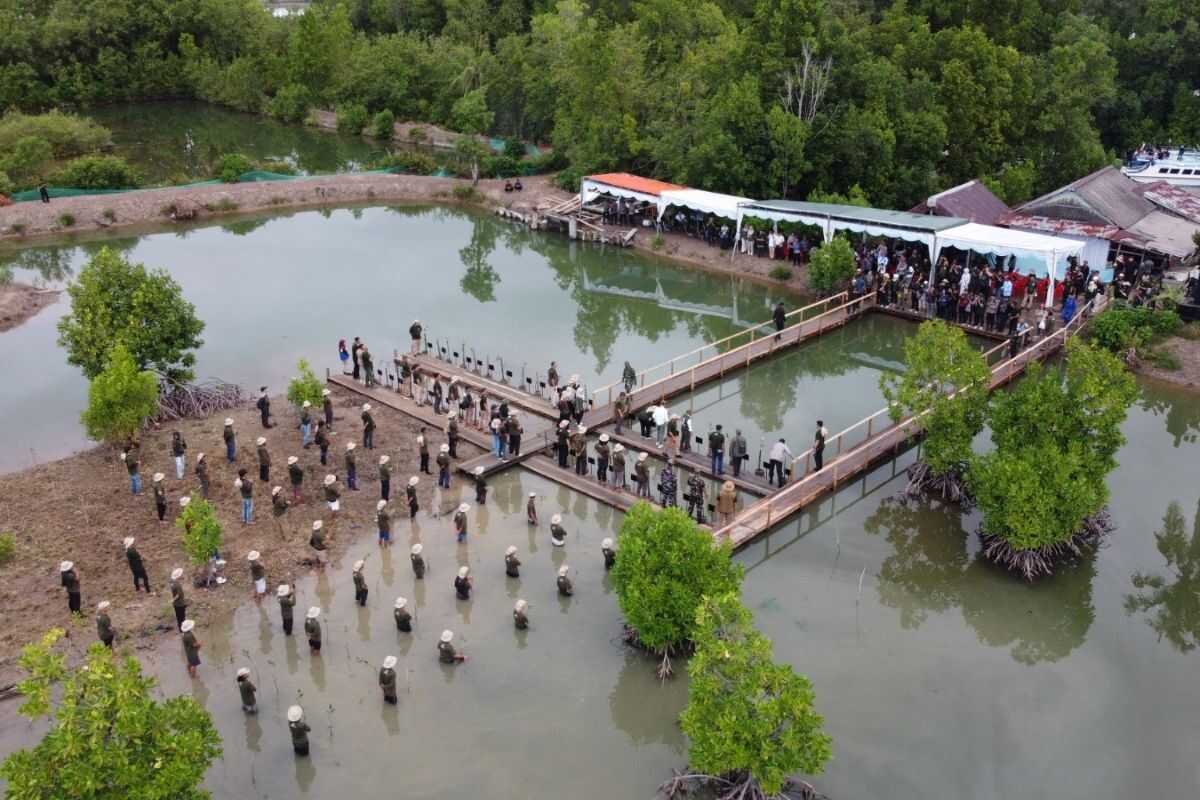
The Ministry of Forestry through the Directorate General for Watershed Management and Forest Rehabilitation (PDASRH) continues to strengthen the rehabilitation of mangrove ecosystems in coastal areas through the Mangroves for Coastal Resilience (M4CR) programme.
The Director of Mangrove Rehabilitation at PDASRH, Nikolas Nugroho Surjobasuindro, emphasised that mangrove rehabilitation must be conducted with approaches that not only focus on ecological aspects but also consider the sustainability of coastal community livelihoods.
“Mangrove rehabilitation aims not only to restore coastal ecosystems but also to ensure communities can continue economic activities sustainably. The silvofishery approach allows mangroves to regenerate without disrupting aquaculture operations,” he stated.
The M4CR programme in North Kalimantan, supported by the World Bank, targets mangrove rehabilitation covering 5,579 hectares by the end of 2026. The initial phase began through the signing of Cooperation Agreements (SPKS) with 11 community groups in Bulungan and Tana Tidung Districts for mangrove planting across 653 hectares of fishpond areas.
The M4CR Manager for North Kalimantan stated that the cooperation represents the initial step for field implementation of the programme.
“We ensure all phases proceed according to technical standards and established area targets, whilst considering group readiness and local conditions,” they explained.
The silvofishery approach permits rehabilitation without halting community aquaculture activities. The Mahakam Berau Watershed Management Centre (BPDAS) assessed that this pattern can maintain balance between environmental recovery and economic productivity.
“Mangrove rehabilitation can proceed alongside fishpond business sustainability. Mangroves grow, and aquaculture activities continue,” they noted.
Cumulatively, mangrove rehabilitation in North Kalimantan has reached 6,543 hectares, involving 45 community groups and 2,115 coastal residents, with planting of over 5.6 million mangrove seedlings.
In East Kalimantan, the programme focuses on the Mahakam Delta coastal area through integration of mangrove rehabilitation and community capacity strengthening. The M4CR Manager for East Kalimantan, Asman Azis, described the programme as showing tangible results.
“For 2026, our target for East Kalimantan M4CR achievement is planting 2,813 hectares in Kutai Kartanegara and 262 hectares in Berau, livelihood demonstration plots for 24 community groups, silvofishery demonstration plots for 10 groups, and distribution of matching grants to 24 community groups,” Asman stated.
The programme benefits are directly felt by coastal communities. The Chair of the Pesona Wanita Pesisir Processing and Marketing Group (Poklahsar) in Saliki Village, Hj. Suliati, stated that matching grant assistance helped increase her group’s business capacity.
“We are grateful to M4CR for providing capital assistance of 150 million rupiah for our group’s business. We used this assistance to renovate our production facility and purchase equipment to support our shrimp processing operations,” she explained.
Through participatory approaches integrating ecological and economic interests, the M4CR programme is expected to accelerate mangrove ecosystem recovery whilst strengthening coastal resilience and community welfare.
The Directorate of Mangrove Rehabilitation is strengthening efforts to build coastal area resilience through engaging youth via the Mangrove Goes To School (MGTS) programme. The programme aims to foster environmental awareness and concrete action to create a healthier, more sustainable, and viable future for coming generations.
MGTS participants not only learn theory but also directly observe the application of conservation technologies through the launch of the Mandara Platform managed by the Ministry of Environment and Forestry.
In addition to mangrove rehabilitation, this tool, registered as a simple patent since September 2025, can also be used for planting other mud vegetation. PLN, through its PLN Cares programme, planted 72,400 mangroves along the coasts of Semarang and Demak to combat erosion, support food security, and achieve Net Zero Emissions.