
LTKL Launches Synergy to Create Sustainable Districts That Prosper Communities
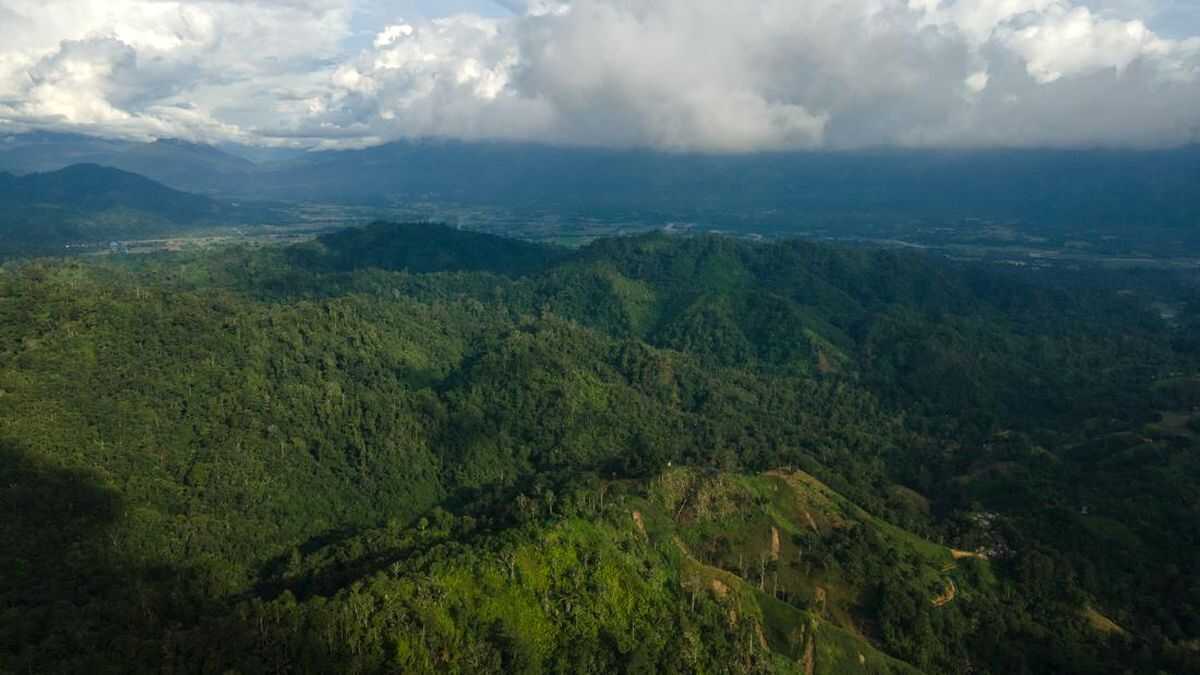
Nine districts organised within the Sustainable District Forum (LTKL) have pledged to collaborate in realising sustainable districts that protect the environment and improve community welfare through multi-stakeholder approaches.
This collaboration aims to achieve restorative economics—an economic model that grows and regenerates—based on the conviction that natural resources form the foundation of long-term prosperity.
Moh. Rizal Intjenae, LTKL Chair and Regent of Sigi, Central Sulawesi, stated that extractive, exploitative, and short-term-oriented economies are no longer relevant to current development contexts. He argued that this old model increases vulnerability, worsens crises, and endangers the present generation.
“Districts organised within the Sustainable District Forum recognise this and have decided to move and transform. We are shifting from fragmented approaches towards a shared vision that places sustainability at the mainstream of development. This transformation is not merely a policy change, but a change in how we think and work,” said Rizal.
In implementation, LTKL applies the restorative economic model through five core principles: ecological boundaries, protection and restoration, value creation from the economic model, inclusivity and adoption of local culture, and data-and science-based approaches.
Under the LTKL framework, districts including Sigi, Siak in Riau, and Sintang in West Kalimantan are building nature-based local economic systems and strengthening cooperation among government, communities, business, academia, and media.
In Siak, there is peat-friendly product innovation and the SKELAS creative business incubator driven by local youth. Since 2023, SKELAS has incubated 27 local and sustainable businesses. One example is Pinaloka, a pineapple production centre working with local farmers to cultivate pineapple on peatland using sustainable agricultural methods.
Pinaloka now produces various derivative products and has received support from Bank Indonesia. There is also peat-based innovation involving 160 residents across three villages, 34 research projects, and affecting 76,744 hectares of peatland. Albumin products from sustainably farmed toman fish are now sold in 141 pharmacies.
In Sintang, an area that suffered severe flooding years ago, forest restoration enterprises have emerged. Local communities now process tengkawang, honey, and other forest commodities.
Meanwhile in Sigi, residents cultivate coffee, cocoa, vanilla, and non-timber forest commodities in agroforestry systems whilst maintaining forest cover. The supply chain is described as complete, from farms through processing mills to national markets, with innovative financing schemes.
Additionally, LTKL operates in other member districts including Aceh Tamiang, Musi Banyuasin, Sanggau, Kapuas Hulu, Gorontalo, and Bone Bolango. LTKL continues to promote signals of restorative economic change through entry points tailored to each district’s potential.
Blueprint for Sustainable Indonesia Districts
The year 2030 has been set as the transformation target for LTKL members to become sustainable districts capable of managing natural resources and land management sustainably, and self-sufficient districts with fiscal independence and adequate human resource capacity.
In this regard, LTKL serves to help members discover sustainable and self-sufficient district models based on each district’s characteristics, potential, and resources.
LTKL itself targets producing a Sustainable Indonesia Districts Blueprint by 2030 as guidance for sustainable development adaptable by other districts across the archipelago. Ristika Putri Istanti, LTKL Secretariat Head, stated that the blueprint will be designed for study, adaptation, and development according to each region’s character, not to be copied wholesale.
“Given the massive loss of forests and critical ecosystems and occurrence of major disasters causing significant losses, the time has come for us to think about what appropriate solutions are. At LTKL, we are building concrete evidence (district proof) that when we protect our natural foundation and regenerate our land through innovation, multi-stakeholder collaboration, and human resource strengthening,” said Ristika.
LTKL demonstrates that large-scale change does not always come from the capital or major institutions. With a vision towards 2030, this movement is not only a district forum but also a realised imagination—that development can be humane with nature as the source of prosperity, and Indonesia’s future built from the ground up in a sustainable manner.
Various LTKL initiatives have received international recognition. One example is the Big Bets Fellowship held by The Rockefeller Foundation, which identified LTKL as an initiative with potential to become a proven solution with significant impact if scaled (proven solution).
“This is an economy that restores ecosystems, restores community dignity, respects nature’s boundaries, and ensures human prosperity,” concluded Ristika.