
LPS Chief: Forced Spin-Off of Islamic Banking Units Should Not Be Compulsory
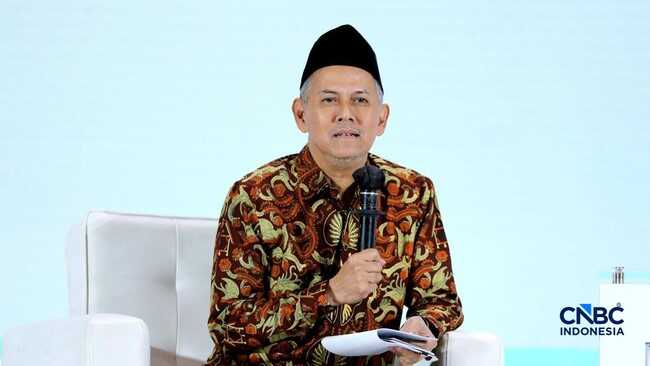
Jakarta - The Chair of the Board of Commissioners of the Deposit Insurance Corporation (LPS), Anggito Abimanyu, has expressed the view that the separation or spin-off of Islamic banking business units should not be forced upon banks. According to him, forced spin-off could “stunt” the scale of Islamic banking operations if not accompanied by capital strengthening.
Anggito referenced the findings of his own research, stating that the spin-off policy is not necessarily conducive to making Islamic banks healthier and more competitive. Rather, Islamic banks forced to spin off could end up with a smaller scale and face difficulties in developing further.
“That is what I disagree with. My research findings suggest [the spin-off policy] will not be healthy for Islamic banking units; it will stunt their growth. Unless they will be merged into one,” he said during the 99 Indonesian Islamic Economists Seminar 2026 themed “Mainstreaming Islamic Economics as a New Pillar of National Economic Growth” at the Menara Bank Mega Auditorium, Jakarta, on Tuesday (24 February 2026).
The former Deputy Minister of Finance gave the example of Saudi Arabia, where not all banks operate under Islamic principles. However, Islamic banking units (UUS) of conventional commercial banks (BUK) there develop more robustly than Islamic commercial banks (BUS). Rather than spin-offs from conventional banks, Islamic units in Saudi Arabia are instead strengthened.
“In Saudi Arabia, that is not how it works. Not all banks there are Islamic. In fact, Islamic units are larger than Islamic commercial banks, with conventional banking at 21%. They are not forced to spin off either. Unlike here, it is not mandated. Let them just operate,” Abimanyu said.
He subsequently stated that the Indonesian government must intervene directly if it wishes to develop Indonesia’s Islamic banking market share, which currently stands at only 9%.
Such intervention could include encouraging mergers of Islamic units to increase their scale. Abimanyu cited the government’s direct involvement in promoting the merger of three state-owned Islamic banks—PT Bank Syariah Mandiri, PT Bank BNI Syariah, and PT Bank BRI Syariah Tbk.—into PT Bank Syariah Indonesia (Persero) Tbk. (BRIS). He also referenced the spin-off of the Islamic unit of PT Bank Tabungan Negara (Persero) Tbk. (BBTN) and its merger with PT Bank Victoria Syariah to form PT Bank Syariah Nasional (BSN).
Abimanyu further suggested that Islamic bank mergers could be extended to Islamic units owned by Regional Development Banks (BPD) and Islamic People’s Credit Banks (BPRS).
On another note, Abimanyu stressed that strengthening Islamic banking does require strong government involvement. Nevertheless, he cautioned that policy should not focus solely on institutional separation, but should also consider capital readiness and business sustainability.
“I have been thinking, for instance, about Islamic BPDs. If they were merged, their combined assets would exceed Rp100 trillion. Islamic BPRs currently struggle to develop because their controlling shareholders are unwilling to inject capital. This is especially challenging for Islamic BPDs, which require approval from governors, regents, other shareholders, and regional legislative bodies. Government involvement is essential,” Abimanyu explained.
Despite this, he, as a member of the Financial Sector Stability Committee (KSSK), has not yet formulated plans to submit proposals to other KSSK members or the Financial Services Authority (OJK), which regulates Islamic banking unit spin-offs.
“In essence, the spin-off policy differs from separation policies in other countries. Based on my research, such a policy is not sufficiently justified. Particularly when there is no commitment from shareholders. If spin-off occurs, the resulting entity becomes smaller. It is better to consider what I mentioned earlier—mergers and so on,” Abimanyu told reporters following the event.
He added that, based on his research, Indonesian Islamic banking units are better left to grow organically. “If spin-off results in a small Islamic bank, it will ultimately lack competitiveness either.”
The OJK mandates that Islamic units with assets reaching 50% of their parent bank’s total assets and/or having minimum assets of Rp50 trillion must spin off. This requirement is outlined in OJK Regulation (POJK) No. 12/2023 concerning Islamic Banking Units.