
LPG Imports Reach 81%, BPH Migas Promotes CNG for Households
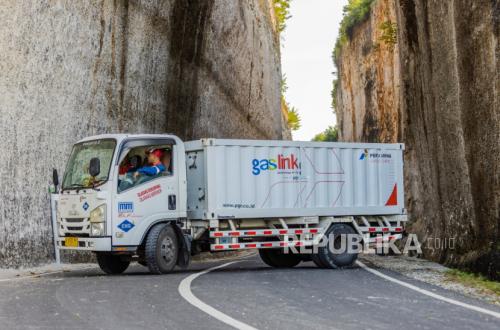
The Badan Pengatur Hilir Minyak dan Gas Bumi (BPH Migas) is beginning to promote the use of Compressed Natural Gas (CNG) and mini-Liquefied Natural Gas (LNG) as alternative household energy sources. This step is being taken due to the high dependence on Liquefied Petroleum Gas (LPG) imports nationally, which have reached around 81 per cent of total domestic needs.
BPH Migas Committee Member Fathul Nugraha stated that household energy needs are currently dominated by subsidised LPG. This situation is seen as causing the burden of imports and energy subsidies to continue increasing year on year.
“So, it’s not limited to LPG alone, but there are options to use city gas networks based on CNG and LNG. These energy choices can also improve the effectiveness of gas distribution and support the government’s targets in converting to safer, cleaner, and more efficient energy,” said Fathul Nugraha when appearing as a speaker at the 11th LNG Supply, Transport & Storage Forum 2026, held alongside the 3rd Small LNG Shipping & Distribution Forum in Bali, quoted on Sunday (10/5/2026).
According to him, optimising CNG mother stations and building mini LNG infrastructure will open up more energy options for the public besides LPG. This step can also strengthen national energy resilience while supporting household energy diversification.
Fathul views the development of CNG and LNG for households as aligning with President RI Prabowo Subianto’s Asta Cita, particularly in promoting national energy self-sufficiency and the utilisation of domestic energy.
“Minister of Energy and Mineral Resources Bahlil Lahadalia also stated that CNG is a gas different from LPG, but it has a similar function as an energy source. The utilisation of CNG is now also starting to be used in the commercial sector such as hotels and restaurants,” he said.
In the Rencana Pembangunan Jangka Menengah Nasional (RPJMN) 2025-2029, the government targets the construction of household natural gas networks to reach 350,000 household connections (SR) by 2029. To achieve this target, BPH Migas is pushing for the acceleration of regulations related to CNG mother stations and mini LNG terminals so that investments can enter more quickly.
The public-private partnership (KPBU) financing model is also seen as important to support gas infrastructure development, especially in eastern Indonesia, which faces geographical challenges.
“To expand the reach of household gas using CNG, it can be done through the conversion of Gas Fuel Filling Stations (SPBG) into mother stations. Meanwhile, for non-pipeline household gas distribution, mini-LNG can be used,” said Fathul.
PGN Gagas, a subsidiary of PGN, welcomes the Ministry of Energy and Mineral Resources’ step in studying the utilisation of CNG as part of the national energy mix. The company views this study as a momentum to expand the measured utilisation of domestic gas.
PGN Gagas sees the development of CNG as aligning with the government’s policy direction in strengthening energy resilience. These efforts are aimed at providing more diverse energy options for the public and business actors.
“We see this not as replacing one energy with another, but expanding choices. The public and business actors need access to diverse, reliable, affordable energy sources based on domestic resources,” said PGN Gagas President Director Santiaji Gunawan in Jakarta on Thursday (30/4/2026).
For more than a decade, PGN Gagas has supplied CNG to various segments, from industry, commercial, SMEs, to transportation. Throughout 2025, natural gas supplies through CNG and LNG services reached around 4,656,449 MMBTU.
In terms of infrastructure, the company operates 14 Gas Fuel Filling Stations (SPBG) spread across seven provinces. These services serve an average of 2,200 vehicles per day through the Gasku programme.
For the non-transportation segment, the Gaslink service has reached more than 600 customers from industry, commercial, and SME sectors, with total supplies reaching 4,067,002 MMBTU throughout 2025.
“CNG is one of the energy options that is already available and can continue to be developed gradually in line with government policy directions,” said Santiaji.
PGN Gagas is also supported by gas compression facilities, gas transport module (GTM) fleets, and other integrated distribution infrastructure with the PGN network. This is seen as strengthening the optimal utilisation of domestic natural gas.