
LPEI States Export Activities Remain Stable Amid Geopolitical Turmoil
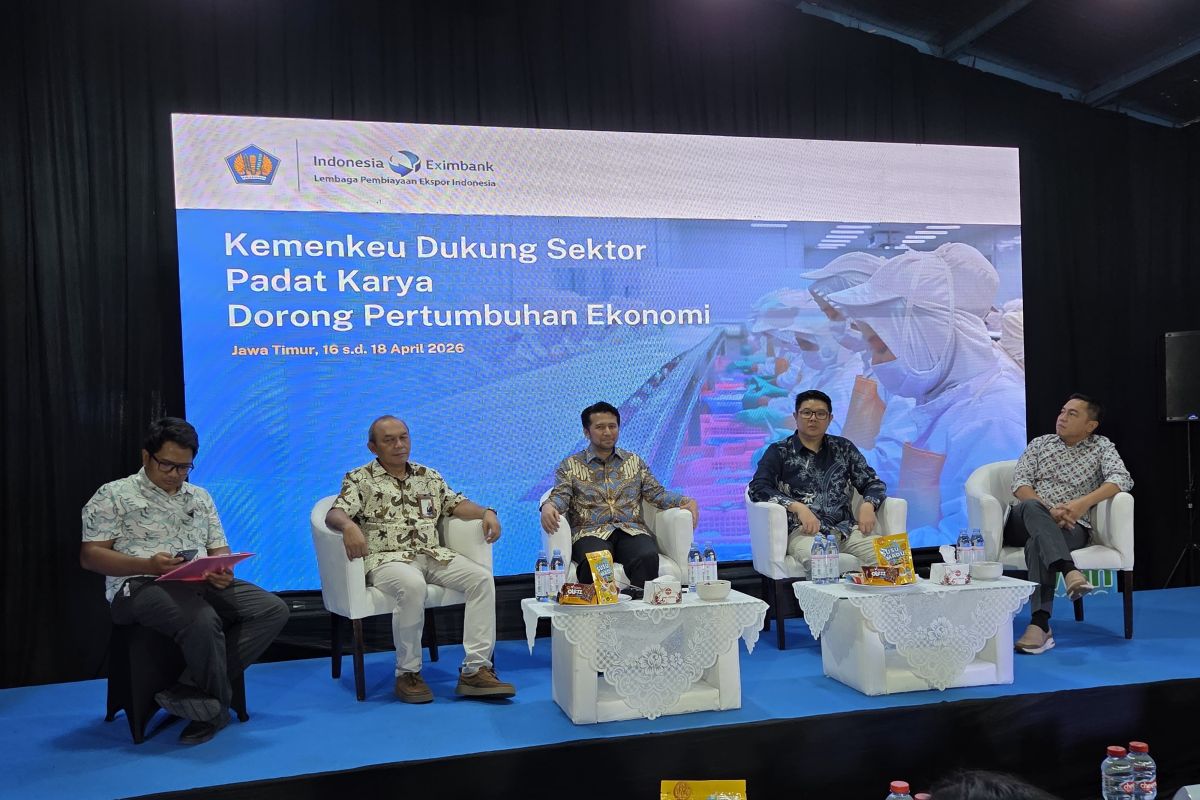
Nganjuk, East Java (ANTARA) - Indonesia Eximbank (LPEI) Business Executive Director II, Sulaeman, stated that national export activities remain stable amid the geopolitical turmoil affecting the region.
As is known, the conflict in the Middle East has triggered several disruptions in global trade, including shortages of plastic raw materials due to the crisis in the Strait of Hormuz and pressure on the rupiah’s exchange rate.
“Up to the latest position, all the pipelines we have are still ongoing and running well,” Sulaeman said during a media visit event in Gresik, East Java, on Friday.
To maintain export performance, LPEI relies on the Special Export Assignment (PKE) programme, which provides comprehensive financing support from the pre-export to post-export stages, as well as guarantee facilities for business actors.
Additionally, LPEI is taking anticipatory measures through stress testing of its export financing portfolio to identify the most affected sectors and debtors, particularly those with exposure to the Middle East region.
Amid the current geopolitical uncertainty, LPEI is also monitoring the impact of global supply chain disruptions and the weakening rupiah, which could potentially affect debtor performance.
Various mitigation measures have been prepared, including ensuring the selection of financing products with clear underlying transactions, both for pre-shipment and post-shipment financing.
Sulaeman further detailed that LPEI’s primary mandate is to boost national exports through two financing schemes: PKE and commercial financing, with the current focus on the PKE scheme.
Each financing under the PKE scheme has a significant multiplier effect, where every Rp1 disbursed can create up to three times the developmental impact.
Overall, the value of PKE financing currently stands at Rp13.7 trillion, spread across six programmes and seven projects.
By 2025, the PKE Trade Finance facility has a total limit of Rp3.35 trillion, with realisations reaching Rp7.68 trillion throughout the year.
The processed food sector is the largest contributor to the portfolio, accounting for 39% or covering 31 debtors. Overall, the programme has reached 18 industrial sectors, including rubber, coffee, furniture, footwear, textiles, jewellery, tea and spices, to electronic products.
“In addition to providing financial support to business actors, PKE Trade Finance also plays a role in driving developmental impacts. Throughout 2025, PKE Trade Finance disbursements have contributed to the creation and/or savings of foreign exchange amounting to Rp21.12 trillion,” he said.
Nevertheless, Sulaeman reminded business actors to remain vigilant against the ongoing impacts of global turmoil, particularly the rise in raw material prices that could pressure margins, especially in the manufacturing sector.
LPEI itself has prepared various mitigation scenarios and is being more selective in determining financing sectors deemed relatively safe under current conditions.
On the same occasion, President Director of PT Mega Global Food Industry (Kokola Group), Richard Cahadi, stated that LPEI’s financing support plays an important role in maintaining production continuity amid global supply chain disruptions.
He explained that the Middle East conflict has triggered a rise in plastic raw material prices due to disrupted naphtha supplies, so the company must ensure the availability of packaging materials to prevent production halts.
In this regard, the PKE financing scheme helps maintain the company’s liquidity, especially when suppliers implement upfront payment systems.
“If we were not supported by LPEI, we would definitely face cash flow difficulties to buy raw materials first. Plastic raw materials are petroleum-based, where the supply chain is indeed disrupted. Our main task as a supplier is to secure that first. And one of the benefits is being supported by LPEI,” said Richard.