
LPDP Director Recommends Government Officials' Children Take 'Partial Funding' Scholarships
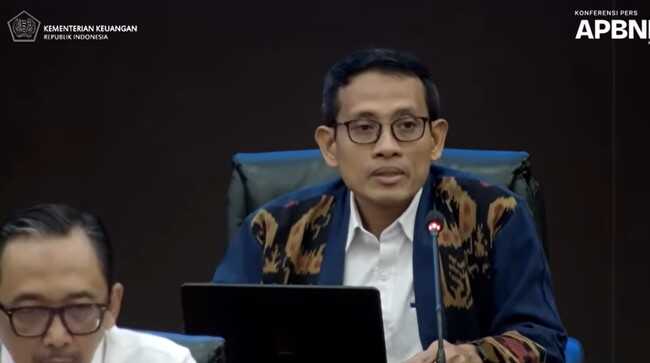
Jakarta — The acting director of the Education Fund Management Institution (LPDP), Sudarto, has recommended that affluent families, public figures, and government officials’ children apply for scholarships through the partial funding route rather than full funding schemes.
The statement was made in response to widespread public criticism regarding numerous government officials’ children and public figures receiving full LPDP scholarships.
“Regarding government officials’ children, they are welcome, though I don’t wish to comment on individuals. We provide opportunities through what is called partial funding. If they wish to contribute 50%, we can offer opportunities there. Partial funding involves discussion between us,” Sudarto said during a media briefing on Thursday (26 February 2026).
Partial scholarships are general scholarships for master’s and doctoral levels available to Indonesian citizens under a co-funding scheme between LPDP and the scholarship recipient.
Sudarto explained that all segments of Indonesian society are entitled to become LPDP scholarship recipients, including government officials’ children.
According to him, LPDP’s core principles are inclusivity and meritocracy, not family background. Additionally, LPDP’s mandate is not merely to finance individual education, but to develop superior talent capable of driving Indonesia’s economic growth significantly.
“What Indonesia needs, for digital economy to grow rapidly, is more than 1-2% of the workforce who can become content creators with innovative and disruptive thinking that can change our working methods and generate advanced Indonesian innovations,” Sudarto said.
Therefore, Sudarto emphasised that scholarships are open to all citizens as long as they meet the criteria.
“All our children have opportunities; they must compete, so we provide equal chances,” he said.
Sudarto also noted that not all Indonesian children have equal opportunities from the start. Therefore, scholarships are designed to be inclusive across all societal levels, including children from Papua, disadvantaged regions (3T areas), and underprivileged families through affirmative action schemes.
Under affirmative action schemes, several requirements are made more flexible, such as English language proficiency, age, and grade point average. This policy is based on the understanding that access barriers do not always reflect intellectual capacity.
“For Papuan children specifically, from 3T regions and underprivileged families, they do not need to meet the same requirements as general applicants. They typically do not need English language requirements with GPAs far below what is usually required, and age requirements are flexible. We understand that not all Indonesian children have equal opportunities, yet many are very likely highly intelligent, top of the top,” he said.
Based on LPDP data, the proportion of recipients from affirmative action regions has increased steadily over the past three years. The institution’s internal policy sets a minimum of 30% of recipients from affirmative action pathways.
It was noted that thousands of recipients come from 127 priority districts, underprivileged families, and native Papuan sons and daughters.
“The accumulated figure now reaches 25% over the past three years. We have set a policy at LPDP for a minimum of 30% in accumulated terms. Why? This must be inclusive for all top Indonesian children,” he said.