
Lower growth target, higher stakes: Key signals as China’s Two Sessions open
analysis East Asia
Lower growth target, higher stakes: Key signals as China’s Two Sessions open
From a lower growth target to bigger bets on technology and consumption, China’s Two Sessions open with a sober assessment of economic challenges and a recalibration of policy priorities.
BEIJING: The lowest economic growth target since 1991. Public spending set to surpass 30 trillion yuan (US$4.3 trillion). And a rare candid admission that 2025 had been one of China’s hardest years in recent memory.
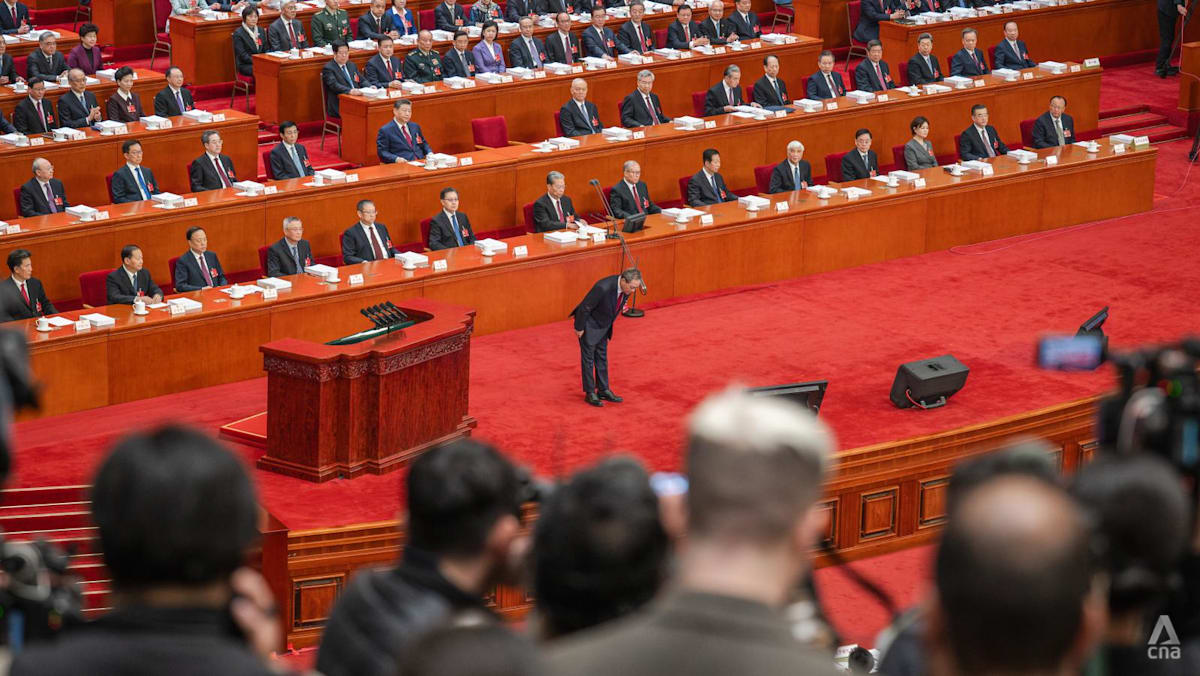
The country’s most important political event kicked off this week under heavy grey skies and snow - bringing together thousands of delegates from provinces, autonomous regions and municipalities.
Delivering the annual government work report on Thursday (Mar 5), Premier Li Qiang laid out Beijing’s economic and policy priorities for 2026 - while also acknowledging persistent headwinds from weak domestic demand, a struggling property market and rising geopolitical risks.
“Rarely have we encountered such a grave and complex landscape, where external shocks and challenges were intertwined with domestic difficulties and tough policy choices,” Li said.
This year’s gathering notably carries added significance as the world’s second-largest economy embarks on its ambitious 15th Five-Year Plan, the sweeping policy blueprint that will shape its economic and social development through 2030.
Against that backdrop, several themes stand out from the opening day of the National People’s Congress (NPC).
ECONOMY: QUALITY OVER QUANTITY
China cut its annual economic growth target to a range of 4.5 to 5 per cent - the first downgrade since 2023 and its lowest since 1991 - signalling more than a modest trimming of ambition.
Analysts said it marks a deliberate, more pragmatic shift from Beijing to better match economic realities.
Dong Ximiao, chief researcher at Merchants Union Consumer Finance, said the range should not be read as a retreat.
“This does not mean abandoning growth,” he told CNA, also noting that the lower bound of 4.5 per cent must be “firmly safeguarded as the bottom line” for stabilising employment and ensuring a strong start to the five-year plan.
The lower range instead reflects a move “from a ‘speed-first’ approach to a ‘quality-first’ approach”, Dong said - creating room for industrial upgrading, green transformation and risk resolution that a rigid higher target would not allow.
Li himself spoke about the pressures driving that reset.
“Some enterprises are facing difficulties in their operations and it is more challenging for people to secure employment and earn more,” he said.
Xu Tianchen, a senior economist at the Economist Intelligence Unit in Beijing, said that policymaking is increasingly about delivering results that “people really want”, citing income increases, access to public services and human capital development.
He also pointed to exports as an underappreciated support for this year’s target - particularly the rise of AI-related goods, from components to infrastructure equipment.
“(China’s) AI story could last for quite a while,” Xu said.
Gary Ng, a senior economist at Natixis, said this year’s lower target sent two clear messages.
“The Chinese government has accepted the reality that growth is decelerating further than expected - and it also signals the amount of capital it is willing to inject into its economy in the short term,” Ng said.
Even as spending remains elevated, discipline will be tightened, said Li, addressing delegates in the Great Hall of the People.
“Every cent we save must be spent on solving critical development problems and meeting people’s urgent needs,” he said.
The 2026 government work report lends weight to both points.
On deceleration, Li acknowledged that “consumption and investment lacked adequate growth momentum” in 2025 and that the economy faced an “imbalance between strong supply and weak demand”.
On the stimulus scale, the report’s fiscal settings tell their own story: while the deficit-to-GDP ratio holds at 4 per cent and spending will break the 30 trillion yuan threshold for the first time, the report stated that room has been left for “structural adjustments, risk prevention and reform”.
To channel more precise spending, Beijing has created a new special fiscal-financial coordination fund of 100 billion yuan to facilitate domestic demand expansion - while 4.4 trillion yuan in local government special-purpose bonds have been earmarked mainly for major projects and debt replacement.
Lin Han-Shen, China director at The Asia Group, said the report was “surprisingly candid” - that consumption had been a problem rather than a strength in 2025.
He said the frank admission that demand had lagged set a deliberately low baseline - one that reflected a clear-eyed assessment of where China’s economy actually stood rather than where Beijing might wish it to be.
MORE INCOME, MORE SPENDING
What’s clear as well is that Beijing is putting fresh focus on household spending as external demand comes under pressure.
Li said the government will roll out an income growth plan for urban and rural residents.
Measures will aim to raise low-income earnings, increase property income and improve wages and social security. Support for childcare, elderly care and housing will also be strengthened.
To boost consumption directly, the government will set aside 250 billion yuan this year for consumer goods trade-in programmes.
That is lower than the 300 billion yuan allocated in 2025, when funding was doubled from its 2024 launch. Last year’s expanded scheme generated more than 2.6 trillion yuan in sales, showing strong public demand.
Kenneth Goh, director of private wealth management at UOB Kay Hian, said the lower allocation does not necessarily signal weaker support.
“The headline reduction is less significant than the composition shift,” he told CNA, noting that the scheme now emphasises electric vehicles, energy-efficient appliances and smart digital products.
“The programme also