
Low-Cost Drones Become Iran's Ultimate Weapon, Troubling US-Israel Alliance
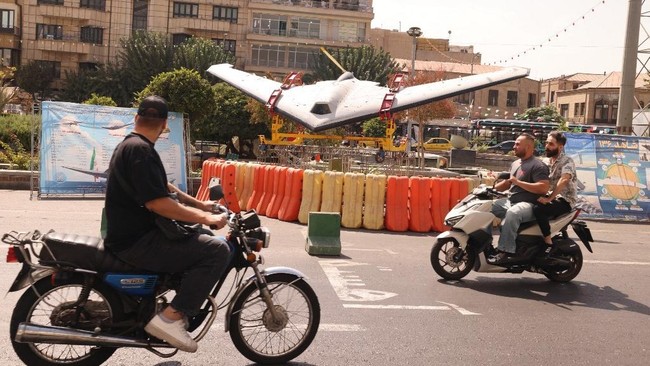
Middle Eastern conflict escalation has entered a new phase following Iran’s deployment of over 2,000 low-cost drones to cripple enemy air defences and create widespread chaos in the region. This development has shocked the United States, particularly given that President Donald Trump had previously focused warnings exclusively on conventional missile threats.
When launching air strikes against Iran on 28 February, Trump issued stern warnings that Tehran’s missile industry would be “razed to the ground”. However, the President made no mention of threats posed by the nation’s unmanned aircraft fleet.
“Iran’s missiles and missile industry will be completely destroyed,” Trump stated firmly before the strikes were launched and widely publicised.
Just six days after this declaration, Iran responded with waves of Shahed kamikaze drone attacks, targeting US allies in the Gulf. The deadliest strikes so far have hit a US military base in Kuwait, killing six American soldiers, whilst also targeting vital energy infrastructure in Saudi Arabia and Qatar.
The Shahed 136 drone has become Iran’s primary tool. This drone is known for its simple yet effective design with relatively inexpensive production costs, ranging from approximately US$20,000 (Rp 338 million) to US$50,000 (Rp 843 million) per unit.
Despite carrying only a 50-kilogramme warhead, far smaller than ballistic missiles, the drone has proven highly effective at destroying critical installations. Its ability to evade radar detection whilst flying at low altitudes makes it particularly difficult to counter.
Mick Mulroy, a former US Marine and former Deputy Assistant Secretary of Defence for the Middle East, has acknowledged the advantages of this inexpensive weapon. He notes that the drone’s effectiveness has been demonstrated in various previous conflicts, including the Ukraine war, prompting the US to develop its own comparable version.
“These drones have proven highly effective. They are so effective that the US is now developing its own version,” said Mulroy, as reported by BBC News on Thursday, 12 March 2026.
US Response
The US counter-weapon has been named Lucas (Low-Cost Uncrewed Combat Attack System). In recent days, US military forces have begun deploying Lucas squadrons in the Middle East to mount counter-attacks against Iran using identical tactics.
Admiral Brad Cooper, head of US forces in the Middle East, stated that his forces have adopted Iranian technology and improved upon it for retaliatory strikes. The US claims the technology now poses a direct threat to Tehran.
“We have taken Iran’s design, made it better, and fired it straight back at Iran,” said Cooper.
Physical and Psychological Strategy
Although air defence systems, such as those in the United Arab Emirates, have succeeded in destroying most incoming drones, Iran’s strategy is understood to involve more than physical destruction alone. Nicholas Carl, an Iran expert at think tank the American Enterprise Institute, believes Iran deliberately forces the US and its allies to deplete stocks of far more expensive interceptor missiles than the drones it sends.
Carl adds that there is a psychological dimension to the drone barrage. Tehran is suspected of attempting to instil terror in densely populated cities to pressure the Trump administration into rapidly agreeing a ceasefire.
“The Iranian regime is also attempting to impose terror and psychological pressure on the US and its regional partners in an effort to force President Donald Trump into a ceasefire agreement,” Carl explained.
Sharp Decline
Nevertheless, the intensity of Iranian attacks has reportedly begun showing signs of sharp decline. Admiral Cooper reported that Iranian drone launches have plummeted by 83% since the first day of fighting, whilst ballistic missile use has fallen by 90% due to military pressure from the US and Israel.
Carl believes Tehran is now struggling to sustain its attack pace. This dramatic decline suggests Iranian weapons stocks may be becoming depleted due to sustained counter-strikes.
“Iran is struggling to maintain its missile and drone attacks, and this could become increasingly difficult in the coming days as US and Israeli military pressure continues,” Carl concluded.