
Long Rally Snapped, IHSG Closes Down 0.68% at 7,623
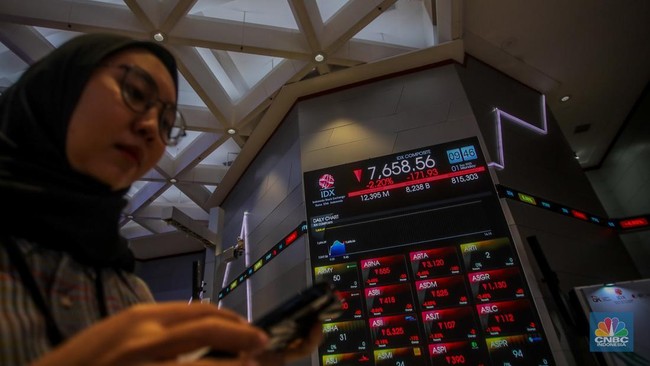
Jakarta, CNBC Indonesia - The Composite Stock Price Index (IHSG) has snapped its recent strengthening rally. At the close of trading today, Wednesday (15/4/2026), the index weakened by 0.68% or 52.36 points to return to the level of 7,623.58. Although the IHSG was comfortably in the green zone for nearly the entire trading session today, it collapsed an hour before the market closed.
This weakening marks the first in the past week. It is known that the IHSG was able to record an increase of nearly 9% at the end of trading yesterday. Citing exchange data, from 7 April to 14 April 2026, the IHSG consistently ended in the red zone and surged 8.66% over that period.
Today’s transaction value was quite brisk, reaching Rp22.61 trillion, involving 51.44 billion shares in 3.16 million transactions. Market capitalisation also rose to Rp13,606 trillion.
The majority of trading sectors weakened, with the deepest corrections recorded in the health, non-primary consumer, and financial sectors. Meanwhile, the highest gains were booked by the industrial, primary consumer, and energy sectors.
Conglomerate group issuers were noted as weighing on the IHSG rise today. The following are the 10 issuers with the largest contributions to the index point weakening, namely the giant bank owned by the Djarum Group (BBCA), the Mayapada Hospital issuer owned by Dato Tahir (SRAJ), the MNC Group issuer of Hary Tanoe (MSIN), the Barito Group issuer of Prajogo Pangestu (TPIA and BRPT), the mining issuer affiliated with the Salin Group (AMMN and BUMI), as well as three SOEs (BBRI, BMRI, and TLKM).
The IHSG’s movement is in line with markets in the region. Asian markets continued their rally at the start of trading today. This aligns with expectations of a ceasefire between Iran and the United States and Israel.
US President Donald Trump said on Tuesday that talks to end the Iran war could resume in Pakistan in the next two days after the failure of negotiations last weekend prompted Washington to impose a blockade on Iranian ports.
Officials from the Gulf region, Pakistan, and Iran also said that US and Iran negotiation teams are likely to return to Pakistan this week, although a senior Iranian source said no date has been set.
“You’d better stay there, because something could happen in the next two days, and we’re leaning that way,” Trump said in an interview with the New York Post.
Although the US blockade has triggered strong rhetoric from Tehran, signs that diplomatic channels are still ongoing have helped calm oil markets, with benchmark prices falling below US$100 on Tuesday.
Global markets are still seeking certainty on the strength of world economic growth amid potential interest rates that will be signalled higher for longer due to the war in the Middle East resulting in rising world oil prices.
The International Monetary Fund (IMF) has cut its global economic growth projection due to the surge in energy prices from the war in the Middle East and disruptions in shipping through the Strait of Hormuz.
In the April 2026 edition of the World Economic Outlook report, the IMF estimates that the global economy is expected to grow by 3.1% this year.
This figure is down from the 3.3% projection in January 2026, before hostilities broke out following the US-Israel attack on Iran that began on 28 February, which triggered Tehran’s retaliatory strikes and expanded the conflict in the region.
The IMF has prepared several scenarios: mild, bad, and severe. In the worst-case scenario, the world economy is nearly in recession, with average oil prices at US$110 per barrel in 2026 and US$125 in 2027. Global growth could fall to 2.0%.
The IMF’s baseline scenario assumes a short conflict and oil prices falling to an average of US$82 per barrel in 2026. However, IMF economist Pierre-Olivier Gourinchas said the current conditions are already moving towards a worse scenario.
The biggest impact is expected in developing countries and the Middle East and Central Asia region. Growth in that region is projected to fall to 1.9% in 2026.
For major economies, the United States is expected to grow by 2.3%, the Eurozone by 1.1%, China will expand by 4.4%, and India by 6.5%. For Indonesia, the IMF maintains its growth projection at 5.0%.