
List of 10 Multibagger Stocks, the Most Profitable Since 1945!
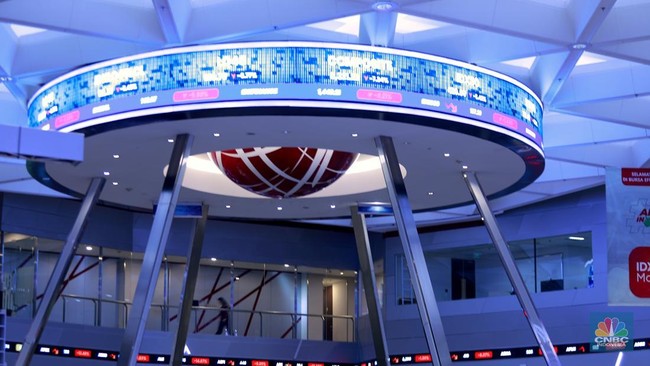
Jakarta, CNBC Indonesia - The journey of Indonesia’s capital market began long before the establishment of the republic. Securities trading activities were recorded during the colonial era, when shares of plantation companies started to be known in Batavia at the end of the 19th century. This dynamic then developed until the formation of the first stock exchange in the early 20th century.
In the early phase, market participants were dominated by investors from Europe, particularly the Netherlands. The instruments traded focused on shares and bonds of colonial companies. However, market activities were not always smooth. World wars, global economic crises, and repeated political regime changes repeatedly caused the capital market to halt and revive.
After a temporary vacuum due to global turmoil, exchange activities resumed in the 1920s before finally halting again during the Great Depression and World War II. The momentum for revival emerged after independence, when the Indonesian government began rebuilding the national financial system, including reactivating the capital market.
In the early years of the republic, the role of the state was very dominant in market activities. The exchange was temporarily focused on trading government bonds before experiencing stagnation again due to nationalisation policies and the economic conditions at the time. Only in subsequent eras did Indonesia’s capital market slowly develop into the more modern form it has today.
Unfortunately, World War I from 1914 to 1918 halted exchange activities. The exchange reopened in 1925, with two new exchanges added in Surabaya and Semarang. However, the 1929 recession and World War II forced all exchanges to close on 10 May 1940.
Then, during the Old Order era from 1952 to 1977, the Jakarta Stock Exchange was reopened by President Soekarno on 3 June 1952 to accommodate government bonds. Management was handed over to the money and securities trading association, consisting of three banks and Bank Indonesia.
At that time, the nationalisation of Dutch companies in 1958 due to the West Irian dispute meant that Dutch securities were no longer traded. Exchange activities stopped again from 1956 to 1977.
Then, during the New Order era from 1977 to the late 1990s, the investment climate improved since 1966, encouraging the birth of the Foreign Investment Law (1967) and Domestic Investment Law (1968), which were later unified into Law No. 25 of 2007. The capital market was reactivated on 10 August 1977 by President Soeharto, managed by BAPEPAM.
PT Semen Cibinong became the first issuer post-reactivation. The capital market in this era went through three phases: long sleep, waking from long sleep, and automation.
Long Sleep Period (until 1988)
In this period, capital market activities were sluggish, with only 24 companies listed on the BEJ over four years without new IPOs. The public preferred banking instruments. The December Package Deregulation 1987 (PAKDES 87) finally provided ease for companies to go public and opened opportunities for foreign investment. This approach ultimately led to rapid trading increases from 1988-1990 after banking and capital market deregulation.
Waking from Long Sleep Period (1990-1992)
In this period, the number of IPO companies surged to 225, known as the IPO boom period. The Composite Stock Price Index (IHSG) base was changed to a base value of 500. In this era, the Indonesia Parallel Exchange (BPI) operated since 1988, BES (Surabaya Stock Exchange) starting in 1989. The December Package 1988 (PAKDES 88) accelerated capital market growth.
Automation Period (1992-late 1990s)
In this era, many institutions encouraged and complemented the country’s stock exchange. On 12 July 1992, the BEJ was privatised from BAPEPAM into the Capital Market Supervisory Agency. Then in 1993, PEFINDO (PT Pemeringkat Efek Indonesia) was established.
Two years later, on 22 May 1995, the BEJ launched the automated trading system JATS. In the same year, on 10 November 1995, Law No. 8 of 1995 on the Capital Market was issued (effective 1996).
In this era, the merger of the Indonesia Parallel Exchange with BES occurred. On 6 August 1996, KPEI was established, and the following year, on 23 December 1997, KSEI was founded. Unfortunately, the 1997 Asian crisis reduced the number of IPOs due to exchange rate turmoil.
Reform Era
Indonesia’s capital market then entered the reform era. In this era, certificate-based trading was abolished. Certificate-less trading was implemented because physical certificates were often lost, forged, and hindered transaction settlements.
In this era, there was a merger of exchanges; on 30 November 2007, the Jakarta Stock Exchange (BEJ) and Surabaya Stock Exchange (BES) officially merged to become the Indonesia Stock Exchange (BEI).
The reform era also featured innovations and new institutions. In 2008, trading suspensions were implemented. In 2009, PHEI was formed, and the JATS-NextG trading system was launched. Then, in 2011, PT ICaMEL was established. The following year in 2012, OJK was established, SIPF was launched, and sharia trading principles and mechanisms were introduced. From 2013-2015, adjustments to trading hours, lot size, tick price, and TICMI merged with ICaMEL.
BEI also created many education and development programmes. In 2015, the “Yuk Nabung Saham” campaign was launched, along with the inauguration of the LQ-45 Index Futures. In 2016, adjustments to tick size and auto rejection, launch of IDX Channel, support for Tax Amnesty, Go Public Information Center. Then in 2017, IDX Incubator, margin relaxation, Indonesia Securities Fund. And in 2018, updates to trading systems and data centre, implementation of T+2 transaction settlements, addition of special notations to issuer codes.
From the long journey of the Indonesia Stock Exchange (BEI), which stocks have soared high since the independence era?
Based on CNBC Indonesia records, there are 10 multibagger stocks that have skyrocketed since listing on the Indonesia Stock Exchange (BEI).
Stocks can become multibaggers (stocks whose prices rise multiple times from the initial purchase price), usually soaring because