
'Like sitting ducks': Fear and uncertainty mount for Southeast Asians stranded in Middle East
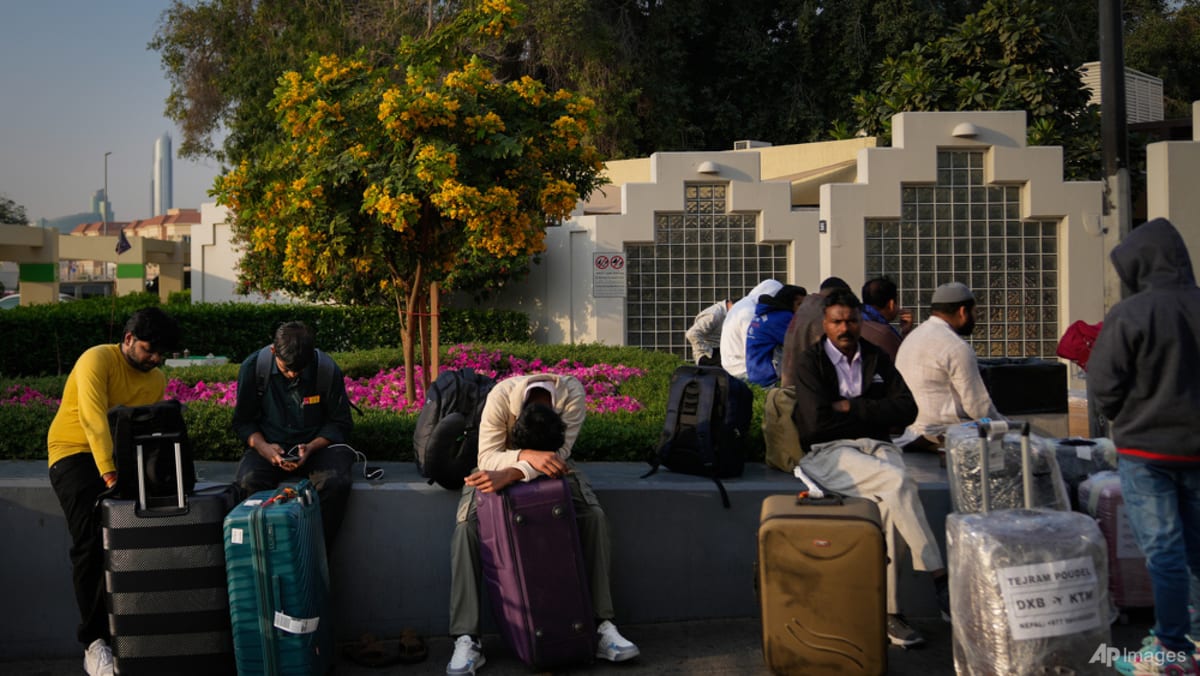
‘Like sitting ducks’: Fear and uncertainty mount for Southeast Asians stranded in Middle East
Amid cancelled flights, closed airspaces and explosions, citizens from across the region share their experiences with CNA.
SINGAPORE: Malaysian Fauzan Azmi was at lunch with his colleagues near the Dubai Marina on Saturday (Feb 28) afternoon when two loud nearby explosions ripped through the air.
“At first we thought it was just a random thing, then a few minutes later someone in our group said it was a missile that was intercepted,” the corporate governance specialist told CNA via a video call on Monday. “So that was the first sign of escalation.”
Later around midnight, Fauzan, 31, who arrived in Dubai on Feb 25 on a business trip, said he received iPhone alerts notifying him to head indoors after the nearby Fairmont Hotel in Palm Jumeirah was reportedly set ablaze after a projectile struck outside its entrance, injuring four people.
“At the hotel area, you could see people running and the management trying to get everyone to the basement. With about 300 people in the lobby trying to check-in, the sirens happening, loud bangs, it wasn’t a smooth process,” he said, describing the scene when he returned to his own hotel, the Grand Hyatt.
“Basically everyone tried to evacuate and get near a sheltered place. They told us that we could come up to our rooms but not stay near the windows. This was about 1.30am,” Fauzan said.
The Grand Hyatt has provided complimentary food and water, Fauzan added.
“I think the worst part is the uncertainty. All hotel rooms are fully booked, people can’t find a place to stay. People who left to the airport and checked out had to come back and find their rooms already occupied.”
“There’s a feeling that we’re like sitting ducks right now,” he added, lamenting that the Malaysian consulate general in Dubai is closed during the “hardest time ever” and he was told to contact the mission via email and telephone.
Another Malaysian, Chen Shiau Haln, told CNA via text message she was en route on an Emirates flight with her husband to Edinburgh from Kuala Lumpur on Saturday. Her flight was due to transit in Dubai when the pilot remained airborne for an extended period amid airspace closure by the United Arab Emirates (UAE).
The 35-year-old bioinformatician, who is pregnant and set to start a new job on Monday in Edinburgh where she currently lives, is dismayed, knowing she is likely not be able to leave the UAE anytime soon after a delayed descent into Dubai.
“We thought that perhaps we might still be able to fly out of the UAE, since the airspace was reported to be only partially closed. It was only around 4.30pm that we found out all flights up to 3.00am had been cancelled,” she said.
Chen said that it was “chaotic” at the transfer desk as passengers scrambled to get information and rebook their flights, while Emirates provided her and her husband with complimentary meals at selected airport food outlets and hotel accommodation vouchers.
Since being stranded in Dubai on Saturday, Chen and her husband have heard loud bangs in the area.
“The loudest one that we’ve heard happened just over an hour ago. It has been quite unnerving, and it feels like we’re on constant high alert. We struggled to sleep on our first night here, and we have our emergency grab bags packed ready to go as and when possible,” she told CNA on Monday afternoon.
The couple are staying in a hotel while monitoring the latest news.
“This is not how I imagined my first week with the new company, but I’ve been trying to stay calm and do what I can, such as offering to make a head start on training materials that I know will be useful in my new job,” she said.
Chen and Fauzan are among thousands of Southeast Asian citizens reportedly stranded in Dubai and other Gulf states amid flight disruptions due to the ongoing Israel-Iran conflict as governments scramble for options on how to evacuate their citizens back home.
Iran’s retaliatory attacks across several Gulf Arab states targeting airbases with United States assets have led to explosions echoing across the area since Saturday.
Explosions were heard across Dubai in the UAE, Bahrain’s capital Manama and Qatar’s capital Doha.
Fauzan was set to return to Kuala Lumpur on Mar 4 but noted that all flights had been suspended in light of the airstrikes.
While some of his colleagues tried to take the bus to Oman then to Egypt, he said the borders at Oman were “very busy” and it would take travellers around 12 hours to pass through, according to the latest update he heard.
Fauzan said he would try to take the bus to Oman if the situation does not improve.
Meanwhile, Chen said that while she had registered with the Malaysian embassy in the UAE, she has not received updates from the embassy or consulate, other than their travel advisories.
“I think it would be most helpful for us to know if and what is being done to support Malaysians abroad, if anything is in the works at all, or even regular communication to know that we’re not forgotten. The silence and uncertainty have not been reassuring,” she added.
Malaysia’s parliament on Monday observed a moment of silence over the deaths of Iran’s Supreme Leader Ayatollah Ali Khamenei and his people, while Prime Minister Anwar Ibrahim expressed condolences and condemned Israel’s US-backed attack on Iran.
He also said that the foreign ministry is monitoring the safety of 29,112 Malaysians in several affected countries but evacuations cannot be carried out as much of the Middle East’s airspace is closed except for flights operating from Saudi Arabia, as reported by local news agency Bernama on Monday.
“As the government, we are responsible for safeguarding and ensuring the safety of Malaysians so that their presence there (in affected countries) is secure,” Anwar said when tabling a motion condemning Israel’s attacks.
“Most of our citizens in Middle Eastern countries are mainly residing in Qatar, the UAE (United Arab Emirates), Saudi A