
Like Eating Simalakama Fruit, Tanah Abang Fabric Sellers Share War's Impact
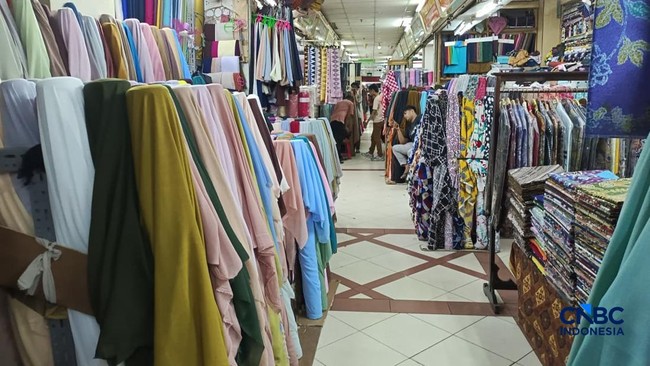
Jakarta, CNBC Indonesia - Fabric prices at Tanah Abang Market remain stable despite rumours of increases due to the war’s impact. However, behind this, traders are confronted with a dilemma: whether to raise prices or hold firm to retain customers.
Based on observations by CNBC Indonesia at Block A of Tanah Abang Market on Monday (13/4/2026), prices for various fabrics are still sold at the old rates. Stacks of fabric and hanging goods in the stalls are still labelled with the same prices as before, indicating that traders are holding back on adjustments.
Rinda, one of the fabric traders, admitted to hearing news of price rises but chose not to act hastily.
“Yes, I’ve seen it in the news. When I read it, I immediately asked (my husband) ‘oh dear, this is going to rise, what now?’, due to the war’s effect. But my husband said to just see the situation,” said Rinda to CNBC Indonesia when met at the location.
According to her, the competitive market conditions require traders to calculate carefully before raising prices.
“We sell together in crowds here in Tanah Abang, so we can’t panic and raise prices while other shops hold steady, or consumers will flock to the cheaper ones,” she explained.
She stated that the decision to raise prices cannot be done unilaterally as it risks losing buyers.
“So we try to see the situation; if we can hold (the increase), we hold it. But if it’s severe, hopefully the government has a solution,” she said.
Currently, Rinda admitted to still selling old stock at relatively stable prices, as the goods were purchased before the turmoil occurred.
“Not yet. This happens to be old stock. I mean, I bought this stock before the war turmoil, so the prices are still safe,” she said.
She added that fabric prices have tended not to change much in recent years.
“Not from last year, it’s been years, 2-3 years at least, fabric prices rarely fluctuate up and down,” added Rinda.
A similar dilemma is felt by Feri, a brocade fabric trader. He admitted to receiving signals of price increases from suppliers but chose to hold selling prices for now.
“Not yet, the material prices are still the same. But when I called yesterday to ask about goods, to take (stock), I was informed that prices are supposedly going to rise,” said Feri when met at the same location.
Although cost pressures are starting to be felt, he and the shop owner agreed not to rush into raising prices.
“But we seem to agree, don’t raise it yet, let’s set it first, for example, this brocade fabric we sell for Rp50,000 (per metre), if it rises, Rp60,000 (per metre), if they buy in bulk, we can give a discount to Rp55,000 (per kg). We can calculate it later,” he explained.
Feri acknowledged that this situation is rare for fabric commodities or textile products, so traders tend to be more cautious in making decisions.
“Because this is the first time fabric prices are rising, it’s the first time I’ve felt warned that fabric prices will rise. For other goods, it’s usual, but for fabric, it’s new that I’m getting this news. Yes, the war’s effect too. Hopefully it ends soon,” he said.
Previously, the General Chairman of the Indonesian Filament Yarn and Fibre Producers Association (APSyFI), Redma Gita Wirawasta, predicted that fabric to finished garment prices would rise due to surges in raw material costs from the Middle East conflict. The increase is expected to spread from upstream to downstream and be felt in retail in the coming weeks, with a potential rise of around 10%.