
Lembang Fault Holds Potential for Major Earthquake, Greater Bandung at Risk
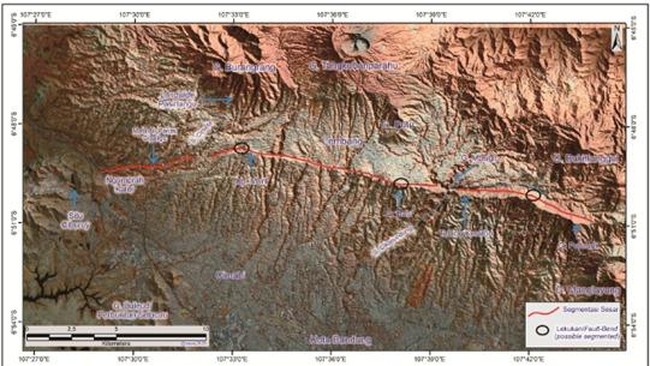
The existence of the Lembang Fault is a serious concern for the people of West Java, particularly those living in Bandung and its surroundings. This active fault stretches almost 29 kilometres from Padalarang to Cimenyan, positioned very close to the centre of Bandung City, right in the foothills of Mount Tangkuban Parahu.
This fault is not merely a geological phenomenon visible on maps but an active system within the Earth’s crust that continues to move. Such activity makes it one of the potential earthquake sources that must be vigilant about in the Greater Bandung region.
Mudrik R. Daryono, an earthquake geology researcher from the National Research and Innovation Agency (BRIN), explained that the Lembang Fault is a major fault line where rock shifts occur deep within the Earth.
The fault’s movement is dominated by left-lateral horizontal shear, where rock blocks on the northern and southern sides move in opposite directions. Although it occurs slowly, this movement can trigger sudden energy release, resulting in an earthquake.
“Clear evidence can be seen from the shift in the Cimeta River, which has moved 120 metres, and in some locations up to 460 metres,” Mudrik stated in his written remarks.
Additionally, there are up-and-down shifts in the ground surface. In the western section, from kilometre 0 to kilometre 6, the surface remains flat. Then, a height difference of up to about 90 metres appears before decreasing towards the east.
“Overall, the shifts along the Lembang Fault are almost entirely dominated by horizontal movement, about 80 to 100%. Meanwhile, the up-and-down shifts are only about 0 to 20%,” he explained.
Mudrik stated that the evidence of river shifts and height changes is the result of gradual processes that have occurred over hundreds of thousands of years to the present. This gradual movement is the action of an active fault that produces earthquakes.
Recent research shows that the Lembang Fault moves at a speed of about 1.9 to 3.4 millimetres per year. Although it appears very small, this ongoing shift, if accumulated over hundreds of years, can trigger an earthquake.
“This is proven by paleoseismology research through trenching at kilometre 11.5, which found a 40-centimetre shift. Here, the southern side of the fault is uplifted compared to the northern side. A shift of that magnitude is clear evidence that in the past, an earthquake with a magnitude of around 6.5 to 7 occurred,” Mudrik explained.
“This estimate is also consistent with the length of the Lembang Fault, which reaches 29 kilometres and indeed has the potential to produce an earthquake of that magnitude,” he added.
Paleoseismology research, or the study of ancient earthquake traces, shows that the Lembang Fault has triggered several major earthquakes in the past. The most recent event is estimated to have occurred in the 15th century. Previously, there is evidence of an earthquake around 60 years before the Common Era that left a 40-centimetre shift trace.
Further back, traces of much older earthquakes were found, around 19,000 years ago. From these records, experts estimate that major earthquakes on the Lembang Fault recur every 170 to 670 years.
“If referring to the estimated cycle of major earthquakes, then theoretically, the next major earthquake could occur at the latest around the year 2170. This means that, in terms of time estimates, this cycle is relatively close to the present,” Mudrik said.
However, he emphasised that it is important to understand that this is only a timeframe overview, not a certainty about when the earthquake will actually occur.
The Lembang Fault is not just a fault line on a map but an active geological system whose presence can be clearly seen in the field. Evidence of past magnitude 6.5-7 earthquakes is also visible from trenching results at kilometre 11.5.
“This scientific understanding is very important so that the public is more prepared and always alert in facing potential disasters,” Mudrik stressed.
This research is a scientific scenario based on modelling, with the worst-case scenario, not a prediction of the event’s timing. The main goal of the research is to increase preparedness and mitigation, not to cause panic.