
Legislator demands legal certainty for palm oil operators following forest area enforcement
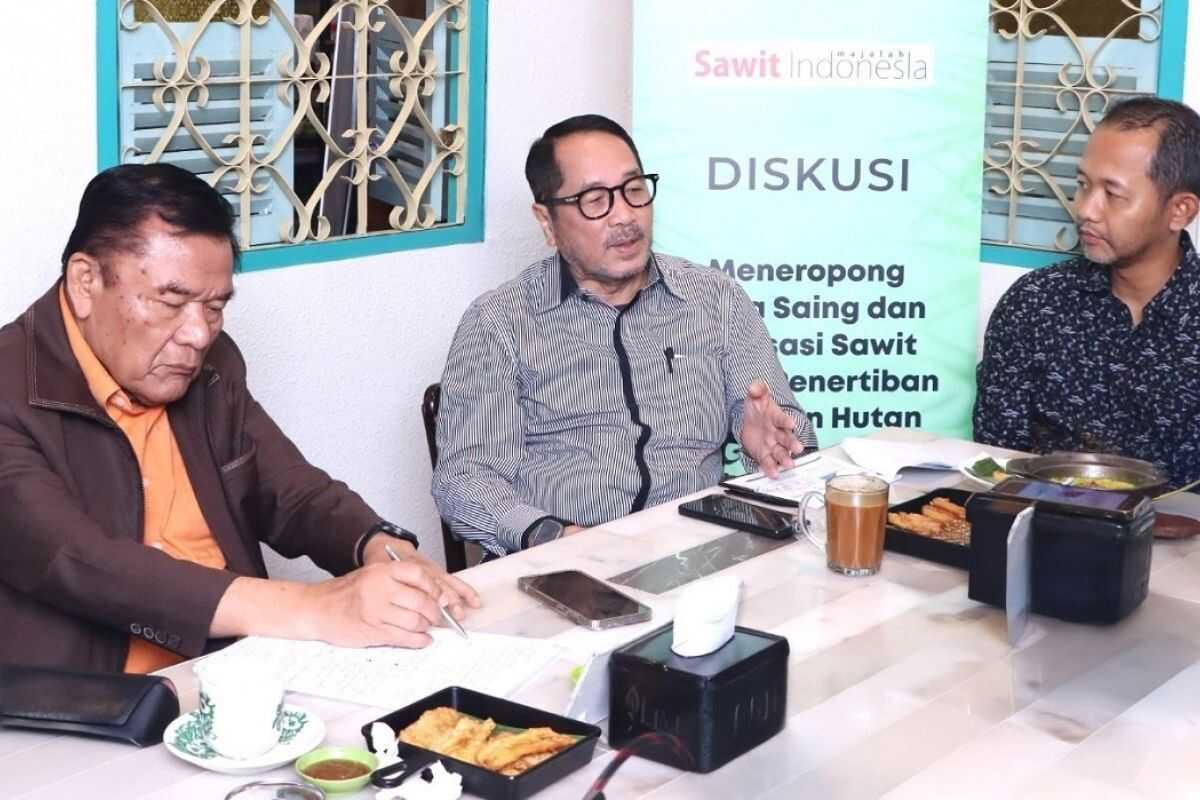
Jakarta (ANTARA) - Member of House of Representatives Commission IV Firman Soebagyo has urged that forest area enforcement activities continue to provide legal and investment certainty to national palm oil operators, including both companies and smallholders.
He stated that he had gathered aspirations and reports from farmers, companies and communities affected by the Forest Area Enforcement Task Force’s activities over the past year.
“The issue of palm oil plantations within forest areas is not solely the fault of companies or farmers, but also the result of past government mistakes,” he said during a discussion themed “Examining Palm Oil Competitiveness Post-Forest Area Enforcement” in Jakarta on Thursday.
Firman explained that the palm oil-in-forest-areas issue came to prominence when the Ministry of Forestry (formerly the Ministry of Environment and Forestry/KLHK) announced encroachment data covering 3.5 million hectares.
In accordance with the Job Creation Law mandate, this encroachment problem was to be resolved within three years, he added. However, the KLHK was unable to complete the task, and following the change of government, the President ultimately established the Forest Area Enforcement Task Force (PKH) to address the matter.
In its first year of operation, the PKH Task Force successfully enforced forest area regulations covering 4.09 million hectares in the palm oil sector, he continued, although data held by the House of Representatives indicated only 3.5 million hectares of palm oil plantations had encroached into forest areas.
According to Firman, the Task Force’s law enforcement activities need to clearly distinguish between administrative violations and criminal offences.
Companies that have already paid fines under Article 110A of the Job Creation Law and are awaiting the government’s verification process should be afforded ease of process and legal certainty.
“But for those who have genuinely violated the law, such as operating without permits, by all means carry out enforcement and impose fines,” said the member of the House’s Legislation Body.
He stressed that the resolution of governance issues, particularly those related to forest areas and land-use concession rights (HGU), must be expedited so that business operators can obtain certainty in their operations.
Currently, operators in the national palm oil industry are hoping for legal certainty to guarantee investment security. Legal uncertainty is considered one of the factors depressing the performance of the national palm oil industry, contributing to declining palm oil production.
“We ask that the PKH Task Force also consider the impact of forest area enforcement on palm oil competitiveness and downstream processing. For plantations with clear permits, enforcement action should not be taken. The PKH Task Force therefore needs to open dialogue with stakeholders,” he said.
Firman stated that as a long-term solution, the House of Representatives is currently drafting a Strategic Commodities Protection Bill to strengthen legal certainty, promote a one-map policy, and restructure cross-sectoral governance.
“We are currently drafting the Strategic Commodities Protection Bill so that there will be a ‘one map policy’. If this materialises, forests will also be safeguarded, because there will be clear regulation. The thrust here is intensification, not extensification,” he said.
He emphasised that Indonesia must not allow strategic commodities such as palm oil to operate without a strong legal framework, and that deliberation of the bill is targeted as a House initiative this year.
Meanwhile, Chairman of the Indonesian Palm Oil Council (DMSI) Sahat Sinaga estimated that national palm oil production in 2026 could potentially decline by 5-6 per cent compared to 2025, which reached approximately 52 million tonnes.
According to him, one factor behind this year’s production decline is the forest area enforcement activities affecting company plantations. Additionally, many companies’ land-use concession rights have expired but they have not yet received permits for extensions or renewals.
“Ultimately, these plantations are not being replanted or rejuvenated by the operators. If production falls, it will clearly disrupt downstream processing in the palm oil sector,” he said.
Sahat noted that the global market has a strong demand for Indonesian palm oil products, not only derivative products but also the biomass generated by palm oil.
For this reason, he added, Indonesia’s palm oil competitiveness must be safeguarded as it has been eroding since 2022-2023. Palm oil has historically held an advantage due to its large volume and more efficient pricing compared to other vegetable oils.