
Lebaran Return Flow: KAI Train Tickets Nearly Sold Out
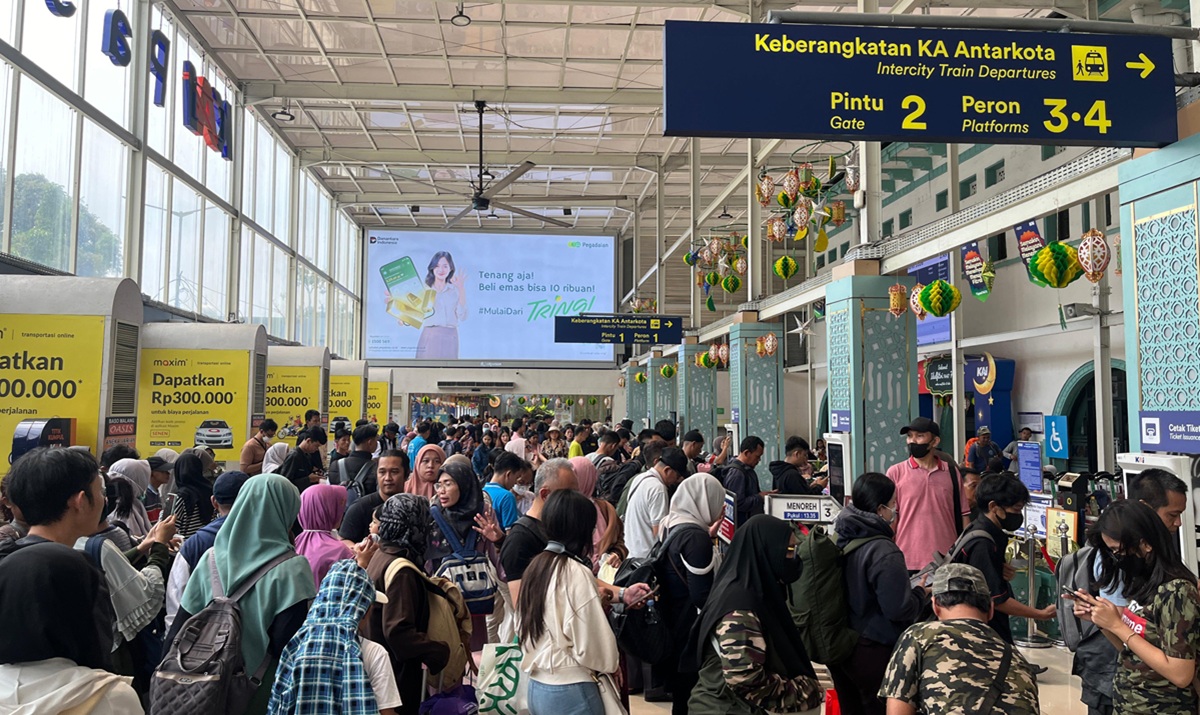
PT Kereta Api Indonesia (Persero) has recorded high public mobility, making trains the primary choice for return journeys after the Lebaran holiday. As of 23 March 2026 at 09:00 WIB, 4,028,839 tickets have been sold, equivalent to 89.6% of the total 4,498,696 seats provided for long-distance and local train services during the period from 11 March to 1 April 2026.
With this achievement, 469,857 seats remain available for the public to utilise during the return flow.
KAI Vice President of Corporate Communication, Anne Purba, stated that this increase in sales demonstrates the strengthening public trust in trains as a Lebaran travel option.
“The trend of train travel continues to rise since mid-March and is now entering the return flow phase. The public opts for trains because they are more comfortable and on schedule,” she said in an official statement on Monday (23/3).
For long-distance train services, ticket sales have reached 3,507,988 tickets or 98.2% of the total 3,571,760 seats provided. This means 63,772 seats are still available for booking by the public for return journeys.
Meanwhile, for local train services managed by KAI, ticket sales are recorded at 520,851 tickets or 56.2% of the total 926,936 available seats. Thus, 406,085 seats remain available for customers.
Sales of local train tickets are generally expected to continue increasing closer to the departure date, as most services can only be booked starting from H-7.
During the 2026 Lebaran Transport Period, from 11 to 22 March 2026, KAI has served 2,131,656 long-distance train passengers and 387,852 local train passengers in Java and Sumatra, totalling 2,519,508 passengers. This achievement indicates steadily increasing public mobility day by day.
In line with this increase, the daily passenger volume and occupancy rate for long-distance trains from 11–22 March 2026 show an upward trend. The peak occurred on 22 March 2026 with 242,773 passengers or 150.7% of the available seat capacity.
This morning, passenger movements are still monitored to be very high, with 222,948 long-distance train passengers scheduled to depart and a temporary occupancy rate of 139.1%. This number still has the potential to grow as ticket sales continue.
Anne explained that occupancy rates above 100% are possible due to dynamic travel patterns within a single train set. In one long-distance train journey, a single seat can be used by more than one passenger on different routes.
“This scheme allows the number of passengers served to be greater than the number of seats available on a single route journey,” she clarified.
Amid this high demand, several trains with high booking rates during the 2026 Lebaran Transport Period include KA Airlangga, KA Joglosemarkerto, KA Sri Tanjung, KA Bengawan, KA Kahuripan, KA Rajabasa, and KA Jayakarta.
Nevertheless, the public still has opportunities to obtain tickets, especially for the return flow, through alternative routes, different departure schedules, or onward travel schemes.