
Learning the Green Economic Transition from a Global Perspective through Global Network Week
Amid the growing urgency of the global climate crisis, the role of the younger generation is increasingly indispensable. Various reports from international organisations, such as the United Nations (UN) and UNDP, emphasise that young people are not only the group most affected by climate change but also key actors in driving innovation, policies, and more sustainable business practices.
For Indonesia, this momentum is particularly relevant. With more than half of its population in the productive age group, the involvement of the younger generation in understanding and developing low-carbon economic solutions will greatly determine the direction of the transition towards a sustainable future.
It is in this context that cross-country learning spaces become important. Through global forums, students not only broaden their horizons but also understand best practices from various countries while building international collaboration networks.
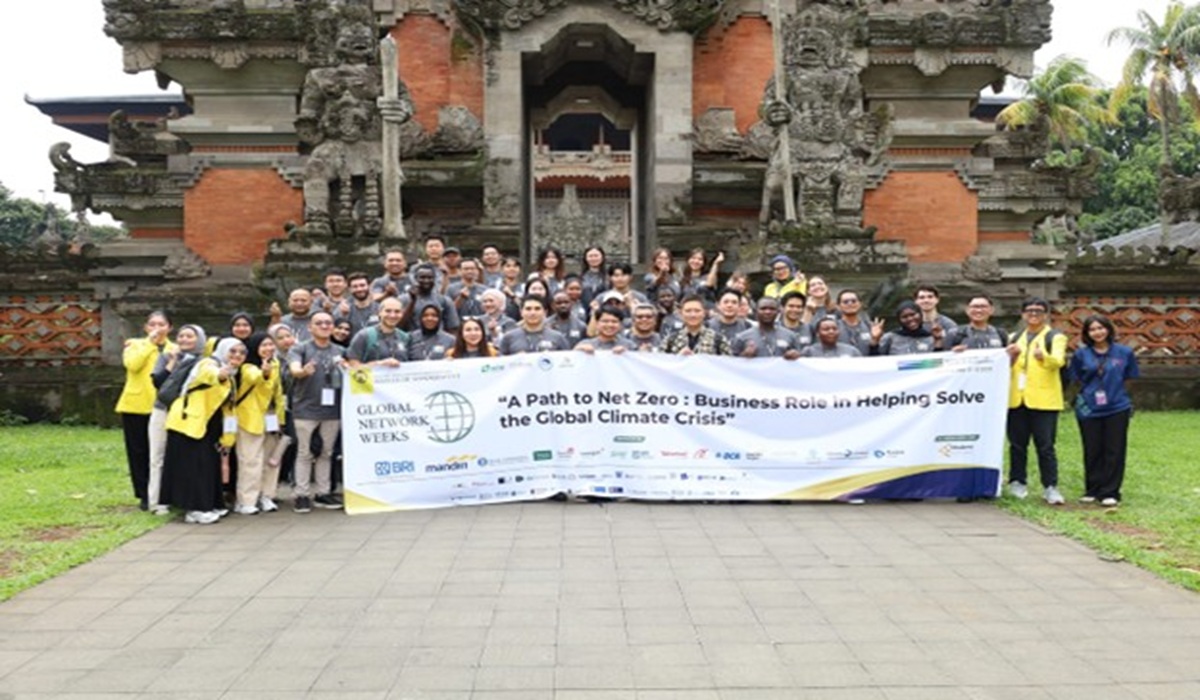
One such initiative is the Global Network Week March 2026, a five-day academic and experiential programme themed “A Path to Net Zero: Business Role in Helping Solve the Global Climate Crisis.”
This event is an annual agenda organised by the Master of Management at the Faculty of Economics and Business, University of Indonesia, which is part of a network of leading international business schools. The programme is designed to provide a comprehensive understanding of how the business world, policymakers, financial institutions, and educational institutions can collaborate in driving the transition to a low-carbon economy.
In 2026, 64 students from various domestic universities, Chinese universities, South Korea, Turkey, the United States, Mexico, Colombia, the United Kingdom, South Africa, and international students from the Master of Management at the Faculty of Economics and Business, University of Indonesia, participated.
Over five days, participants engaged in a series of activities combining academic discussions, field visits, and cultural exchanges. The first day began with a visit to Taman Mini Indonesia Indah (TMII), followed by discussions on green tourism and sustainable cultural heritage management. This discussion highlighted how the preservation of traditions can go hand in hand with carbon emission reduction efforts.
On the second day, the focus shifted to the role of capital markets and sustainable finance. Participants visited the Indonesia Stock Exchange and discussed with experts on how financial instruments can drive green investments and climate action.
The third day addressed digital transformation and sustainable energy. In this session, participants delved into how digitalisation can improve energy efficiency while supporting the development of renewable energy-based systems.
Next, the fourth day spotlighted the importance of biodiversity conservation and the role of education in shaping the foundation for green business in the future. The programme concluded on the fifth day with group discussions and participant presentations, which encouraged the emergence of various solution ideas relevant to both global and local contexts.
In this programme, five Tanoto Scholars (recipients of the Tanoto Foundation scholarship) also participated and brought home diverse new perspectives. Karina Iapepayocha Sembiring, a Tanoto Scholar from IPB University, assessed that this forum opened up cross-country collaboration spaces that she had rarely encountered before.
“Discussing with participants from various countries allowed me to see the same issues from different angles. This broadens the way I understand global challenges,” she said.
Nabilla Aulia, a Tanoto Scholar from the University of Indonesia majoring in Environmental Engineering, had a similar experience. She admitted to gaining new perspectives on the relationship between the economy and the environment.
“So far, they have often been seen as opposing. But here, I see how the concept of sustainable business and ESG principles can actually bridge the two,” she said.
Meanwhile, Nabila Sabkha Paramadani, a Tanoto Scholar from the University of Indonesia, highlighted the importance of cross-cultural perspective exchanges in understanding complex issues.
“Interacting with participants from various countries makes us realise that there is no single approach to solving global problems,” she stated.
For Muhammad Raditya Fahrezi, a Tanoto Scholar from IPB University, the discussion on the business sector’s contribution to net-zero emission targets was highly relevant to his field of agriculture.
“Agriculture has a significant environmental impact. Understanding how its practices can be more sustainable is very important,” he said.
Muhammad Ichsan, a Tanoto Scholar from the University of Indonesia, echoed this sentiment, emphasising the importance of an interdisciplinary approach.
“Issues like climate change cannot be solved from one field alone. We need collaboration and a broader perspective,” he said.
The experience in a global forum like GN Week not only enriches academic knowledge but also hones communication, collaboration, and cross-cultural adaptation skills, which are increasingly needed in facing global challenges.
Moreover, this experience strengthens the role of the younger generation as part of the solution. Amid the complexity of the climate crisis, efforts to promote a green economy cannot rely on one sector alone. Collaboration across actors is required, and the younger generation, with their perspectives and energy, holds a strategic position to bridge various interests.
With more and more global learning spaces, Indonesia’s younger generation has a great opportunity not only to be observers but also drivers in creating a greener, more inclusive, and sustainable future.