
Learning from Gilimanuk Congestion, Government Must Increase Ferry Docks as Vessel Moorings
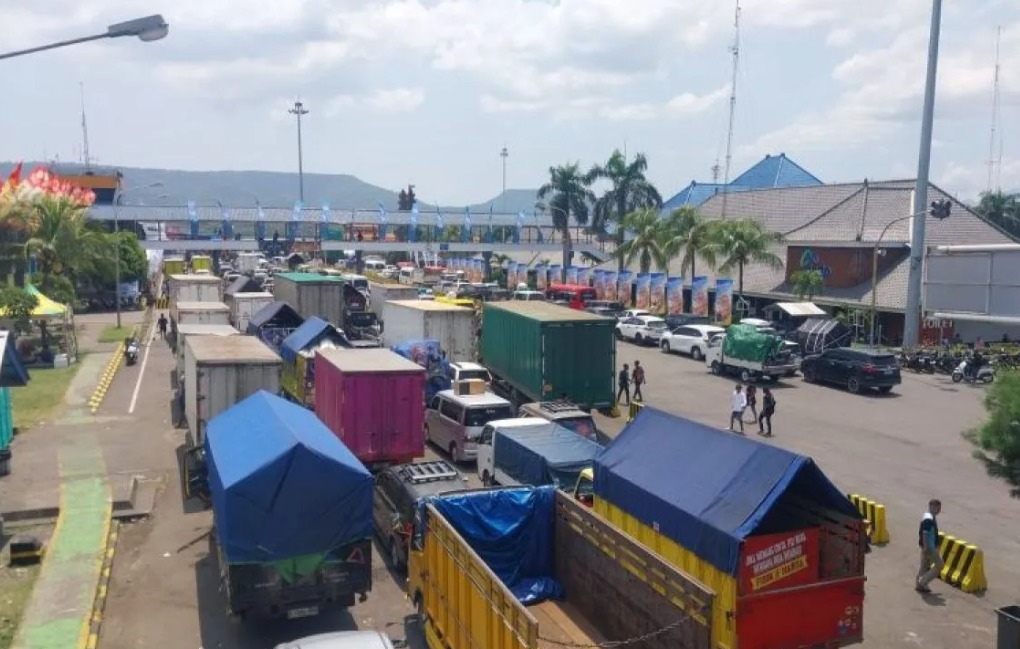
The National Association of River, Lake, and Ferry Transport Operators (Gapasdap) understands Transport Minister Dudy Purwagandhi’s concerns regarding severe congestion on the route to Gilimanuk Port, which was reported to have reached approximately 45 kilometres based on aerial monitoring.
The congestion was indeed triggered by a surge in vehicle traffic during the Lebaran exodus period, which coincided with Balinese community mobility ahead of Nyepi Day.
However, Gapasdap contends that the ferry congestion problem cannot be resolved solely through operational vehicle restrictions or temporary traffic engineering measures.
Gapasdap General Chairman Khoiri Soetomo stressed that limiting traffic through a joint ministerial decision represents only a short-term solution and does not address the root cause of the problem.
According to him, the main issue lies in the imbalance between the growth in the ferry fleet and the dock capacity of ferry ports. The number of vessels continues to grow to serve public mobility needs and national logistics, but the development of docks as vessel moorings has not expanded proportionally. This condition has made docks the bottleneck, causing vessels and vehicles to wait long periods for their turn to moor.
“If docks do not increase, the road to the port will always become a car park,” said Khoiri on Tuesday, 17 March 2026.
Therefore, Gapasdap urges the government to begin formulating a clear and sustainable national roadmap for developing ferry port infrastructure. Gapasdap proposes that development be undertaken in phases with a minimum target of one new pair of docks annually on major national ferry routes.
With this approach, he said, the capacity of the ferry system can increase in line with the growth in vehicle mobility and national logistics requirements.
He stated that if the Ministry of Transport faces constraints in accelerating infrastructure development, the government could consider involving other ministries with large-scale infrastructure development capacity, such as the Ministry of Public Works and Public Housing, which has proven successful in accelerating the development of the national toll road network.
“From the budgetary perspective, ferry dock development does not require excessively large costs. Even by rough estimation, the construction cost of one new pair of ferry docks is estimated not to exceed one-fifth of the cost of the Free Nutritious Meals programme in a single day,” he explained.
Therefore, he continued, dock development is actually a relatively small but high-impact infrastructure investment for the smooth operation of national transport.
“Gapasdap hopes that the government can begin to prioritise the development of ferry port capacity more seriously so that lengthy congestion during every travel season does not continue to recur in the future,” he concluded.
One of the vessels also implemented an Arrive Unload Depart (AUD) pattern at Ketapang Port to speed up vehicle loading and unloading processes so that queues can gradually be resolved.