
Launch of Level Crossing Management, Cross-Sector Collaboration Accelerates Safety Measures
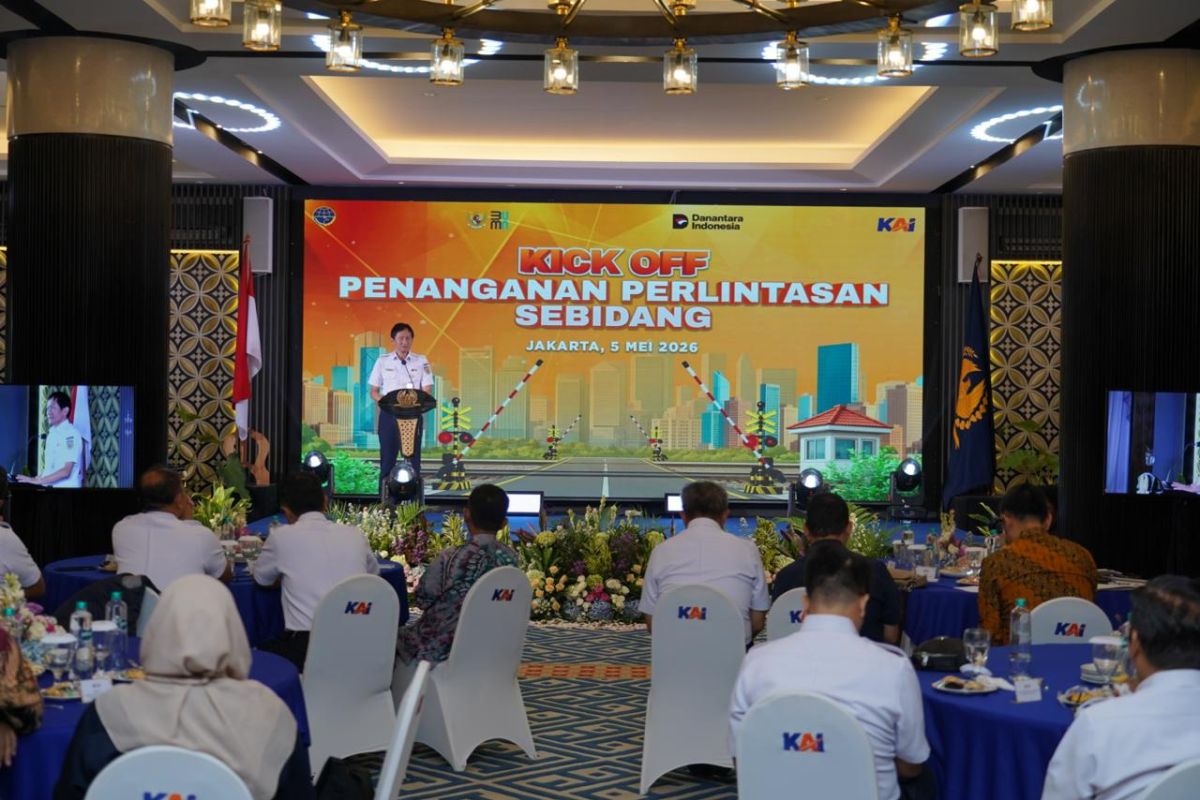
PT Kereta Api Indonesia (Persero), together with Danantara, BP BUMN, the Directorate General of Railways (DJKA), and the National Transportation Safety Committee (KNKT), held the Kick-Off Meeting for Level Crossing Management at the Ballroom of the Jakarta Railways Center, Jakarta, on Tuesday (5/5).
This event serves as a forum for aligning cross-sector steps to accelerate improvements in safety at level crossings, which pose high risks in various regions.
Currently, there are 3,674 level crossings in Indonesia, with 1,810 sites focused on for handling. Of these, 172 crossings are directed for closure due to limited conditions, while the remaining 1,638 require gradual enhancements to safety facilities.
From 2023 to 2026, there were 948 victims of accidents at level crossings, with around 80% of incidents occurring at unguarded crossings. This situation drives the acceleration of more targeted and coordinated handling measures.
Director General of Railways at the Ministry of Transportation, Allan Tandiono, in his remarks, emphasised that safety is the top priority in transportation operations.
“Nothing is more valuable than human life. Level crossings are points where two transportation systems with different operational patterns meet. Trains cannot stop suddenly, while road traffic is dynamic. If not managed properly, the risks are very high,” he stated.
He added that handling level crossings requires collective involvement from all parties, from central government, local government, operators, to the community. The approach must be comprehensive, through the closure of high-risk crossings, enhancement of safety systems, and the long-term construction of grade-separated crossings.
KAI President Director Bobby Rasyidin stated that this meeting marks the starting point for accelerating more concrete actions on the ground, as well as a reflection on previous incidents.
“We express our condolences for the incident on 27 April 2026. There were 16 fatalities and 17 passengers still under care, with conditions continuing to improve. This incident serves as a reminder that the responsibility for safety lies with us all,” said Bobby.
Bobby emphasised that handling efforts will focus on accelerating on-site actions, including the closure of 172 identified crossings, as well as increased guarding at hundreds of other sites.
“Experience shows that guarding crossings can significantly reduce accident risks. Therefore, guarding measures, strengthened supervision, and the utilisation of technology must be implemented simultaneously,” he continued.
In addition, KAI will strengthen the implementation of safety technology, including the use of communication-based systems, GPS, and the development of automation systems to support more responsive operational control against potential risks.
Through this kick-off meeting, the parties agreed to strengthen collaboration in handling level crossings, including accelerating the closure of high-risk sites, enhancing safety facilities, and strengthening supervision and public education.
This commitment is a follow-up to the inter-agency synergy in improving level crossing safety that has been built previously. Each party will carry out its role according to its authority, from strengthening regulations, funding support, to technical implementation on the ground.
“Safety is a priority that must be maintained at all times. KAI, together with all stakeholders, will carry out every step in a disciplined and sustainable manner, so that risks at crossings can be minimised and the public can carry out activities with a sense of security,” Bobby concluded.